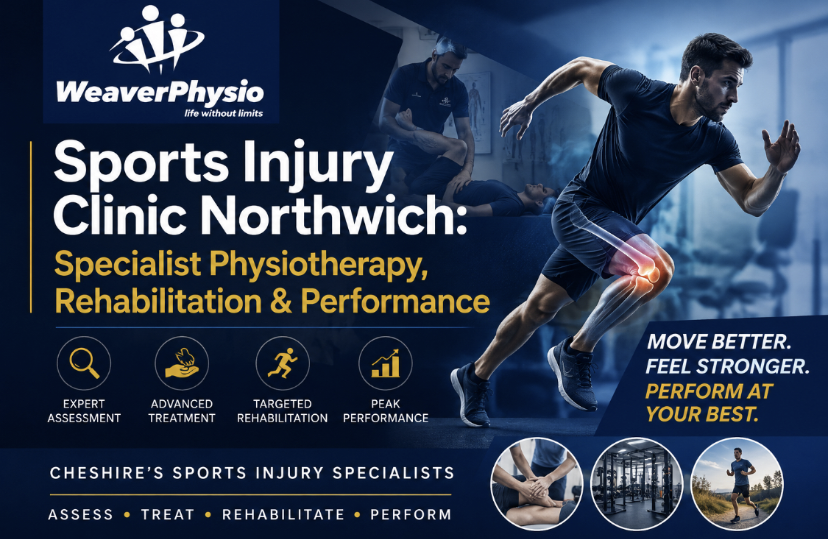
Sports Injury Clinic Northwich:
Specialist Physiotherapy, Rehabilitation & Performance
A sports injury should not simply be something you wait to disappear. Whether you are a competitive athlete, recreational runner, gym enthusiast, cyclist, footballer or simply someone determined to stay active, the quality of your rehabilitation can influence not only how quickly you return, but how confidently and successfully you perform when you get there.
At Weaver Physio in Northwich, our approach goes beyond temporarily settling symptoms. We assess the injury, investigate the factors that may have contributed to it, restore movement and strength, and progressively prepare your body for the demands of your sport.
With 70+ years of combined clinical experience, our team provides specialist sports injury physiotherapy and rehabilitation for people throughout Northwich and the wider Cheshire area.
If you are searching for a sports injury clinic in Northwich because an injury is limiting your training, affecting your performance or repeatedly returning, our aim is simple:
Understand the problem. Rebuild the body. Restore confidence. Return stronger.
Why Sports Injury Rehabilitation Is About More Than Pain Relief
Pain reduction is important, but it is only one part of successful sports injury rehabilitation.
An athlete may become relatively pain-free while still lacking the strength, control, mobility, power or load tolerance required to return safely to training and competition.
This is where specialist sports physiotherapy becomes particularly valuable.
At Weaver Physio, rehabilitation is designed around the demands you need your body to tolerate. A runner may need progressive calf capacity, single-leg control and running-specific loading. A footballer may require acceleration, deceleration, cutting and change-of-direction work. A gym athlete may need progressive resistance training before returning to heavy lifting.
The goal is therefore not simply:
“Does it still hurt?”
A better question is:
“Is your body ready for what you are asking it to do?”
That distinction is central to our approach at our Northwich sports injury clinic.
When Should You See a Sports Injury Physiotherapist?
Not every ache after exercise represents an injury. Temporary muscle soreness following unfamiliar or intense training can be completely normal.
However, persistent or worsening symptoms deserve attention.
Consider arranging a sports injury assessment if you experience:
Pain that repeatedly returns during training
Sharp or localised pain with particular movements
Persistent swelling or stiffness
Reduced strength or power
Difficulty running, jumping, lifting or changing direction
Symptoms that improve with rest but return when training resumes
Reduced confidence in the injured area
A noticeable change in your movement or running technique
An injury that has failed to improve as expected
Repeated injuries affecting the same area
Early assessment can help establish what you are dealing with and, importantly, what you should do next.
Simply stopping activity indefinitely is rarely a complete rehabilitation strategy. Equally, repeatedly training through significant pain without understanding its cause can potentially prolong the problem.
The answer is usually appropriate, progressive and individualised rehabilitation.
Sports Injury Physiotherapy in Northwich
Sports injuries can occur suddenly, such as during a sprint, tackle, landing or heavy lift. Others develop gradually as the cumulative demands placed on the body exceed its current capacity to recover and adapt.
At Weaver Physio, we assess and rehabilitate a wide range of sporting and musculoskeletal problems, including:
Running Injuries
Achilles tendinopathy
Plantar heel pain and plantar fasciitis
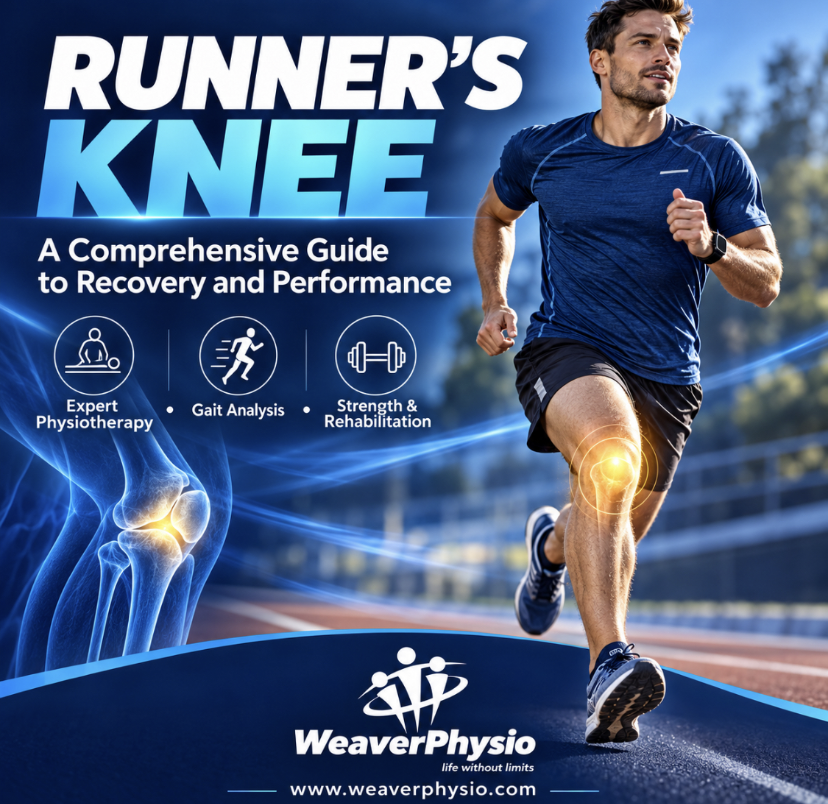
Runner’s knee
Patellofemoral pain
Iliotibial band syndrome (ITBS)
Shin pain and medial tibial stress syndrome
Calf strains
Hamstring injuries
Hip and gluteal pain
Foot and ankle injuries
Lower-Limb Sports Injuries
Ankle sprains
Knee injuries
Muscle strains
Tendon problems
Groin injuries
Hip pain
Patellar tendinopathy
Rehabilitation following surgery
Upper-Limb Sports Injuries
Rotator cuff problems
Shoulder pain
Tennis elbow
Golfer’s elbow
Wrist problems
Muscle and tendon injuries
Persistent & Recurrent Injuries
We also regularly assess people who tell us:
“It gets better, but every time I return to training it comes back.”
These cases require more than repeatedly treating the painful area. We need to understand why the tissues may be struggling to tolerate the demands being placed upon them.
Finding the Cause – Not Just Treating the Symptoms
One of the most important elements of high-quality sports injury rehabilitation is identifying the factors contributing to the problem.
The location of pain does not always tell the whole story.
Depending on your injury, our assessment may examine:
Joint mobility
Muscle strength
Flexibility
Movement control
Balance
Single-leg stability
Training volume and intensity
Recent changes in activity
Running mechanics
Sport-specific movement patterns
Previous injury history
Recovery between training sessions
We then use these findings to create a rehabilitation programme around you, your injury and your goals.
There is no generic rehabilitation programme that is perfect for every runner, footballer, cyclist or athlete.
Individualisation matters.
What Happens During a Sports Injury Assessment at Weaver Physio?
Your initial appointment starts with a detailed clinical history.
We want to understand how the injury began, what aggravates or eases your symptoms, how it affects your sport and what you ultimately want to return to.
Your physical assessment may then include appropriate tests of:
Movement • Mobility • Strength • Flexibility • Neurological function • Balance • Stability • Functional capacity • Sport-specific movement
Where clinically appropriate, we may also assess movements such as squatting, hopping, jumping, landing or running.
From there, we explain our clinical findings and develop a structured treatment and rehabilitation plan.
You should understand what we think is happening, what the rehabilitation process involves and what you can do to help your recovery.
The Weaver Sports Injury Rehabilitation Approach
At Weaver Physio, rehabilitation progresses from assessment through to performance rather than stopping as soon as symptoms settle.
1. Assess
Everything begins with a thorough clinical assessment.
We establish the nature of the injury and investigate the factors that may be contributing to it.
This gives your rehabilitation direction rather than relying on guesswork.
2. Settle Symptoms & Restore Movement
Where appropriate, early treatment may focus on reducing pain and restoring comfortable movement so rehabilitation can progress.
Treatment may include:
Manual therapy
Soft-tissue techniques
Sports massage
Acupuncture or dry needling
Mobility exercises
Exercise therapy
Education and load modification
Treatment is selected according to your individual clinical presentation rather than automatically applying the same techniques to everyone.
3. Rebuild Strength & Capacity
As symptoms improve, rehabilitation becomes progressively more active.
This may involve developing:
Strength • Stability • Balance • Coordination • Tendon capacity • Muscle capacity • Movement control
Progressive loading is particularly important for many muscle and tendon injuries.
The objective is to increase what your body can tolerate rather than simply avoiding everything that causes discomfort.
4. Return to Sport
The final stage bridges the gap between rehabilitation exercises and the real demands of sport.
Depending on your activity, this could include:
Running progressions
Plyometric exercises
Jumping and landing
Acceleration and deceleration
Change of direction
Sport-specific drills
Progressive resistance training
Return-to-training planning
The aim is to ensure your rehabilitation actually prepares you for your sport, not simply everyday life.
Running Injury Specialists in Northwich
Runners place unique repetitive demands on the body. Small changes in training volume, speed, terrain, recovery or tissue capacity can sometimes be enough to trigger symptoms.
At Weaver Physio, we work with runners across Cheshire experiencing everything from their first running injury to complex recurring problems that have interrupted training for months.
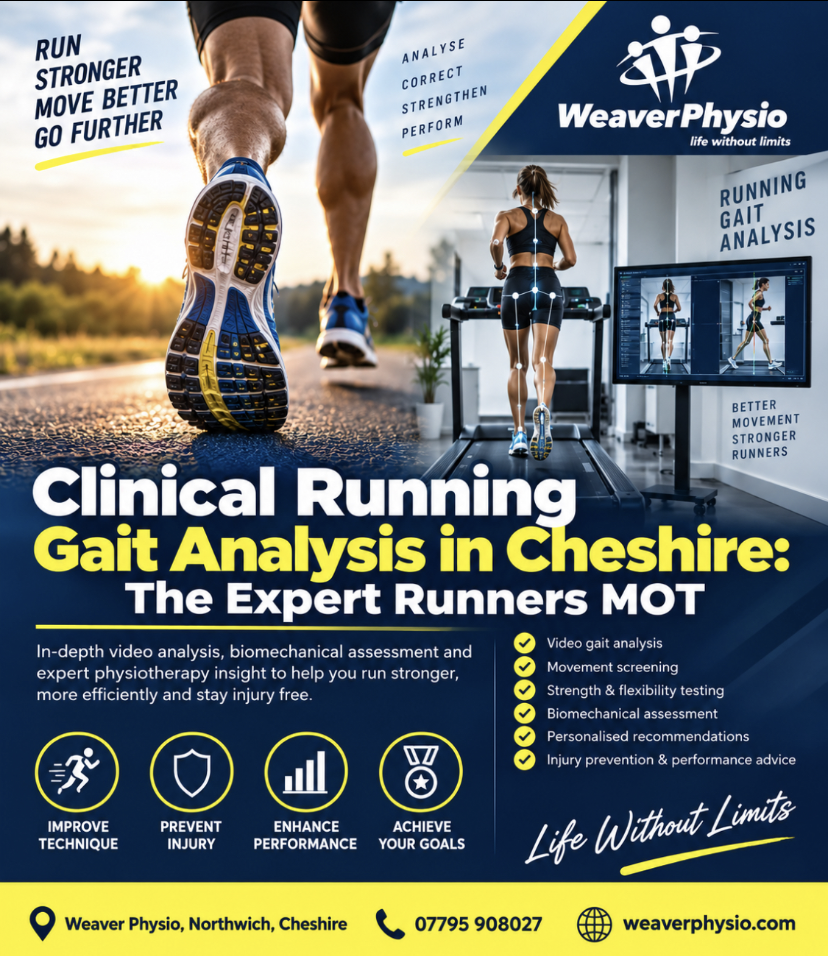
Where appropriate, our assessment can incorporate video running gait analysis.
Slow-motion video allows us to examine aspects of your running mechanics that can be difficult to assess accurately at full speed.
Rather than trying to force every runner into an imaginary “perfect” technique, we consider whether particular movement characteristics are relevant to your symptoms, performance and injury history.
This information can then help guide strength training, rehabilitation and, where appropriate, gait retraining.
Shockwave Therapy for Persistent Tendon Problems
Some tendon conditions can become persistent and difficult to resolve.
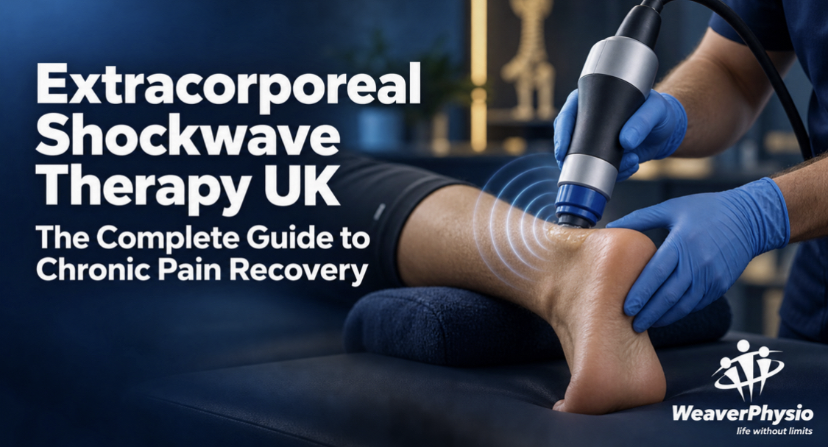
At Weaver Physio, Extracorporeal Shockwave Therapy (ESWT) may be considered as part of a wider rehabilitation programme for selected musculoskeletal conditions.
Shockwave therapy uses externally applied acoustic pressure waves and may be appropriate for conditions such as:
Plantar fasciitis / plantar heel pain
Achilles tendinopathy
Patellar tendinopathy
Greater trochanteric pain / gluteal tendinopathy
Tennis elbow
Selected chronic tendon problems
Importantly, shockwave therapy is not viewed as a substitute for rehabilitation.
Where appropriate, it is integrated alongside progressive loading, strength work and modification of relevant contributing factors.
Sports Massage & Hands-On Treatment
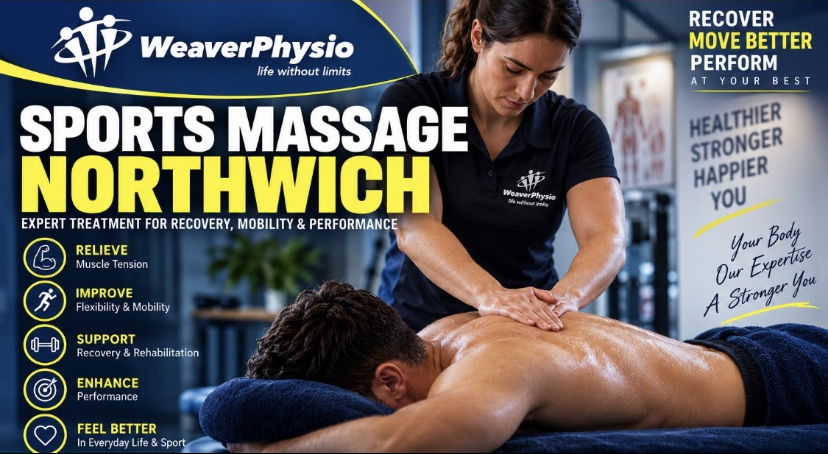
Sports massage can also play a useful supporting role within sports injury management.
Depending on your presentation, treatment may be used to address muscle tightness, improve comfortable movement or help manage symptoms while you progress through rehabilitation.
However, hands-on treatment alone rarely provides everything an athlete needs to return successfully to sport.
This is why we combine appropriate treatment with exercise rehabilitation, progressive strengthening and return-to-sport planning.
Our objective is not to make you dependent upon treatment.
It is to help your body become capable again.
From Rehabilitation to Performance
There is an important difference between being pain-free and being performance-ready.
Imagine a runner recovering from a calf injury. Walking without pain is encouraging, but it does not demonstrate that the calf can tolerate thousands of loading cycles during a long run.
Similarly, being able to squat without knee pain does not necessarily mean a footballer is ready to sprint, cut, tackle and change direction repeatedly for 90 minutes.
Successful rehabilitation therefore needs progression.
We gradually expose the body to increasing demands until there is a logical bridge between the clinic and your chosen activity.
That is how confidence is rebuilt.
Strength & Conditioning for Injury Prevention
Strength training is increasingly important within modern sports injury rehabilitation.
We may use progressive strengthening to improve the capacity of muscles, tendons and joints to tolerate sporting demands.
Depending on your needs, your programme may incorporate:
Isometric exercises
Progressive resistance training
Heavy slow resistance
Single-leg strengthening
Balance and stability work
Plyometrics
Power development
Running-specific exercises
The exact programme depends on your injury, current ability and sporting goals.
The aim is not merely to rehabilitate the injured structure.
We want to build a body that is better prepared for what comes next.
Why Choose Weaver Physio as Your Sports Injury Clinic in Northwich?
Choosing a sports injury clinic is ultimately about trusting the people responsible for your recovery.
At Weaver Physio, our approach combines extensive clinical experience with modern rehabilitation principles.
70+ Years of Combined Clinical Experience
Our experienced team has worked with a wide range of musculoskeletal conditions, sporting injuries, runners and active individuals.
Chartered Physiotherapy
Our physiotherapy team provides professional assessment, treatment and rehabilitation, with care guided by current clinical reasoning and evidence-based practice.
Individual Rehabilitation
Your programme is built around your injury, lifestyle, sporting demands and goals rather than following a generic protocol.
Running & Sports Injury Expertise
We have a strong focus on running injuries, tendon rehabilitation, sports injuries and return-to-performance rehabilitation.
Advanced Treatment Options
Where clinically appropriate, your treatment programme may incorporate:
Shockwave Therapy • Running Gait Analysis • Sports Massage • Acupuncture • Dry Needling • Manual Therapy • Exercise Rehabilitation • Strength & Conditioning
Rehabilitation That Goes Beyond the Treatment Table
We do not want your recovery to finish when the pain disappears.
Our goal is to restore the movement, strength and physical capacity required to help you return to the activities that matter to you.
Sports Injury Clinic Serving Northwich & Cheshire
Based in Northwich, Weaver Physio welcomes athletes, runners and active individuals from across the surrounding Cheshire area, including Hartford, Weaverham, Winsford, Middlewich, Knutsford, Tarporley, Frodsham and Sandbach.
Whether you are preparing for your first 5K, training for a marathon, returning to football or rugby, competing in endurance sport, lifting weights or simply trying to stay active without recurring pain, your rehabilitation should reflect your goals.
Don’t Just Recover. Build Your Return.
An injury can be frustrating, particularly when it repeatedly interrupts training or prevents you doing something important to you.
But rehabilitation should provide more than temporary relief.
It should give you a clear understanding of the problem, a structured route forward and measurable progression towards the demands of your sport.
At Weaver Physio, we combine specialist sports injury assessment, evidence-informed treatment, progressive exercise rehabilitation and return-to-sport planning to help you move from injury back towards performance.
Assess the injury.
Restore movement.
Rebuild strength.
Develop capacity.
Return with confidence.
If you’re looking for a sports injury clinic in Northwich, book a sports injury assessment with Weaver Physio and start building your route back to the activity you love.
Weaver Physio – Cheshire’s Sports Injury Specialists
Frequently Asked Questions About Sports Injury Physiotherapy in Northwich
What happens at my first sports injury physiotherapy appointment?
Your initial appointment includes a detailed discussion about your injury, symptoms, training history and goals followed by an appropriate physical examination. We may assess movement, strength, mobility, flexibility and functional activities relevant to your sport. We then explain our findings and discuss a personalised treatment and rehabilitation plan.
Do I need a GP referral to see a physiotherapist?
Private physiotherapy can generally be accessed through self-referral, so you can usually book an assessment directly. If you intend to use private medical insurance, check your policy because individual insurers and policies may have specific referral or authorisation requirements.
How quickly can I return to sport after an injury?
There is no universal recovery time. It depends on the type and severity of the injury, how long you have experienced symptoms, your sport, training demands and how your body responds to rehabilitation. We use progressive rehabilitation to help guide a safe return rather than relying purely on an arbitrary date.
Should I completely rest a sports injury?
Not necessarily. Some injuries require an initial reduction or modification in activity, but prolonged complete rest is not appropriate for every condition. Many sports injuries benefit from carefully managed movement and progressive loading. Your physiotherapist can advise you on what you should temporarily reduce and what you can safely continue.
Can you treat an injury that has been present for months?
Yes. Persistent problems are common in sports physiotherapy. These cases often require us to look beyond the painful area and consider factors such as strength, tissue capacity, movement, training load and previous rehabilitation.
Can sports physiotherapy help prevent my injury returning?
No intervention can guarantee that an injury will never recur. However, identifying modifiable risk factors, rebuilding strength and capacity, improving rehabilitation quality and gradually preparing the body for sporting demands can help reduce avoidable risks and improve readiness for return to sport.
Do you offer treatment for running injuries in Northwich?
Yes. Weaver Physio has a particular interest in running injury rehabilitation. Depending on your individual needs, assessment may include strength and movement testing, rehabilitation planning and video running gait analysis.
Is shockwave therapy available at Weaver Physio?
Yes. Shockwave Therapy is available for selected persistent musculoskeletal and tendon conditions where clinically appropriate. It is generally used as part of a broader rehabilitation strategy rather than as a stand-alone solution.
Is sports massage useful during injury rehabilitation?
Sports massage can be useful for symptom management and may complement rehabilitation in appropriate cases. However, long-term recovery usually requires addressing factors such as strength, load tolerance and sport-specific capacity, which is why we integrate hands-on treatment with active rehabilitation.
What makes Weaver Physio different from a general physiotherapy clinic?
Our approach has a strong emphasis on sports injury rehabilitation, running injuries, tendon problems, progressive strength and conditioning, gait analysis and return-to-performance planning. The objective is not simply to settle pain but to help you rebuild the physical capacity and confidence required for your activity.