
ITBS
Iliotibial Band Syndrome Treatment & Running Rehabilitation in Northwich
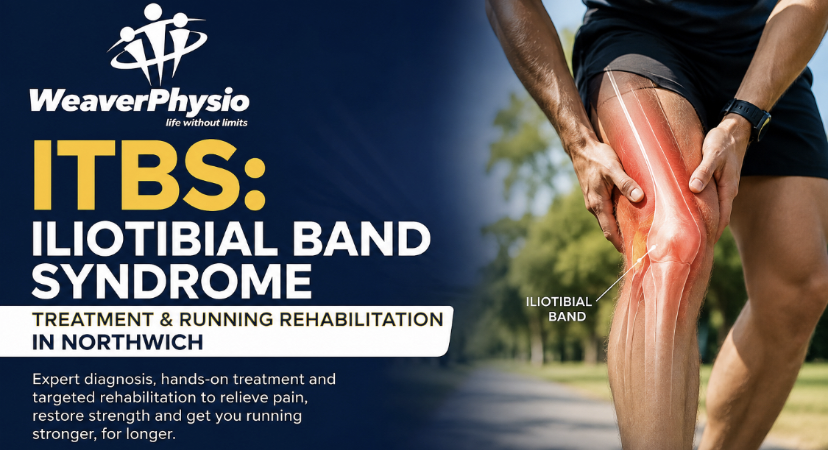
If pain on the outside of your knee keeps appearing at almost exactly the same point in every run, Iliotibial Band Syndrome (ITBS) could be the reason.
ITBS is one of the most recognised causes of lateral knee pain in runners, and it can be incredibly frustrating. Your knee may feel completely comfortable when walking, working or starting a run, only for a sharp or burning pain to develop several miles later. You stop, the symptoms settle, you try again a few days later—and the same thing happens.
At Weaver Physiotherapy & Sports Injury Clinic in Northwich, we believe successful treatment should involve much more than simply resting, stretching the IT band or repeatedly treating the painful area.
Our approach focuses on understanding why your knee has become sensitive to running load in the first place.
That means assessing your training load, strength, movement control, running biomechanics, mobility and other factors that may be contributing to your symptoms. From there, we can build an individual rehabilitation programme designed not simply to reduce pain, but to improve your ability to tolerate running again.
Whether you’re preparing for a marathon, returning to your local 5K, running through Marbury Park or simply want to enjoy pain-free miles again, the goal is the same:
Identify the problem. Address the contributing factors. Build capacity. Return to running stronger.
What Is Iliotibial Band Syndrome (ITBS)?
The iliotibial band, commonly called the IT band or ITB, is a strong band of connective tissue running down the outside of the thigh from the hip region towards the outside of the knee.
ITBS typically causes pain around the outer aspect of the knee, particularly during repetitive activities such as running and cycling.
Historically, ITBS was often described as a friction problem, with the IT band supposedly moving backwards and forwards across the lateral femoral epicondyle.
Our understanding has developed considerably.
Current anatomical and biomechanical thinking suggests that ITBS is better understood as involving compression of sensitive tissues around the lateral knee, rather than simply an IT band repeatedly “rubbing” over the bone.
This distinction matters because it changes how we approach rehabilitation.
Rather than simply trying to stretch or loosen the IT band, modern management places greater emphasis on:
Appropriate load management
Progressive strengthening
Hip and pelvic control
Lower-limb biomechanics
Running gait
Training errors
Gradual reintroduction of running-specific load
At Weaver Physio, our aim is therefore not simply to chase the painful structure. We look at the entire runner and the demands being placed upon their body.
What Does ITBS Feel Like?
ITBS symptoms can vary between runners, but a common presentation is a relatively localised pain on the outside of the knee.
Many runners describe it as sharp, burning, stinging or aching.
One of the most characteristic features is that symptoms can appear at a surprisingly predictable point during a run.
You might feel comfortable for the first 20 or 30 minutes, for example, before the pain begins. Continuing to run can then cause symptoms to become progressively more uncomfortable until you are forced to stop.
Common ITBS symptoms can include:
Pain on the outside of the knee
Sharp or burning lateral knee pain when running
Pain beginning after a relatively predictable distance
Symptoms aggravated by downhill running
Pain associated with longer runs or increased training volume
Discomfort when repeatedly bending and straightening the knee
Symptoms that settle with rest but return when running resumes
If this pattern sounds familiar, repeatedly resting until the pain disappears before immediately returning to your previous mileage may simply recreate the same problem.
The important question is:
Why is your knee currently unable to tolerate the load you’re asking it to handle?
Why Do Runners Develop ITBS?
There is rarely one single cause.
Running injuries are often multifactorial, meaning several factors combine until the load being placed upon a particular area exceeds its current capacity.
With ITBS, potential contributors may include changes in training volume, running intensity, hill work, recovery, strength, movement control and running biomechanics.
This is why two runners with pain in exactly the same location may require very different rehabilitation programmes.
1. Sudden Changes in Running Load
A rapid increase in mileage is one of the first things we consider.
Your cardiovascular fitness can sometimes improve more quickly than the capacity of your musculoskeletal tissues to tolerate repeated loading.
Problems may therefore develop following:
Rapid increases in weekly mileage
Additional speed sessions
Increased long-run distance
More frequent running
Sudden introduction of hill training
Returning too quickly after time away from running
Increasing training intensity and volume simultaneously
The solution isn’t necessarily complete rest.
It is often about finding a manageable level of running load while progressively rebuilding capacity.
2. Hip and Pelvic Control
The hip muscles play an important role in controlling the position of the pelvis, femur and lower limb during running.
In some runners, reduced strength or control around the hip may contribute to movement patterns such as increased hip adduction or pelvic drop.
These findings do not automatically mean they are the cause of someone’s pain. However, when they are relevant to the individual runner, improving hip strength and lower-limb control can form an important part of rehabilitation.
At Weaver Physio, we frequently assess the gluteal muscles, single-leg control, pelvic stability and running mechanics rather than simply concentrating on the painful knee.
3. Running Biomechanics
Running is a highly repetitive activity.
Even relatively small movement characteristics can become significant when repeated thousands of times during a training week.
Depending on the individual runner, we may assess:
Pelvic control
Hip movement
Knee alignment
Foot and ankle mechanics
Step width
Cadence
Overstriding
Trunk position
Ground contact characteristics
Running technique under fatigue
There is no single “perfect” running style.
Our goal isn’t to make everybody run identically. It is to identify whether there are modifiable characteristics that appear relevant to your symptoms, performance and injury history.
4. Strength and Running Capacity
Running itself does not necessarily provide all the strength qualities required to tolerate increasingly demanding training.
A runner may therefore have excellent cardiovascular fitness while lacking sufficient strength, control or capacity in areas such as the:
Gluteals
Quadriceps
Hamstrings
Calves
Soleus
Hip stabilisers
Trunk musculature
This is one reason strength and conditioning is such an important component of running rehabilitation at Weaver Physio.
We focus on developing a strong foundation combining:
Balance + Strength + Stability + Coordination
As rehabilitation progresses, we can then introduce more demanding running-specific loading, including plyometric and energy-storage exercises where appropriate.
Why Stretching the IT Band Isn’t Usually the Complete Answer
Many runners diagnosed with ITBS are immediately told:
“Your IT band is tight—you need to stretch it.”
The problem is that the iliotibial band is not a conventional muscle.
It is an extremely strong connective-tissue structure, and the idea that a few stretches will substantially lengthen the IT band itself is questionable.
That doesn’t mean mobility work is always useless.
Addressing restrictions in surrounding areas such as the hip flexors, quadriceps or other tissues may sometimes form part of a broader programme. However, repeatedly and aggressively stretching directly into the painful lateral knee is unlikely to address all the reasons the problem developed.
The better question isn’t simply:
“How do we loosen the IT band?”
It is:
“How do we improve this runner’s ability to tolerate the forces and demands of running?”
That shift in thinking is central to our approach at Weaver Physio.
Can You Run With ITBS?
Not every runner with ITBS needs to stop running completely.
For some people, relative load modification may be more appropriate than total rest.
This might involve temporarily:
Reducing weekly mileage
Shortening individual runs
Running less frequently
Removing speed sessions
Avoiding steep downhill running
Choosing flatter routes
Increasing recovery between sessions
The appropriate strategy depends on your symptoms and clinical presentation.
A useful rehabilitation programme should therefore establish what you can currently tolerate, rather than automatically removing all activity.
Your running can then be progressively rebuilt as symptoms settle and physical capacity improves.
ITBS Treatment in Northwich: The Weaver Physio Approach
At Weaver Physiotherapy & Sports Injury Clinic, treatment starts with a detailed assessment.
We don’t want to simply establish that your outer knee hurts.
We want to understand why it hurts when you run.
Your assessment may consider your injury history, current training programme, recent changes in mileage, strength, flexibility, joint mobility, functional movement and running goals.
We may also use functional tests such as squats, single-leg movements and running-specific assessments to understand how your body manages load.
Treatment and rehabilitation can then be tailored specifically to your findings.
Depending on your assessment, management may include:
Physiotherapy
Training-load modification
Progressive exercise rehabilitation
Hip and gluteal strengthening
Lower-limb strengthening
Balance and stability exercises
Movement-control exercises
Running-specific conditioning
Manual therapy where clinically appropriate
Soft-tissue techniques
Running gait analysis
Gait retraining
Progressive return-to-running programmes
The emphasis is on progressive rehabilitation rather than passive treatment alone.
Strength Training for ITBS
Strengthening is often one of the most important elements of successful ITBS rehabilitation.
Early exercises may focus on developing controlled force around the hip and knee. As your capacity improves, exercises should become progressively more demanding and increasingly relevant to running.
Depending on your individual assessment, rehabilitation might progress through exercises such as:
Hip abduction exercises
Bridges and bridge variations
Step-ups
Split squats
Single-leg squats
Lunges
Romanian deadlifts
Calf strengthening
Single-leg stability exercises
Running-specific drills
Hopping and plyometric exercises
Simply receiving a list of exercises isn’t enough.
Exercise selection, load, repetitions, frequency and progression all matter.
The ultimate goal is to bridge the gap between rehabilitation exercises and the considerably greater demands of running.
Running Gait Analysis for ITBS in Northwich
If your ITBS repeatedly returns whenever you increase your mileage, simply treating the knee may not provide the complete answer.
This is where running gait analysis can be particularly valuable.
At Weaver Physio, our running assessments allow us to examine how your entire body moves while you run.
We can assess factors such as:
Pelvic stability
Hip control
Knee position
Foot and ankle mechanics
Cadence
Step characteristics
Trunk movement
Overall running technique
Slow-motion video allows movement patterns to be reviewed in far greater detail than is possible simply by watching someone run in real time.
The important point, however, is that gait analysis should not be used to find meaningless “faults.”
Every runner moves differently.
We use gait analysis alongside your symptoms, clinical assessment, strength testing and training history to identify findings that may actually be relevant to you.
Could Increasing Running Cadence Help ITBS?
In selected runners, changing cadence can be a useful gait-retraining strategy.
A modest increase in step rate may reduce certain biomechanical loads and can sometimes help runners alter characteristics such as overstriding.
However, there is no universal cadence that every runner should achieve.
Rather than automatically telling every runner to increase their cadence by a fixed percentage, we assess whether a cadence modification is actually appropriate for the individual.
When gait changes are indicated, they should usually be introduced gradually so your body has time to adapt.
Weaver Physio Runner’s MOT: Looking Beyond the Pain
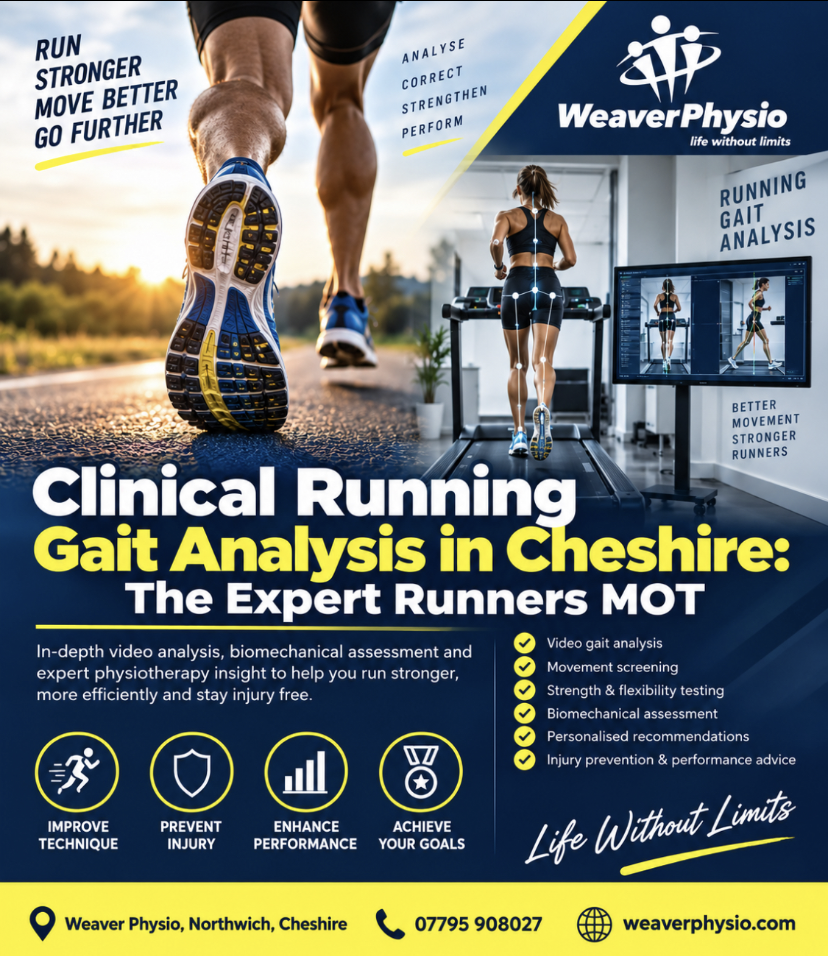
For runners who want a more comprehensive understanding of their movement, our Runner’s MOT and Video Gait Analysis in Northwich takes the assessment beyond the treatment couch.
The objective is to understand how your body performs during the activity that actually causes your symptoms—running.
We combine running analysis with assessment of areas such as:
Balance • Strength • Stability • Coordination • Mobility • Running Mechanics
This can be particularly useful for runners experiencing recurring problems such as:
Iliotibial Band Syndrome
Runner’s knee
Achilles tendinopathy
Plantar heel pain
Shin pain
Calf injuries
Hamstring injuries
Hip pain
Recurrent knee pain
Rather than simply asking you to stop running, we want to understand how we can help you run better, tolerate more and reduce the likelihood of the same problem repeatedly disrupting your training.
Does Shockwave Therapy Help ITBS?
At Weaver Physio, treatment is always selected according to the individual rather than simply applying a modality because a condition has become persistent.
For longstanding lateral knee pain, the first priority is confirming that ITBS is actually the correct diagnosis and identifying the factors maintaining the problem.
Where clinically appropriate, adjunctive treatments may sometimes be considered alongside rehabilitation. However, progressive loading, appropriate training modification and addressing relevant biomechanical factors remain central to management.
No treatment modality should replace a well-structured rehabilitation programme.
Returning to Running After ITBS
The goal of rehabilitation isn’t simply reaching the point where walking and everyday activities are pain-free.
A runner needs to tolerate running.
That requires progressively rebuilding the forces, repetition and fatigue involved in the sport.
Your return may therefore progress from controlled strengthening towards:
Strength → Single-Leg Control → Running-Specific Loading → Plyometrics → Graded Running → Normal Training
Mileage and intensity should then be increased progressively according to your response.
One of the biggest mistakes runners make is feeling better after a period of rest and immediately returning to their previous training volume.
Pain settling doesn’t necessarily mean your previous running capacity has been restored.
Recovery and readiness are not always the same thing.
ITBS Treatment for Runners Across Northwich and Cheshire
Weaver Physiotherapy & Sports Injury Clinic provides physiotherapy, sports injury rehabilitation and running gait analysis for runners throughout Northwich and the surrounding Cheshire area, including Hartford, Weaverham, Winsford, Middlewich, Knutsford, Tarporley, Frodsham and surrounding communities.
Whether you’re a new runner completing your first Couch to 5K or an experienced athlete preparing for a marathon, recurring lateral knee pain doesn’t have to become something you simply accept.
The earlier you understand what is driving the problem, the sooner you can begin building an effective route back to running.
Stop Chasing the IT Band. Start Building a Better Runner.
ITBS rehabilitation should involve much more than stretching the outside of your leg and hoping the pain disappears.
Successful recovery involves understanding the relationship between training load, tissue capacity, strength, movement and running biomechanics.
At Weaver Physio, our approach is built around identifying the factors that matter to you and developing a progressive programme capable of taking you from pain and uncertainty back towards confident running.
Our Chartered Physiotherapists combine clinical assessment, progressive rehabilitation and specialist running analysis to help runners understand their injuries and build the physical capacity required for the road, trail or race ahead.
If lateral knee pain is repeatedly stopping your runs, don’t simply wait for it to disappear before repeating the same training cycle.
Find out why it’s happening—and build the capacity to run stronger.
Book an ITBS Physiotherapy Assessment or Runner’s MOT in Northwich
Take the first step towards returning to comfortable, confident running with Weaver Physiotherapy & Sports Injury Clinic.
Frequently Asked Questions About ITBS
How long does ITBS take to recover?
There isn’t one recovery timeline that applies to every runner. Recovery depends on factors including symptom duration, irritability, training load, physical capacity and how effectively contributing factors are addressed.
Some runners improve relatively quickly, while persistent cases may require a longer period of progressive rehabilitation.
The objective should not simply be becoming pain-free—it should be rebuilding sufficient capacity to tolerate your intended running volume.
Should I stop running completely with ITBS?
Not necessarily. Some runners can continue with a modified running programme provided symptoms remain manageable and running isn’t progressively aggravating the condition.
Others may initially require a greater reduction in running load.
A physiotherapy assessment can help determine an appropriate starting point and progression.
Should I stretch my IT band?
Aggressively attempting to stretch the IT band itself is unlikely to be the complete solution to ITBS.
Your programme may include mobility exercises for relevant surrounding structures, but rehabilitation should generally consider strength, load tolerance, movement control and running-specific capacity rather than concentrating solely on stretching.
Should I foam roll my IT band?
Foam rolling may provide a temporary change in how surrounding tissues feel, but it should not be considered a way of permanently “lengthening” the IT band.
Aggressive rolling directly over an already painful lateral knee can also be uncomfortable and potentially aggravating.
If you use a foam roller, it should complement—not replace—appropriate rehabilitation.
Can weak glutes cause ITBS?
Hip strength and control can be relevant in some runners with ITBS, but describing “weak glutes” as the single cause is usually an oversimplification.
A good assessment considers hip strength alongside training load, movement patterns, running mechanics, previous injuries and overall physical capacity.
Does gait analysis help with ITBS?
It can be particularly useful when ITBS is recurrent or strongly associated with running.
Video gait analysis allows us to assess how your pelvis, hips, knees, ankles, feet and trunk behave while you actually run. Findings can then be combined with your clinical assessment to determine whether targeted gait retraining may be beneficial.
What’s the difference between ITBS and a meniscus injury?
ITBS commonly produces relatively localised pain around the outside of the knee, often associated with repetitive running.
Meniscal problems may cause joint-line pain and can sometimes be associated with swelling, catching, clicking, giving way or locking.
However, symptoms can overlap, so persistent or significant knee pain should be properly assessed rather than self-diagnosed.
Why does my ITBS keep coming back?
Recurring symptoms often suggest that the original contributing factors or running capacity have not been fully addressed.
Rest may settle pain, but if you return to exactly the same training load without rebuilding strength, capacity or addressing relevant biomechanical factors, symptoms can return.
This is why Weaver Physio focuses on rehabilitation and long-term running capacity—not simply short-term pain relief.
ITBS Treatment Northwich | Weaver Physiotherapy & Sports Injury Clinic
If you’re searching for ITBS treatment in Northwich, physiotherapy for runner’s knee, running injury treatment in Cheshire or professional running gait analysis, Weaver Physio can help you understand what’s causing your symptoms and develop an individual plan for returning to running.
Assess. Rehabilitate. Strengthen. Progress. Perform.
Weaver Physio — helping Cheshire runners move better, run stronger and return with confidence.