
12 Questions to Ask Before Joint Replacement Surgery

November 2, 2026

A Guide for Hip and Knee Patients

Considering a hip or knee replacement? Your first consultation with an orthopaedic surgeon is a chance to understand your diagnosis, compare appropriate treatment options and decide what matters most to you. Taking a list of questions can make the conversation easier and help you leave with a clearer picture of the likely benefits, risks and recovery involved.


This guide explains 12 useful questions to ask before joint replacement surgery. It is intended to help you prepare for a discussion with your orthopaedic team; it cannot determine whether surgery is right for you. Your recommendation will depend on your symptoms, examination, imaging where relevant, medical history and personal priorities.


Why prepare questions before an orthopaedic consultation?


Hip and knee pain can affect walking, sleep, work, exercise and ordinary tasks such as dressing or climbing stairs. When symptoms persist, it is natural to want a clear answer and a plan. Yet a consultation can involve unfamiliar terminology, several treatment choices and a lot of information in a short time.


Writing down questions in advance gives you a prompt to return to if you feel anxious or overwhelmed. You can also take a family member or friend, with your permission, and ask the clinician to explain anything that is unclear. NICE recommends shared decision-making and discussion of alternatives, benefits, risks, implant options and recovery for people considering elective hip, knee or shoulder replacement. Its joint replacement guideline also says information should be specific to the procedure and provided in an understandable format.


There is no single question list that suits everyone. Use the suggestions below to identify what you want to understand, then ask the surgeon to relate the answers to your own circumstances.


1. Do I really need joint replacement surgery now?


Ask what the assessment suggests is causing your pain and how the joint problem relates to your symptoms and everyday function. A scan or X-ray is only one part of the picture: it is useful to understand how the findings fit with your examination, history and goals.


For osteoarthritis, NICE advises considering referral for joint replacement when symptoms substantially affect quality of life and non-surgical management is ineffective or unsuitable. That does not mean surgery is automatic. Ask what makes it reasonable to consider now, what the likely consequences of waiting might be in your case, and what signs would prompt you to seek review sooner. The NICE osteoarthritis recommendations emphasise clinical assessment rather than relying on a numerical severity score alone.


2. What is actually causing my joint pain?


Pain around the hip or knee does not always come from the joint itself. Tendons, muscles, the lower back, nearby nerves or other structures can contribute, and more than one factor may be present. Ask your surgeon to explain the working diagnosis in plain language and how confident they are about it.


Useful follow-up questions include: What did the examination show? Do I need further tests? Would another clinician or specialist opinion help? What findings would make you reconsider the diagnosis? Understanding the suspected source of symptoms helps you judge whether a proposed treatment is likely to address the problem you experience. It also gives you a basis for discussing what improvement is realistic.


3. What are my surgical and non-surgical treatment options?


Ask the surgeon to compare the reasonable options for your particular condition. Depending on the diagnosis and your circumstances, this may include activity or lifestyle changes, tailored exercise, pain-management approaches, walking aids, other treatments, continued monitoring or a surgical procedure. Not every option is suitable for every person, and non-surgical care should be discussed in context rather than treated as a universal substitute for surgery.


For osteoarthritis, NICE recommends tailored therapeutic exercise and, where appropriate, support with weight management. The NHS overview of alternatives to hip replacement describes options that may be considered before surgery. Ask what you have already tried, whether it was delivered in a way that fits your needs, and what evidence or clinical reasoning supports the next step. Also ask what may happen if you choose to continue with non-surgical management for now.


4. Which type of joint replacement or implant is suitable for me?


There are different procedures and implant designs. The appropriate choice can depend on the joint, the extent and pattern of damage, bone quality, age, activity, medical history and the surgeon’s assessment. Ask why a particular operation and implant are being recommended, what alternatives exist, and what advantages or limitations apply to each in your case.


You do not need to select an implant based on a brand name or promotional claim. Instead, ask how the surgeon’s recommendation relates to your priorities and what is known about the implant’s performance. NICE advises discussing the potential benefits and risks of available procedures and implant types, including the possibility of further surgery in the future. Ask whether the surgeon has any specific advice about activities or follow-up linked to the implant chosen.


5. What results can I realistically expect?


Ask which symptoms surgery is most likely to improve and which may remain. Many people have less pain and better function after joint replacement, but no operation can guarantee complete pain relief or a return to every previous activity. The result can vary according to the condition being treated, general health, recovery and individual expectations.


Try to describe your own goals in practical terms: walking to the shops, sleeping more comfortably, returning to work, gardening or taking part in a particular sport. Then ask whether each goal is realistic and what timeframe might apply. Ask how success is measured and what could limit progress. A balanced conversation about likely gains and uncertainty can help you decide whether the expected outcome is meaningful to you.


6. What are the risks and possible complications?


Every operation has potential complications. Ask the surgeon to explain the risks that matter most for your planned procedure and health, how likely they are in your situation, what warning signs to look for and how complications would be managed. Depending on the operation, discussion may include infection, blood clots, bleeding, anaesthetic issues, stiffness, persistent pain, dislocation after hip replacement, or the possibility that another procedure is needed.


Avoid relying only on a general percentage found online: figures may differ according to the operation, patient group, follow-up period and definition of a complication. Ask whether your own medical conditions, medicines or previous operations change your risk, and what can be done before and after surgery to reduce it. The NHS provides separate explanations of hip replacement complications and knee replacement complications.


7. How long will recovery and rehabilitation take?


Ask what the first days, weeks and months are likely to involve, while remembering that recovery varies. Find out how long you may stay in hospital, when you are expected to start walking, what equipment you might use, which exercises you will be given and who to contact if progress is difficult.


NHS guidance notes that recovery after hip or knee replacement can take several months, and that recovery after knee replacement can take longer. Your plan will depend on the operation and your health, so use published timelines as general guidance rather than a personal forecast. Ask what progress the team expects at each stage, how pain and swelling are managed, and what you should do if symptoms worsen. NICE recommends rehabilitation after surgery, including advice on daily activities and exercise, with additional supervised support when a person has specific needs.


8. Will I be able to return to my usual activities?


Be specific about what you hope to do: driving, caring responsibilities, work, walking, cycling, swimming, gardening or sport. Ask when you may be able to resume each activity, what conditions need to be met first and whether any movement or impact restrictions may apply.


The answer can differ between hip and knee procedures and between individuals. Work involving heavy lifting or prolonged standing may require a different plan from desk-based work. Some sports may be appropriate after recovery, while others may need to be modified or discussed with the surgical team. Ask for advice that fits your job and activities rather than relying on another person’s recovery story. Your surgeon and rehabilitation team can help you progress safely in line with your procedure-specific instructions.


9. How long might the implant last?


Implant lifespan is not identical for every patient. It can depend on factors such as implant design, activity, body weight, age, surgical factors and general health. Ask what evidence applies to the implant being recommended, how the team monitors its performance and what symptoms should lead you to seek assessment.


A replacement may last many years, but it can wear, loosen or develop another problem, and some people may need further surgery. No one can predict the exact lifespan for an individual. Ask whether your age or likely activity level changes the chance that revision surgery could be needed later. The aim is to understand the range of possibilities and how they affect your choice, rather than to expect a precise expiry date.


10. What is the total cost of surgery and follow-up?


If you are considering private treatment, request a written, itemised estimate. Ask whether the quote includes the surgeon and anaesthetist fees, hospital and theatre costs, implant, tests, medication, physiotherapy, follow-up appointments and any costs if your stay or recovery needs change. Confirm what happens if a complication requires extra treatment and whether insurance authorisation is needed.


If you are using NHS care, ask your team how the pathway works locally, what appointments and rehabilitation are included, and whom to contact with questions. Cost and coverage arrangements vary, so check the details directly with the provider or insurer. A clear estimate helps you compare like with like and prevents you from making a decision based on a headline price that excludes important parts of care.


11. How could my health conditions or medicines affect surgery?


Tell the surgical team about all relevant health conditions, previous operations, allergies and medicines, including non-prescription products and supplements. Ask whether any condition needs review before surgery, whether your medication plan may change, and whether extra monitoring or preparation is recommended.


Your clinician can explain how factors such as diabetes, heart or lung conditions, blood pressure, smoking or other health concerns may influence surgical planning and recovery. This is a discussion about managing individual risks, not a reason to assume that surgery is automatically unsuitable. NICE advises clinicians to explain how risks may vary between individuals. Do not stop or change prescribed medication unless the clinician responsible for your care tells you to do so.


12. Who will perform the operation and who will support me afterwards?


Ask who will carry out the surgery, who else will be involved in your care, where the operation will take place and how to contact the team before and after it. You can ask about the surgeon’s experience with the proposed procedure, the hospital’s arrangements and what follow-up is routinely provided.


Clarify who will explain the operation, manage pain, guide early movement and review your progress. Ask what happens if you have a concern once you are home and whether there is a named contact. For NHS care, the team can explain the local pathway; for private care, confirm what is included in your package and which services may be charged separately. Knowing who is responsible at each stage can make the process feel more organised.


What should I take to my consultation?


A little preparation can make it easier to use your appointment well. Consider bringing:


● A short list of your symptoms, when they began and what makes them better or worse.

● The activities that have become difficult and the changes you most hope to achieve.

● A current list of medicines, supplements, allergies and relevant medical conditions.

● Details of treatments you have already tried and how they affected you.

● Your written questions, plus a notebook or phone to record key points.

● A relative or friend, if you would find their support helpful and the clinic permits this.


You can ask the surgeon to repeat or write down information, explain unfamiliar terms, or tell you where to find reliable written guidance after the appointment. If you are unsure about a recommendation, ask what the alternatives are and whether there is time to consider the decision or seek another opinion.


How physiotherapy may fit before and after joint replacement


Physiotherapy can be part of care before or after an operation, depending on your needs and the plan agreed with your clinical team. Before surgery, an appropriately tailored programme may help you maintain movement, build strength and practise activities that matter to you. NICE recommends advice on preoperative rehabilitation for people having hip or knee replacement, including exercises and ways to maximise function.


After surgery, the hospital team will give you procedure-specific instructions and exercises. Some people manage well with a self-directed programme; others benefit from additional supervised rehabilitation if they have difficulty with daily tasks or ongoing functional problems. Follow the plan provided by your surgeon and hospital team, especially in the early stages.


At Weaver Physio in Northwich, physiotherapists can assess joint pain and discuss exercise or rehabilitation options that fit your circumstances. If you have already had surgery, bring your surgeon’s guidance and any precautions to your appointment so that rehabilitation can be planned around them. Physiotherapy supports assessment and movement goals; decisions about whether to have joint replacement should be made with your orthopaedic team.


Make an informed decision at your first consultation


You do not need to ask all 12 questions in exactly this order. Start with the issues that matter most to you: the diagnosis, whether surgery is appropriate now, the alternatives, the likely outcome, the risks and the practicalities of recovery. Ask for clear explanations, and take time to consider the answers.


A useful consultation should help you understand why a treatment is being recommended and how it fits your goals and health. If something remains unclear, ask who you can contact for follow-up information. Keeping a written record of the discussion can also help you compare options and make a decision with confidence.


For advice on joint pain assessment or rehabilitation after surgery, contact Weaver Physio in Northwich, Cheshire. We support patients from Northwich and surrounding areas with physiotherapy tailored to their needs.


This article is for general information and does not replace advice from your GP, orthopaedic surgeon or physiotherapist. Treatment decisions should be based on an individual clinical assessment.


Further reading


● NICE: Joint replacement (primary)—hip, knee and shoulder

● NICE: Osteoarthritis in over 16s—diagnosis and management

● NHS: Preparing for a hip replacement

● NHS: Recovering from a hip replacement

● NHS: Recovering from a knee replacement

October 29, 2026
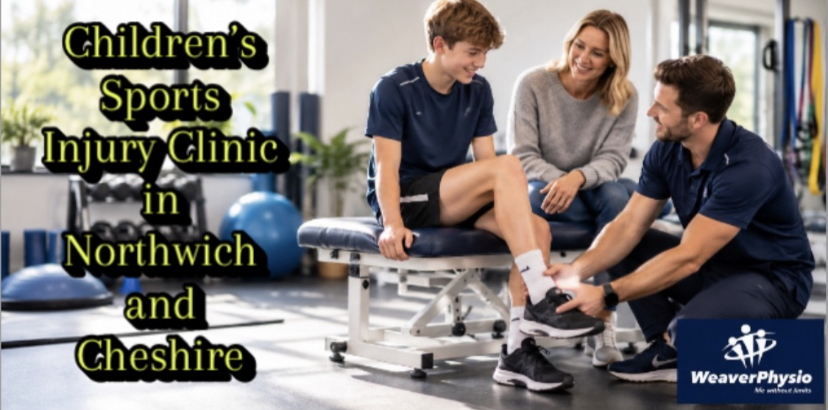
When an injury affects your child’s sport, play or everyday activities, it can be difficult to know what to do next. At Weaver Physiotherapy & Sports Injury Clinic, we offer assessment and rehabilitation for children and young people with sports-related and musculoskeletal problems. Based in Northwich, our clinic welcomes families from across Cheshire, including Tarporley, Knutsford, Winsford, Middlewich, Hartford, Weaverham, Sandbach and Frodsham. You can contact us directly to discuss your child’s symptoms and arrange an appointment; a GP referral is not required to book privately. A physiotherapy assessment considers the injury, your child’s movement and the activities they want to return to. Treatment and rehabilitation are then discussed in light of their needs and assessment findings. What happens at a child’s sports injury assessment? The appointment begins with a discussion about when the problem started, what activities affect it and how it is changing your child’s movement. We may ask about their usual sport, training routine, recent changes in activity and relevant medical history. The practitioner will then assess the affected area and relevant movement and function. This helps explore possible causes and identify appropriate next steps. Depending on your child’s presentation, the plan may include advice, a tailored exercise programme and hands-on treatment where appropriate. Treatment is individual . The approach will depend on the assessment findings, your child’s symptoms and how they respond to activity. If rehabilitation is recommended, exercises can be progressed to support comfortable movement and a gradual return to sport. Sports injuries and pain we can assess Children and teenagers may develop pain or injury after a sudden movement, a knock or a change in training. Assessment may be appropriate for concerns involving the: Back, hip or knee Ankle or foot Shoulder, elbow, hand or wrist Sports-related problems can include sprains, strains, tendon pain and injuries associated with repeated loading. Your child’s symptoms and activity will guide the assessment, rather than focusing only on the painful area. If you have noticed a change in your child’s posture or are concerned about a possible spinal curve, speak to your GP. The NHS advises contacting a GP if you think your child may have scoliosis. Read NHS guidance on scoliosis ⁠. Booking an appointment Please contact Weaver Physio to discuss your child’s symptoms and arrange a suitable appointment. Same-day appointments depend on availability, so please book ahead rather than relying on a walk-in consultation. When you get in touch, it can help to explain: When the symptoms began Which movements or activities make them better or worse Whether the problem affects walking, sleep, school, training or sport Any relevant medical history or recent changes in activity It can also help to let your child describe how the problem feels in their own words. Please bring comfortable clothing that allows movement to be assessed. Weaver Physiotherapy & Sports Injury Clinic 110 Middlewich Road, Northwich, Cheshire, CW9 7DP Call 01606 227484⁠ or visit weaverphysio.com ⁠. Free onsite parking is available. When to seek urgent medical help A physiotherapy appointment is for non-emergency musculoskeletal concerns. If your child has a serious injury, or you are unsure whether they need urgent care, use NHS guidance or contact NHS 111. The NHS advises taking a child to A&E or an urgent treatment centre if they have an arm or leg injury and cannot use the limb. Read the NHS guidance on children’s accidents . For information about checking an individual physiotherapist’s registration, visit the HCPC Register ⁠. Frequently asked questions Do we need a GP referral? No. You can contact the clinic directly to ask about booking a private appointment for your child. Do you accept walk-ins? Please book an appointment in advance. Same-day consultations may be available, depending on the clinic schedule. What should my child wear? Comfortable clothing that allows them to move freely is helpful for the assessment. Do you provide scans? Scans are not included in every clinic appointment. If further investigation appears appropriate, this can be discussed with you and your child. How much does an appointment cost? Please contact the clinic for current fees and to discuss the appointment that may be suitable for your child. Discuss an appointment for your child If pain or an injury is affecting your child’s movement, sport or usual routine, contact Weaver Physiotherapy & Sports Injury Clinic to discuss an assessment in Northwich. We’ll talk through your concerns and the possible next steps for your child.
October 22, 2026
A Practical Guide for Runners
October 22, 2026
Recovery and Injury Prevention
October 14, 2026
A Practical Guide
By M NORMAN • October 8, 2026
A Practical Guide for Endurance Runners
October 7, 2026
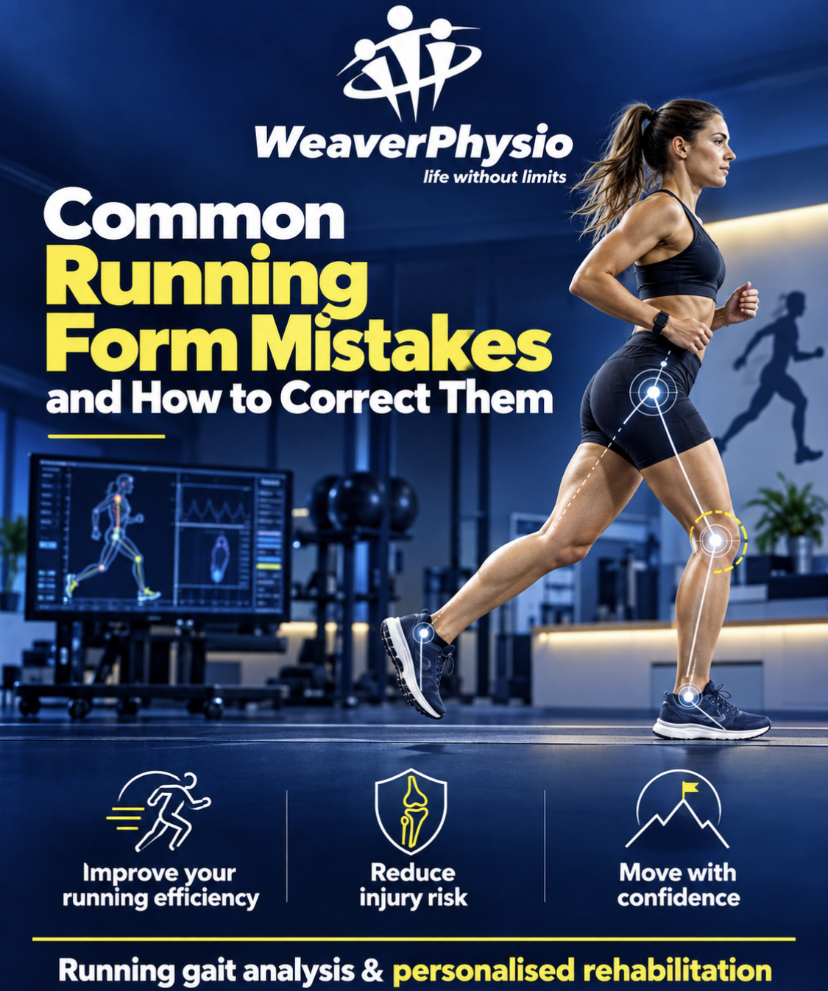
Have you ever been told that your running style is “wrong” and immediately wondered whether you need to change it? Advice online can make normal differences in movement look like faults. While certain running habits may be worth exploring—particularly when pain keeps returning—there is no single perfect stride, cadence or foot strike for every runner. At Weaver Physiotherapy & Sports Injury Clinic, we take an individual approach to running technique. Your training history, symptoms, strength, mobility, goals and the way you respond to load all matter. For runners in Northwich, Middlewich, Winsford, Knutsford, Sandbach, Frodsham and Tarporley, our Runner’s MOT and running gait analysis⁠ provides clear, personalised feedback rather than generic rules. What are common running form mistakes? A “running form mistake” is often better described as a movement habit to investigate. A pattern may look unusual without being harmful, and a video alone cannot confirm that it is the cause of pain. Common concerns include: Overstriding – the foot appearing to land well ahead of the body. Upper-body tension – raised shoulders, clenched hands, a tight jaw or stiff arm swing. Forcing foot strike – deliberately trying to run on the forefoot or heel when it feels awkward. Slumped posture – losing trunk control as fatigue develops. Abrupt changes in technique – trying to alter cadence, posture and foot strike at the same time. These patterns can change with pace, hills, footwear, fatigue, confidence and training load. Research has found limited evidence that individual biomechanics alone predict running injury, which is why form should be considered alongside the wider picture rather than treated as a diagnosis. Is there one correct way to run? No. Effective running does not look identical from person to person. Your anatomy, strength, experience, speed, terrain and fatigue level all influence your stride. A single photograph or short clip captures only one moment. It cannot explain how you feel during a run, what your training has involved that week, or whether a movement pattern is actually contributing to symptoms. If you are comfortable, progressing well and free from persistent pain, you may not need to change your technique simply because it differs from someone else’s. The aim is not to chase a “perfect” running style. It is to understand your own movement and make sensible adjustments only when they are relevant to your goals or symptoms. How to assess your running form safely Start with one question. Perhaps your foot feels as though it reaches too far forwards, your shoulders tighten on longer runs, or you notice discomfort appearing as you fatigue. During an easy run at your usual pace, consider: Does your breathing feel relaxed? Are your shoulders, hands and jaw unnecessarily tense? Does your stride feel comfortable and natural? Does your movement alter later in the run? Is there recurring pain during, after or the following day? If you use video, record a brief clip from a safe, consistent position beside the route or on a treadmill. Never hold or watch a phone while running. Footage can be useful for observation, but it should prompt questions—not provide a self-diagnosis. How to change running technique without overdoing it Avoid making dramatic changes based on a social-media tip or a one-size-fits-all rule. A sudden change in cadence, posture or foot strike may feel unnatural and can make it difficult to work out what is helping. Instead: Choose one area to explore. Use one simple cue during an easy run. Keep the adjustment gentle and brief. Notice how it feels during the run and over the next 24–48 hours. Do not introduce several technique changes at once. For example, if you feel tense through the upper body, a helpful cue may be “soft shoulders and easy arms” rather than forcing a rigid posture. If you are concerned about stride length, focus on a light, comfortable rhythm rather than trying to land in a prescribed position. Training progression matters too. Increasing distance, pace, hills and frequency too quickly can overload tissues, regardless of how your running looks. NHS advice recommends building running gradually and listening to pain rather than pushing through it. Read the NHS guide to common running injuries ⁠. When should you seek individual running advice? Consider a running assessment if pain: Keeps returning or becomes more severe Changes the way you run Persists after reducing or adapting training Is associated with swelling, weakness, limping or a loss of confidence Leaves you unsure which changes, if any, are appropriate Sudden severe pain, inability to bear weight, major swelling, numbness, deformity or a suspected serious injury should be assessed urgently. NHS guidance on sprains and strains explains when to seek urgent help. What can running gait analysis help with? A running gait analysis does not promise to predict injury or reveal one universal correction. It can, however, provide a clearer view of movement patterns in the context of your symptoms, training and goals. At Weaver Physio, our Runner’s MOT (/runners-mot)⁠ combines slow-motion video gait analysis with strength, mobility and movement assessment. We look at factors such as: Running rhythm and lower-limb control Trunk, hip, knee and foot movement Strength, balance and mobility Previous injuries and current symptoms Training volume, recovery and running goals Your findings are then used to create practical, personalised recommendations. This may include a gradual gait cue, running-specific strength work, mobility exercises, load-management advice or a structured return-to-running plan. Our Chartered Physiotherapists and Sports Rehabilitators bring more than 70 years of combined clinical experience to help runners move with greater understanding and confidence. Build a stronger, more confident running stride Running form is not a test you have to pass. A movement pattern may be worth exploring, but it does not automatically mean that something is wrong. Pay attention to comfort, recurring symptoms and changes that develop with fatigue. Make adjustments gradually, progress training sensibly and seek individual support if pain continues. For runners across Northwich and Cheshire, Weaver Physio’s running gait analysis service (/runners-mot)⁠ offers professional, tailored guidance to help you run stronger and with more confidence. Frequently Asked Questions Is there one correct running form for everyone? No. There is no single ideal foot strike, cadence or posture that applies to every runner. Comfortable, efficient running can look different depending on the individual, their pace, experience and physical characteristics. Can changing my running form cause pain? It can. Sudden or uncomfortable changes may increase stress in unfamiliar areas. Make one gradual change at a time and reduce or stop if pain worsens. How can I tell if I overstride? Overstriding may appear as the foot landing well ahead of your body, but this does not automatically mean it is causing a problem. A short video can provide useful context, while a gait assessment can help interpret the pattern alongside your symptoms and training. When should I book a running gait analysis? Book an assessment if pain is recurring, your running style has changed, you are returning from injury, or you would like clearer guidance about your stride and training. Weaver Physio supports runners from Northwich, Middlewich, Winsford, Knutsford, Sandbach, Frodsham, Tarporley and across Cheshire.
September 23, 2026
Expert Joint Care
September 21, 2026
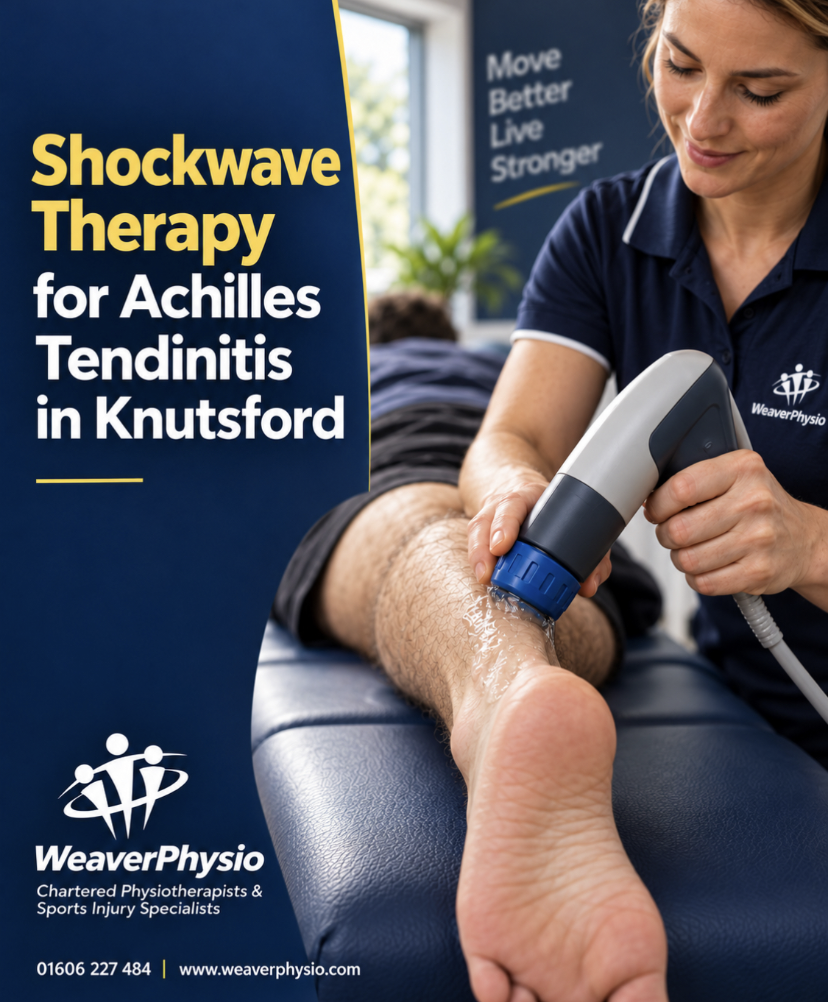
Persistent pain at the back of the heel can make simple things—walking the dog, climbing stairs, training for the Knutsford 10K or enjoying a run around Tatton Park—feel far more difficult than they should. At Weaver Physiotherapy & Sports Injury Clinic, we provide shockwave therapy ⁠ as part of a structured rehabilitation programme for people with persistent Achilles tendon pain. Our Northwich clinic is easily accessible from Knutsford and supports active adults, runners and sportspeople across Cheshire. The goal is not simply to settle symptoms for a few days. It is to understand why the tendon is painful, improve its capacity for load, and help you return to the activities that matter to you with greater confidence. Achilles Tendinitis or Achilles Tendinopathy? “Achilles tendonitis” is the term most people use when describing pain, stiffness or swelling around the tendon at the back of the ankle. However, when symptoms have persisted for several weeks or months, the more accurate clinical term is often Achilles tendinopathy. Tendinopathy is a complex condition associated with tendon pain, reduced function and lower tolerance to exercise or repeated loading. The tendon may become more sensitive and less able to cope with the demands being placed upon it. It is not always a straightforward inflammatory problem, which is why complete rest, stretching or massage alone may not create a lasting solution. A detailed review of tendinopathy research describes the changes that can occur within painful tendons and the importance of an individualised management approach. Common symptoms include: Pain or stiffness at the back of the heel, especially first thing in the morning Discomfort when walking uphill, climbing stairs or rising onto tiptoes Pain during or after running, football, tennis, gym training or long walks Thickening or tenderness in the tendon Symptoms that improve as you warm up, then return later At Weaver Physio, we assess whether your symptoms are likely to be related to mid-portion or insertional Achilles tendinopathy, and screen for other possible causes of heel and calf pain. If there is concern about a rupture, significant tear or another condition requiring medical investigation, we will advise on the appropriate next step. What Is Shockwave Therapy? Extracorporeal Shockwave Therapy—often shortened to ESWT or radial shockwave therapy—uses controlled acoustic pressure waves delivered through a handheld applicator. It is not an electric shock and does not involve injections or surgery. During treatment, gel is applied to the skin and the handpiece is positioned over the relevant area of the Achilles tendon. The sensation is commonly described as firm tapping or pulsing. Your clinician can adjust the treatment intensity to keep it manageable. Shockwave therapy may be considered for longer-standing tendon pain, particularly where a well-planned rehabilitation programme has not yet delivered the progress you need. It should always be used following a thorough assessment and alongside progressive exercise—not as a standalone “quick fix”. How Shockwave Therapy May Help Achilles Pain Shockwave therapy is thought to influence pain sensitivity and stimulate biological responses within the tendon and surrounding tissues. The practical aim is to create a window in which you can move more comfortably and build strength more effectively. For Achilles tendinopathy, a comprehensive treatment plan may help you to: Reduce pain that is limiting walking, work or sport Improve confidence with daily activity and exercise Progress calf-strength and tendon-loading exercises more successfully Address training errors, footwear issues and movement factors contributing to overload Build resilience for a return to running, sport or long-distance walking Outcomes vary between individuals. Some people notice a change in symptoms early in treatment, while tendon adaptation and improvements in load tolerance typically take longer. We will always discuss realistic expectations and measure your progress against your own goals. Your Shockwave Therapy Assessment Near Knutsford Your journey starts with a detailed physiotherapy assessment. We look beyond the painful spot to understand the full picture, including: Your symptom history and training or activity levels Previous injuries and treatment Calf strength, ankle mobility and balance Achilles tendon tenderness and loading tolerance Footwear, running surface and recent changes in training volume Hip, knee and foot control where relevant This allows us to confirm whether shockwave therapy is an appropriate option and develop a recovery plan tailored to you. Weaver Physio’s team also provides specialist physiotherapy and sports injury rehabilitation ⁠, so your treatment can be integrated with hands-on care, exercise rehabilitation and return-to-sport planning where needed. What Does a Typical Course Involve? A course of shockwave therapy commonly involves three to five sessions, often spaced about one week apart. The exact number and timing will depend on your presentation, response to treatment and rehabilitation goals. Each appointment is combined with guidance on tendon loading. This may include: Isometric calf exercises for pain management Progressive heel raises and heavy slow resistance work Soleus and gastrocnemius strengthening Balance, control and single-leg stability work A gradual return to running, hills, speed work or plyometric exercise Rather than avoiding all activity, we help you find an appropriate level of movement that keeps the tendon challenged without repeatedly exceeding its current capacity. Is Shockwave Therapy Right for You? Shockwave therapy may be suitable if you have persistent Achilles symptoms that have not settled with sensible activity modification and a targeted rehabilitation programme. It is particularly relevant for people who want a non-invasive option before considering more invasive interventions. However, it is not suitable for everyone. Your physiotherapist will discuss relevant precautions and assess factors such as pregnancy, blood-clotting issues, certain medications, recent steroid injection near the treatment area, suspected rupture or other medical considerations. It is also important to seek urgent medical advice if you experience a sudden pop in the back of the ankle, immediate weakness when pushing off, marked bruising or an inability to rise onto your toes. These can be warning signs of an Achilles rupture. Why Choose Weaver Physio? Weaver Physiotherapy & Sports Injury Clinic combines clinical assessment with a practical understanding of sport, training and everyday activity. We are based in Northwich and regularly support patients travelling from Knutsford, Alderley Edge, Holmes Chapel, Middlewich and across Cheshire. Our approach is built around three principles: Accurate assessment We identify the likely driver of your Achilles pain rather than treating every heel problem the same way. Evidence-informed rehabilitation Shockwave therapy is used as one part of a clear, progressive plan designed to restore strength and confidence. A return to the life you enjoy Whether your goal is pain-free dog walks, a hiking holiday, club running or competitive sport, your programme is shaped around it. Book an Achilles Tendon Assessment Persistent Achilles pain does not have to dictate how active you can be. If you are looking for shockwave therapy for Achilles tendinitis in Knutsford, Weaver Physio can help you understand your options and build a tailored recovery plan. Contact Weaver Physiotherapy & Sports Injury Clinic to arrange an assessment: Book or contact Weaver Physio 01606 227 484 07795 908 027 110 Middlewich Road, Northwich, CW9 7DP Frequently Asked Questions Is shockwave therapy painful? Most people describe shockwave therapy as uncomfortable rather than painful. The feeling is similar to firm tapping against the skin, and the intensity can be adjusted throughout treatment. Mild soreness, redness or tenderness can occur afterwards and usually settles within a few days. How many sessions will I need? Many patients have a course of three to five sessions, usually one week apart. Your clinician will recommend an appropriate plan based on your symptoms, tendon presentation and response to treatment. Can I exercise after shockwave therapy? Light daily activity is usually encouraged, but your clinician may advise avoiding high-impact exercise—such as running, jumping or hard hill work—for a short period after treatment. You will be given clear guidance on what to continue, reduce and progress. Will shockwave therapy cure my Achilles pain? No treatment can guarantee a cure. Shockwave therapy may help reduce pain and support recovery in suitable cases, but lasting improvement usually depends on combining treatment with a progressive loading programme, sensible activity management and a gradual return to sport.
September 16, 2026
A Complete Guide to Recovery and Better Running
Show More