
Runner’s Knee Treatment in Northwich
A Complete Guide to Recovery and Better Running
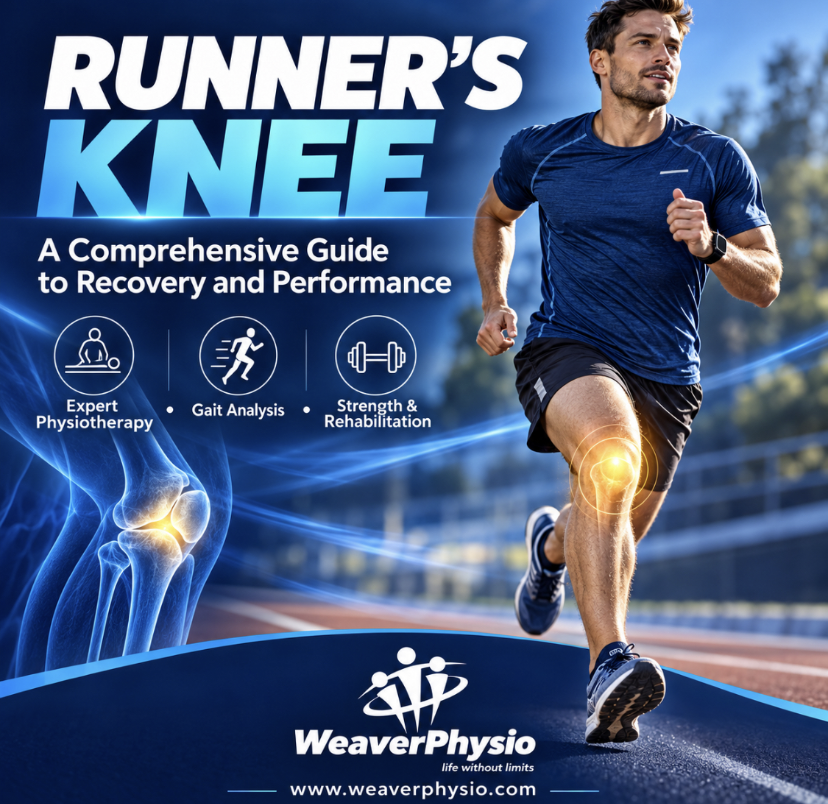
Runner’s knee can make every run feel uncertain. A familiar route around Northwich, a gentle downhill section or even a flight of stairs can suddenly bring on an ache around the kneecap—leaving you wondering whether you should stop running altogether.
The encouraging news is that most runner’s knee is manageable with the right diagnosis, intelligent load management and progressive rehabilitation. At Weaver Physiotherapy & Sports Injury Clinic, our Chartered Physiotherapists help runners identify why their knee has become sensitive, rebuild strength and confidence, and return to running with a clearer plan.
What is runner’s knee?
“Runner’s knee” is a commonly used term for patellofemoral pain: pain felt around or behind the kneecap where it meets the thigh bone. It is not limited to runners. Walkers, hikers, gym-goers and people who spend long periods sitting can experience the same symptoms.
Typical signs include:
A dull ache around, behind or beneath the kneecap
Pain during or after running, particularly on hills or downhills
Discomfort when descending stairs, squatting, lunging or jumping
Stiffness after sitting with the knee bent for a long period—often called “theatre sign”
Symptoms that increase after a sudden change in mileage, pace, terrain or training frequency
Runner’s knee does not automatically mean that your knee is “worn out” or permanently damaged. Patellofemoral pain is often linked to how much stress the knee is currently being asked to tolerate, alongside factors such as strength, movement control, recovery, training history and running technique. NHS guidance on patellofemoral pain explains that symptoms are commonly felt around the front of the knee and are often aggravated by stairs, squats and running.
Why runner’s knee develops
The most useful way to understand runner’s knee is to think about load versus capacity.
Your training load includes every demand placed on your body: running distance, pace sessions, hills, gym work, football, walking, poor sleep and even a busy week on your feet. Capacity is your current ability to absorb that demand through the strength and resilience of your muscles, tendons, joints and nervous system.
Problems often develop when load rises more quickly than capacity. Common triggers include:
Increasing weekly mileage too quickly
Adding hill sessions, faster intervals or trail running
Returning to running after illness, injury or time away
Beginning a new gym programme alongside increased running
Replacing recovery runs with hard sessions
Reduced hip, quadriceps or calf strength
Limited ankle mobility, hip control or single-leg stability
A running style that places repeated stress through the knee
This is why two runners can complete the same route with very different outcomes. The route is not necessarily the problem; it is the relationship between the route, the runner’s current capacity and their recovery.
Is complete rest the answer?
Not usually. For many people, stopping every activity for weeks can lead to deconditioning, reduced confidence and an even lower tolerance when they try to return.
A better approach is often relative rest: temporarily adjusting the running dose while building the physical capacity needed to tolerate it again. That might mean reducing distance, avoiding hills, slowing the pace, using run-walk intervals or swapping one run for lower-impact cross-training.
Pain should not be ignored, but it does not always mean that harm is occurring. At Weaver Physio, we help runners use symptoms, function and next-day response to guide decisions rather than relying on a one-size-fits-all rule.
A simple guide is:
Green: mild discomfort that remains manageable, does not worsen significantly during the run and settles quickly afterwards.
Amber: pain that increases as you run, changes your stride or lingers into the next day—adjust pace, distance, terrain or frequency.
Red: sharp pain, swelling, giving way, locking, significant loss of movement or pain that continues to escalate—stop and arrange an assessment.
Every runner is different, so this is not a substitute for an individual assessment. Persistent or worsening knee pain should be properly examined.
The role of strength in runner’s knee recovery
Strong legs do not simply make you faster—they improve your ability to absorb force and control movement with every stride.
A high-quality rehabilitation programme for runner’s knee may develop:
Quadriceps strength to improve knee load tolerance
Gluteal strength for pelvic and hip control
Calf and foot strength to support force absorption and propulsion
Single-leg control for running, hills and changes of direction
Balance, stability and coordination for efficient movement
Plyometric capacity when appropriate for return to faster running
Exercises may include variations of squats, split squats, step-downs, bridges, calf raises and controlled single-leg work. The correct exercise is the one that matches your current symptoms, strength and running goals—not necessarily the hardest one on social media.
Current best-practice guidance supports knee-targeted exercise therapy, tailored to the individual, as a key part of managing patellofemoral pain. See the 2024 British Journal of Sports Medicine best-practice guide and the JOSPT clinical practice guideline
Why a Runner’s MOT can make the difference
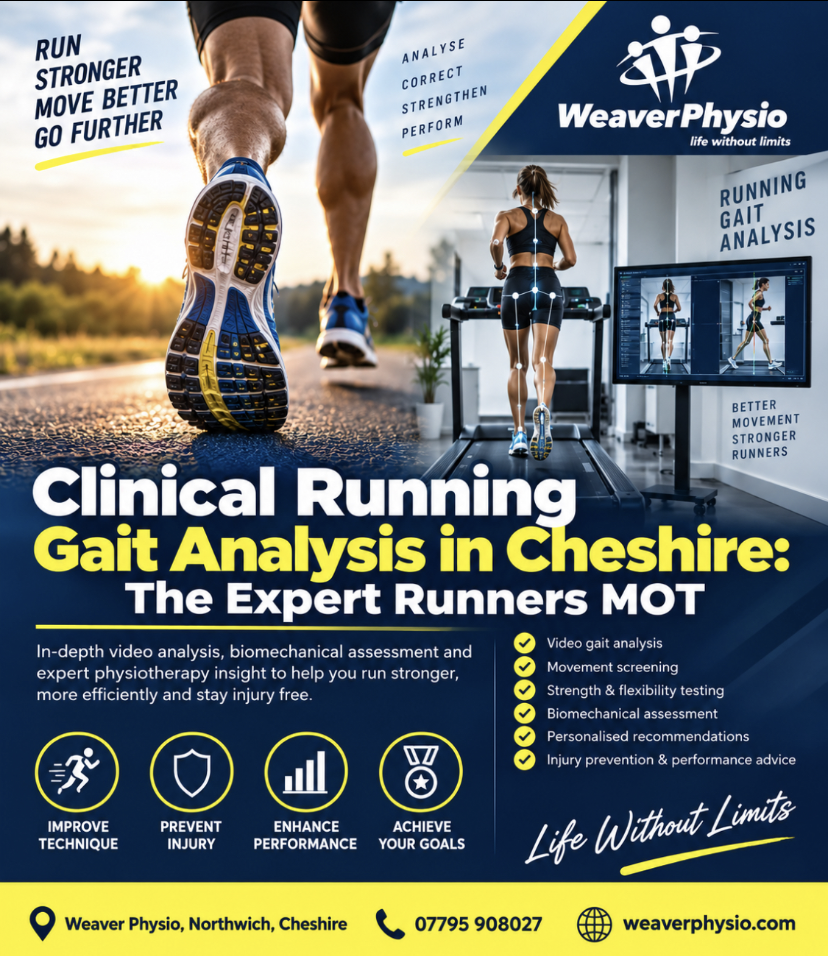
Generic advice can be useful, but it cannot show how you move. A Runner’s MOT at Weaver Physio looks beyond the painful area to assess the whole runner.
Your assessment may include:
Detailed injury and training-history review
Knee, hip, ankle and foot assessment
Strength, flexibility and mobility testing
Balance and single-leg control assessment
Slow-motion video running gait analysis
Review of cadence, stride, pelvic control and running mechanics
Personalised rehabilitation and return-to-running plan
We are not looking for one “perfect” running style. We are looking for the movement patterns, training errors and strength gaps that may be increasing stress on your knee. Small, individual changes can make a meaningful difference when repeated across thousands of steps.
Our Weaver Physio 5-Step Running Recovery System™ is designed to help you:
Assess the true source of symptoms and contributing factors
Correct movement restrictions and training errors
Strengthen balance, stability, coordination and running capacity
Progress safely through a structured return-to-running plan
Perform with greater confidence, resilience and efficiency
Can footwear or orthotics help?
Sometimes—but they are not automatically the answer.
Running shoes, insoles and orthotics may be helpful when they suit the runner’s individual needs, comfort and movement pattern. However, buying a new pair of shoes rarely solves knee pain on its own. The most important questions are usually:
Has your training changed recently?
Is your body strong enough for your current running demands?
Are your shoes comfortable and suitable for the running you are doing?
Does your technique or cadence need adjusting?
Are you recovering well between sessions?
A clinical gait analysis helps us make recommendations based on evidence from your assessment, rather than guesswork.
How long does runner’s knee take to settle?
There is no fixed timeline. Some runners improve within a few weeks, while longer-standing symptoms can take several months to settle fully. Recovery depends on the duration and severity of symptoms, your training demands, consistency with rehabilitation and how effectively load is managed.
The key is to aim for steady progress rather than a rushed return. A well-structured plan should allow you to maintain as much fitness as possible while rebuilding the strength and confidence needed for running.
When should you seek an assessment?
Book a physiotherapy assessment if your knee pain:
Persists beyond a couple of weeks despite sensible training adjustments
Is stopping you from running or affecting daily activities
Causes swelling, locking, giving way or repeated clicking with pain
Began after a fall, twist or direct impact
Is becoming more severe or spreading
Is associated with night pain, fever, unexplained weight loss, numbness or a hot, red swollen joint
These symptoms may need prompt medical assessment to rule out problems other than runner’s knee.
Runner’s knee treatment in Northwich
At Weaver Physiotherapy & Sports Injury Clinic, we provide evidence-based runner’s knee treatment in Northwich for runners from across Cheshire, including Winsford, Hartford, Weaverham, Middlewich, Knutsford, Tarporley and Frodsham.
Our Chartered Physiotherapists combine hands-on physiotherapy where appropriate with progressive rehabilitation, strength and conditioning, running gait analysis and tailored load management. We focus on identifying the root cause, not simply telling you to stop doing what you love.
Whether your goal is to jog pain-free, complete your first 10K, prepare for a marathon or return to competitive running, we will create a plan around you.
Book your Physiotherapy Assessment or Runner’s MOT with Weaver Physio today.
Visit Weaver Physio or call 01606 227484 .
Frequently asked questions
Can I run with mild runner’s knee pain?
Often, yes—but the right level depends on your symptoms, running history and next-day response. Mild, manageable discomfort may allow modified running, while increasing pain, altered running form or symptoms that linger should prompt a reduction in load and professional advice.
Is runner’s knee the same as arthritis?
No. Runner’s knee usually refers to patellofemoral pain around the kneecap. While knee pain has many possible causes, runner’s knee does not automatically mean arthritis or irreversible joint damage.
Do I need a scan for runner’s knee?
Not always. Patellofemoral pain is commonly diagnosed through a detailed history and physical examination. Scans may be considered if there has been trauma, significant swelling, locking, instability, suspected structural injury or symptoms that do not follow the expected pattern.
Will sports massage cure runner’s knee?
Sports massage can be useful for managing muscle tightness and improving comfort as part of a broader plan. It is not a stand-alone cure. Lasting recovery usually requires appropriate load management, strength development and a progressive return to running.
Do I need a GP referral to see a physio?
No. You can self-refer directly to Weaver Physiotherapy & Sports Injury Clinic for a running injury or knee pain assessment in Northwich.