
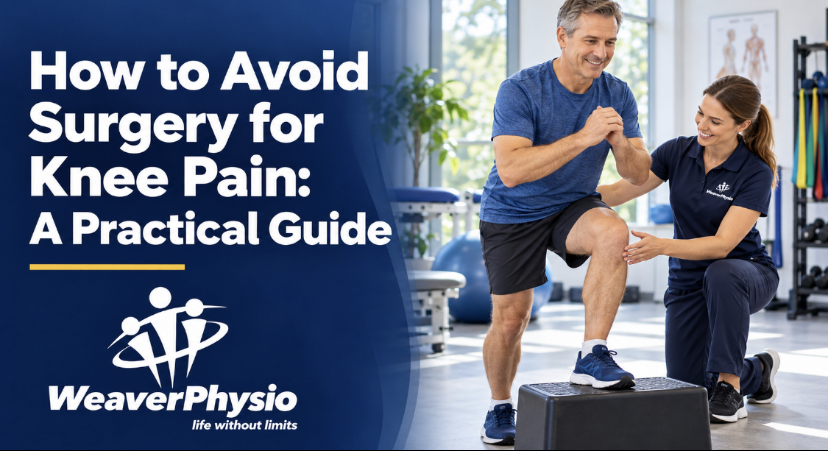
How to Avoid Surgery for Knee Pain
A Practical Guide
Worrying about knee surgery is understandable. You may be concerned about the operation itself, the recovery period or whether exercise could aggravate your symptoms. If you’re looking for ways to avoid surgery for knee pain, the first step is to understand what may be causing it and what options are appropriate for you.
There isn’t one treatment that works for every knee problem, and no conservative approach can guarantee that surgery will never be needed. But a clear diagnosis, a suitable rehabilitation plan and regular reviews can help many people manage symptoms and improve their everyday function. The aim is to make informed decisions about your knee, rather than relying on guesswork or stopping activity altogether.
This guide explains what non-surgical care may involve, how to pace exercise, what progress can look like and when to seek a clinical review. At Weaver Physiotherapy & Sports Injury Clinic in Northwich, an individual assessment can help identify factors contributing to your symptoms and guide your next steps.
Start by finding out what may be causing your knee pain
“Knee pain” describes a symptom, not a single diagnosis. Pain can be associated with osteoarthritis, a tendon or ligament problem, a meniscus injury, a recent sprain, changes in activity or another condition. The location of the pain can offer clues, but it cannot confirm the cause by itself.
A clinician may ask when your symptoms began, whether there was an injury, which activities are difficult and whether you’ve noticed swelling, stiffness, weakness or locking. They may assess your knee movement, strength, balance and walking, as well as how your symptoms affect work, sport and daily tasks. Imaging is considered when it is likely to help clarify the situation; a scan is not automatically needed for every case.
It’s useful to distinguish between easing symptoms and addressing the factors that may be contributing to them. Pain relief may make movement more comfortable, while rehabilitation can work on strength, mobility and the knee’s ability to tolerate everyday demands. These approaches may complement each other, but they do not all treat the same issue.
Is surgery always avoidable?
No. Some knee problems may need specialist assessment or surgical treatment. The right decision depends on the cause of the pain, the effect it has on your quality of life, examination findings and how suitable non-surgical care has worked for you.
For osteoarthritis, NICE recommends tailored therapeutic exercise and, where appropriate, weight-management support as core treatments. Its guidance says referral for joint replacement can be considered when symptoms substantially affect quality of life and non-surgical management is ineffective or unsuitable. These recommendations concern osteoarthritis; other knee conditions may need a different approach.
So the goal of conservative care is not to promise that surgery can be prevented. It is to explore suitable options, monitor how your knee responds and make decisions with a clinician based on your needs and progress.
Build a practical, personalised non-surgical plan
A helpful plan should fit your symptoms, priorities and daily routine. Depending on the diagnosis, it may include the following.
1. Choose goals that matter to you
Think about the activities you want to manage more comfortably. They might include walking around the shops, standing at work, climbing stairs, gardening, getting up from a chair or returning to sport.
These specific goals give you a more useful way to review progress than relying on a single pain score. You can ask: Can I walk further? Are stairs easier? Do I recover more quickly after activity?
2. Agree a suitable exercise programme
Strengthening and general aerobic activity may be part of a rehabilitation programme. The exercises should match your assessment and start at a manageable level. A physiotherapist can help select and adjust them as your strength, movement and confidence change.
It is common for exercise to feel uncomfortable when you first begin, particularly if your knee has been painful or stiff for some time. NICE advises that pain may increase when people with osteoarthritis start therapeutic exercise, and that regular, consistent exercise can help improve pain, function and quality of life over time. That does not mean you should push through every symptom: if pain is escalating or your function is getting worse, seek advice about adjusting the plan.
3. Adjust activity without stopping everything
If a particular activity repeatedly flares your knee, temporarily changing how long, how often or how intensely you do it may help. For example, you might shorten a walk, take breaks from prolonged standing or choose a lower-impact activity while you build capacity.
Complete rest is not always the best long-term answer. The right balance depends on what is causing your symptoms, so discuss persistent or worsening pain with a clinician.
4. Consider other supports with professional advice
Weight management may be relevant for some people with osteoarthritis. NICE advises that weight loss can improve quality of life and physical function and reduce pain for people living with overweight or obesity. Support should be appropriate to the individual and focused on realistic, sustainable changes.
Medication, injections, footwear changes or a walking aid may also be discussed in some cases. These options have different benefits and limitations, and they are not suitable for everyone. Ask a GP, pharmacist or relevant clinician about medication or injection options and how they relate to your health and diagnosis.
5. Review the plan and make changes where needed
A rehabilitation plan should be reviewed if your symptoms, goals or circumstances change. Keep a simple record of the activities you can manage, what tends to aggravate symptoms and how long it takes your knee to settle afterwards. This gives you and your clinician useful information when deciding whether to progress, modify or reassess the plan.
How to pace exercise and judge progress
A temporary increase in discomfort does not automatically mean you have damaged your knee. Equally, worsening pain should not be dismissed. Try to judge your response over time and in relation to function: are you managing your usual tasks more easily, or is your walking, sleep or daily activity becoming more limited?
A gradual programme may begin with manageable movements and progress as your tolerance improves. The amount and type of exercise will depend on your symptoms and diagnosis. If an exercise causes a persistent flare, significant swelling or difficulty with normal activities, pause that exercise and seek guidance before increasing the effort.
The NHS knee pain guidance includes basic self-care advice and explains when to seek urgent help. For longer-lasting or recurrent symptoms, a clinical assessment can help you decide whether your current approach is suitable.
When should you seek a review?
Arrange a clinical review if knee pain is worsening, returning frequently or making everyday activities harder. It is also reasonable to ask for help if you have tried adapting your activity but are making little progress, or if you remain unsure what is causing the problem.
Seek urgent advice through NHS 111 if your knee is very painful, badly swollen or has changed shape; if you cannot move it or put weight on it; or if it is hot and red and you also have a high temperature or feel unwell. These symptoms may need prompt assessment.
When you attend a review, explain what you have tried, what helped, what made symptoms worse and which activities remain difficult. That context can help guide the next decision.
What to expect from physiotherapy for knee pain
An assessment-led physiotherapy plan starts with your symptoms, health and activity history, movement and goals. A physiotherapist may look at knee mobility, strength, balance and how you perform relevant tasks. The findings help shape a programme that is specific to your needs rather than a standard set of exercises.
At Weaver Physiotherapy & Sports Injury Clinic, the team’s combined clinical experience exceeds 70 years. Your programme may be reviewed as you progress, with exercises or activity adjusted to reflect changes in symptoms, strength and function. Physiotherapy can help inform your care and support rehabilitation, but it cannot guarantee that surgery will be avoided.
You can learn more about physiotherapy and rehabilitation at Weaver Physio or explore our Northwich physiotherapy services . The clinic supports people from Northwich and surrounding Cheshire areas, including Middlewich, Winsford, Knutsford, Sandbach, Frodsham and Tarporley.
Take an informed next step
Exploring how to avoid surgery for knee pain does not mean you have to rule out every future option. It means finding out what may be contributing to your symptoms, considering suitable non-surgical care and reviewing your plan if your knee or your priorities change.
If knee pain is affecting your daily life, an assessment can help you discuss your symptoms, understand possible next steps and work towards activities that matter to you. Contact Weaver Physio in Northwich to arrange a physiotherapy assessment.
Frequently asked questions
Can exercise make knee pain worse?
It can aggravate symptoms if the activity or effort does not suit your current capacity, but discomfort does not automatically mean you have caused damage. Track how your knee feels during and after exercise and whether everyday function is changing. If symptoms keep worsening, swelling increases or routine activities become harder, seek advice about adjusting your programme.
Are injections a permanent alternative to knee replacement?
No. An injection may reduce symptoms for some people, but it is not a permanent solution or a guaranteed substitute for surgery. The possible benefits and risks depend on the cause of your pain, your health and the type of injection. Discuss what to expect with a clinician, including what options remain if the effect is limited or wears off.
How long should I try non-surgical treatment?
There is no single timeframe that applies to every knee condition. NICE’s quality standard for osteoarthritis says people should be supported with core non-surgical treatments for at least three months before referral for consideration of joint surgery. This applies to osteoarthritis and should not be treated as a rule for every knee injury or diagnosis. Your clinician can advise on a suitable plan and review points.
When should I get medical advice for knee pain?
Seek advice if your pain is worsening, keeps returning or limits sleep, work or usual activities. Get urgent advice if the knee is severely painful, badly swollen, misshapen, hot and red with fever, or you cannot move it or bear weight. The NHS knee pain page provides further guidance on symptoms and where to seek help.
Can physiotherapy help me avoid surgery?
Physiotherapy may help some people improve strength, movement and function, and may support non-surgical management where appropriate. Whether it is suitable depends on the cause and severity of the problem. An assessment can help you discuss options, but no physiotherapist can promise that surgery will never be needed.