
BPPV Treatment Northwich
Expert Physiotherapy for Vertigo, Dizziness & Balance Problems
Have you ever rolled over in bed, looked upwards or turned your head and suddenly felt as though the entire room was spinning?
This frightening sensation can appear without warning. Although an episode may last only seconds, it can leave you feeling nauseous, unsteady and reluctant to move your head in case the spinning returns.
One of the most common causes of this type of positional vertigo is Benign Paroxysmal Positional Vertigo (BPPV).
At Weaver Physiotherapy & Sports Injury Clinic in Northwich, our Chartered Physiotherapists provide specialist assessment and vestibular rehabilitation for dizziness, vertigo and balance disorders.
The encouraging news is that when BPPV is correctly identified, it can often respond very well to specific repositioning techniques.
If dizziness is affecting your confidence, mobility, work, sleep or everyday life, understanding why it is happening is an important first step towards getting your balance back.
What Is BPPV?
BPPV – Benign Paroxysmal Positional Vertigo – is an inner-ear balance disorder that causes short episodes of vertigo following certain changes in head position.
The name itself describes the condition:
Benign – it is generally not caused by a life-threatening disease.
Paroxysmal – symptoms tend to occur suddenly and in short bursts.
Positional – vertigo is triggered by particular head or body positions.
Vertigo – the sensation that you or your surroundings are moving or spinning when they are actually still.
Unlike the vague light-headedness people sometimes describe as “dizziness”, BPPV typically produces a distinctive sensation of movement or rotation.
Understanding this difference can be important when determining the most appropriate treatment.
What Causes BPPV?
Deep within the inner ear is an intricate system responsible for helping your brain understand movement, acceleration and the position of your head.
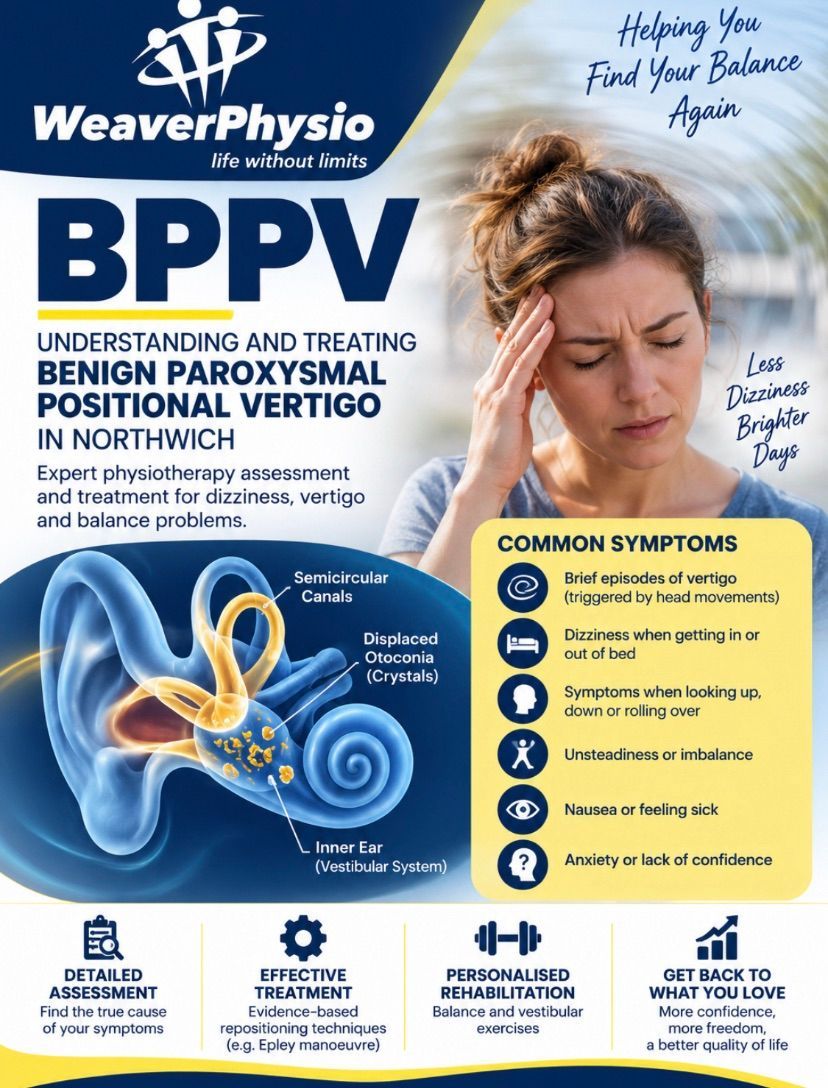
Part of this system contains tiny calcium carbonate particles called otoconia, often informally referred to as “ear crystals”.
Normally, these particles sit within structures called the otolith organs.
With BPPV, some of the particles become displaced and enter one of the semicircular canals.
These canals contain fluid and are designed to detect rotational movement of your head.
When displaced particles move through a semicircular canal, they can stimulate the balance sensors inappropriately.
Your inner ear may therefore signal to your brain that your head is moving even though the movement has already stopped.
The mismatch between information coming from your:
vestibular system
eyes
joints and muscles
can produce the sudden spinning sensation characteristic of BPPV
What Does BPPV Feel Like?
People experience vertigo differently, but BPPV classically causes brief episodes of spinning triggered by changes in head position.
Common BPPV symptoms can include:
sudden spinning or rotational vertigo
dizziness when rolling over in bed
symptoms when getting into or out of bed
vertigo when looking upwards
dizziness when bending forwards
symptoms when turning the head quickly
nausea
temporary unsteadiness
reduced confidence with walking or movement
anxiety about triggering another episode
Some people describe feeling perfectly well while sitting still, only for the room to suddenly spin when they turn their head.
This positional pattern is one of the features that can help distinguish BPPV from other causes of dizziness.
Why Is BPPV Often Worse in Bed?
A very common description is:
“I turned over in bed and suddenly the whole room started spinning.”
Rolling over, lying backwards or sitting up can change the orientation of the semicircular canals relative to gravity.
If displaced otoconia are present, these movements may cause them to shift within the canal.
That movement can stimulate the vestibular system and provoke vertigo.
This is why activities such as:
rolling over → lying down → sitting up → looking upwards → bending down
can become particularly troublesome.
Some people consequently start avoiding particular movements altogether.
Although understandable, prolonged movement avoidance can contribute to stiffness, reduced confidence and ongoing balance problems.
BPPV Assessment in Northwich
Not every episode of dizziness is caused by BPPV.
A thorough clinical assessment is therefore extremely important.
At Weaver Physio, your vestibular assessment begins with a detailed discussion about your symptoms, including:
when the dizziness began
how long each episode lasts
which movements trigger symptoms
whether you experience nausea
whether there are associated hearing symptoms
your medical history
medication
previous episodes
falls or balance difficulties
neck problems
neurological symptoms
This information helps determine whether your presentation is consistent with BPPV or whether further medical assessment may be appropriate.
How Is BPPV Diagnosed?
Where clinically appropriate, specific positional tests can be performed to investigate BPPV.
One of the best-known is the Dix–Hallpike test, which is commonly used when posterior canal BPPV is suspected.
The head and body are carefully moved through specific positions while the clinician observes your symptoms and eye movements.
BPPV can cause a characteristic involuntary eye movement known as nystagmus.
The pattern of nystagmus, combined with your symptoms and clinical history, can help identify:
whether BPPV is present
which ear may be affected
which semicircular canal is involved
which treatment manoeuvre may be most appropriate
This matters because BPPV is not a single identical condition in every patient.
Different canals can be affected, and treatment should be selected according to the clinical findings rather than simply performing the same manoeuvre on everyone.
Epley Manoeuvre for BPPV
For the common posterior-canal form of BPPV, one treatment frequently used is the Epley manoeuvre.
Rather than being an exercise designed to strengthen the neck or improve fitness, it is a canalith repositioning procedure.
The clinician carefully guides your head through a sequence of positions.
Gravity is used to encourage the displaced particles to travel through the semicircular canal and back towards an area of the inner ear where they are less likely to provoke vertigo.
Many people respond well to canalith repositioning, although the number of treatments required varies between individuals.
The correct manoeuvre depends on the findings from your assessment.
What Happens During BPPV Treatment?
Your appointment is designed to be controlled, systematic and tailored to you.
Treatment may involve:
1. Detailed assessment
We establish the characteristics of your dizziness and screen for features that may suggest another cause.
2. Positional testing
Where appropriate, specific tests help determine whether BPPV is responsible for your symptoms.
3. Identification of the affected canal
Your symptom response and eye movements help guide treatment selection.
4. Repositioning treatment
A suitable canalith repositioning manoeuvre can then be performed.
5. Reassessment
The response to treatment can be reviewed to determine whether further treatment is required.
6. Vestibular rehabilitation when appropriate
If imbalance, motion sensitivity or reduced confidence persists, additional rehabilitation may form part of your recovery.
Vestibular Rehabilitation Northwich
Not everyone with dizziness requires only an Epley manoeuvre.
Some people continue to experience:
unsteadiness
sensitivity to movement
reduced balance
visual sensitivity
fear of falling
reduced confidence
neck stiffness caused by avoiding movement
This is where vestibular rehabilitation physiotherapy can become particularly valuable.
Vestibular rehabilitation uses carefully selected exercises designed to help the brain interpret and adapt to information from the balance system.
Depending on your individual assessment, rehabilitation may include exercises addressing:
balance
gaze stability
head movement tolerance
coordination
walking
proprioception
functional movement
confidence with everyday activities
The objective isn’t simply to make you “better at balance exercises”.
It is to help you return confidently to normal life.
BPPV and Loss of Confidence
The physical spinning is only one aspect of living with recurrent vertigo.
Not knowing when another episode will happen can affect confidence considerably.
You may start wondering:
What happens if I become dizzy while driving?
What if I fall?
Should I avoid turning my head?
Can I exercise safely?
Why does this keep happening?
Some people begin moving very cautiously or stop participating in activities they previously enjoyed.
For this reason, effective BPPV management isn’t only about reducing vertigo.
It is also about restoring confidence in movement.
BPPV vs Other Causes of Dizziness
Dizziness has many potential causes, and this is precisely why accurate assessment matters.
Symptoms can arise from problems involving the vestibular system, cardiovascular system, neurological system, medication and other medical conditions.
Other vestibular conditions can also produce dizziness.
BPPV therefore shouldn’t automatically be assumed simply because somebody experiences vertigo.
Particular attention should be paid to symptoms such as new neurological changes, severe or unusual headache, fainting, significant new weakness, speech difficulties, sudden hearing changes or other concerning symptoms.
These may require urgent medical assessment rather than routine physiotherapy.
BPPV vs Ménière’s Disease
BPPV and Ménière’s disease both involve vertigo, but their typical presentations differ.
BPPV generally produces brief episodes associated with particular head positions.
Ménière’s disease can cause longer episodes and is commonly associated with auditory symptoms such as fluctuating hearing loss, tinnitus or a sensation of pressure/fullness within the ear.
A comprehensive history can therefore provide valuable clues about what may be causing your dizziness.
Can BPPV Return?
Yes. BPPV can recur.
Having successful treatment does not guarantee that somebody will never experience another episode.
However, recognising the symptoms early can make recurrence less frightening.
If familiar positional vertigo returns, reassessment can establish whether BPPV has recurred and which canal is affected.
It is worth remembering that a new episode of dizziness should not automatically be assumed to be BPPV simply because you have experienced it previously.
Why Choose Weaver Physio for BPPV Treatment in Northwich?
At Weaver Physiotherapy & Sports Injury Clinic, we understand how disruptive dizziness can be.
It can interfere with sleeping, walking, driving, exercising, working and even simple activities such as getting out of bed.
Our approach focuses on identifying the likely cause rather than simply giving you generic balance exercises.
With 70+ years of combined clinical experience, our team provides professional, evidence-informed physiotherapy and rehabilitation in Northwich, Cheshire.
Our approach includes:
Detailed assessment
We take time to understand the pattern and characteristics of your symptoms.
Targeted positional testing
Where appropriate, clinical testing helps establish whether BPPV may be responsible.
Individualised treatment
Treatment is selected according to your clinical findings rather than using a one-size-fits-all approach.
Vestibular rehabilitation
Where necessary, we can address persistent balance difficulties and movement sensitivity.
A focus on functional recovery
Our aim is to help you return confidently to the activities that matter to you.
BPPV Treatment Near Me in Northwich, Cheshire
If you’re searching Google for:
“BPPV treatment near me”
“vertigo treatment Northwich”
“vestibular physiotherapy Northwich”
“Epley manoeuvre Northwich”
“dizziness physiotherapy Cheshire”
“balance clinic Northwich”
Weaver Physio provides specialist physiotherapy assessment for people experiencing dizziness, vertigo and balance difficulties in Northwich and the surrounding Cheshire area.
We regularly welcome patients from Northwich and nearby communities including Hartford, Weaverham, Barnton, Winnington, Davenham, Rudheath, Middlewich, Winsford and Knutsford.
Regain Your Balance. Restore Your Confidence.
Living with vertigo can make everyday movements feel unpredictable.
But if your symptoms are caused by BPPV, there may be a clearly identifiable mechanical reason behind them — and an appropriate repositioning treatment may provide substantial improvement.
The first step is establishing what is actually causing your dizziness.
At Weaver Physio, our goal is to provide a thorough assessment, clear explanation and personalised treatment plan so you understand your symptoms and know what to do next.
Book a BPPV & Vestibular Assessment in Northwich
Weaver Physiotherapy & Sports Injury Clinic
Northwich, Cheshire
Tel: 01606 227484
Website: weaverphysio.com
Helping You Find Your Balance Again.
Frequently Asked Questions About BPPV
Can BPPV disappear without treatment?
BPPV can sometimes resolve spontaneously. However, the duration varies, and persistent vertigo can significantly affect confidence, mobility and quality of life. Assessment can determine whether BPPV is actually responsible for your symptoms and whether a repositioning manoeuvre is appropriate.
Is the Epley manoeuvre painful?
The Epley manoeuvre itself should not normally be painful, although certain positions may temporarily reproduce vertigo or nausea. People with significant neck or back problems, vascular conditions or other relevant medical issues may require modifications or alternative approaches following appropriate clinical screening.
How quickly can BPPV improve?
Some people notice substantial improvement following a successful repositioning manoeuvre, while others require repeat treatment or further vestibular rehabilitation. Recovery depends on factors including the canal involved, recurrence and whether additional balance problems are present.
Can physiotherapy help vertigo?
Physiotherapy can be particularly helpful for certain vestibular disorders, including BPPV. Treatment depends on the underlying cause and may include canalith repositioning procedures, vestibular rehabilitation, balance training and graded exposure to movement.
Is all dizziness caused by the inner ear?
No. Dizziness has many possible causes, which is why proper assessment is essential. If symptoms do not fit a typical BPPV presentation or there are concerning associated symptoms, further medical investigation may be recommended.
What movements commonly trigger BPPV?
Common triggers include rolling over in bed, lying backwards, getting out of bed, looking upwards and bending forwards. The exact trigger can vary depending on which ear and semicircular canal are involved.
Can BPPV come back after successful treatment?
Yes. BPPV can recur. If symptoms return, reassessment is advisable because the affected ear or canal may not necessarily be the same as during the previous episode.