
Vestibular Rehabilitation Northwich:
Specialist Physiotherapy for Dizziness, Vertigo & Balance Problems
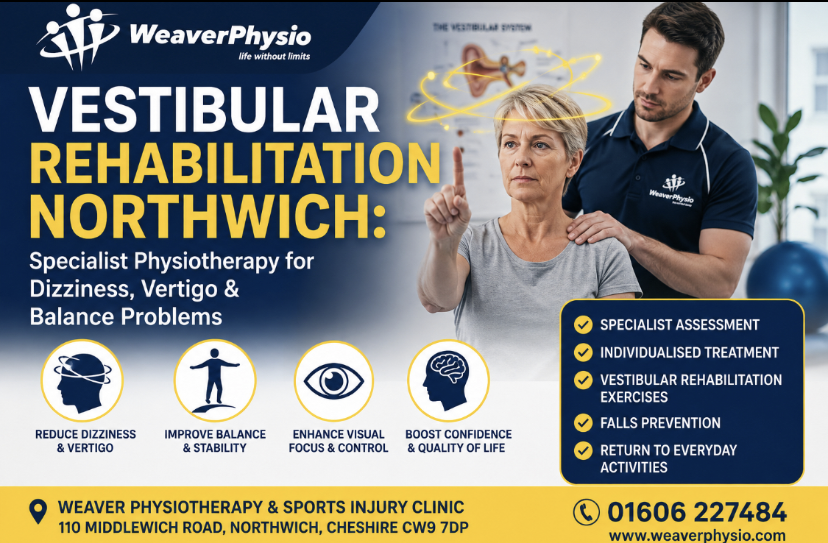
Dizziness, vertigo and poor balance can have a significant impact on everyday life. Simple activities such as getting out of bed, turning your head, walking through a busy shop or navigating uneven ground can suddenly feel difficult or unsettling. For some people, symptoms may be brief and position-dependent; for others, they can persist and affect confidence, concentration, mobility and independence.
At Weaver Physiotherapy & Sports Injury Clinic in Northwich, our vestibular rehabilitation service provides specialist physiotherapy assessment and individually tailored rehabilitation for people experiencing dizziness, vertigo, unsteadiness and balance-related problems.
Rather than simply trying to suppress symptoms, vestibular physiotherapy aims to identify what may be contributing to your problem and determine the most appropriate treatment or rehabilitation strategy.
Our goal is straightforward: to help you feel steadier, move more confidently and return safely to the activities that matter to you.
What Is Vestibular Rehabilitation?
Vestibular rehabilitation is a specialist area of physiotherapy used to assess and manage certain disorders affecting balance and spatial orientation.
Your ability to remain balanced depends on several systems working together, including:
The vestibular system within the inner ear
Your vision
Sensory information from your muscles and joints
Your brain and central nervous system
Muscle strength, coordination and postural control
The brain constantly processes information from these systems to determine where your body and head are positioned in space.
When the information becomes disrupted or inconsistent, you may experience symptoms including dizziness, vertigo, blurred or unstable vision, nausea, unsteadiness or difficulty walking.
A carefully prescribed vestibular rehabilitation programme can encourage the nervous system to adapt to altered signals and improve the way sensory information is processed.
Vestibular Physiotherapy in Northwich
At Weaver Physio, treatment begins with a detailed assessment rather than a generic collection of balance exercises.
Dizziness can have many potential causes, and not every person experiencing dizziness has a vestibular disorder. Understanding your symptoms, medical history and clinical presentation is therefore an important part of deciding whether vestibular physiotherapy is appropriate.
Your assessment may explore:
The nature and duration of your dizziness
Positions or movements that trigger symptoms
Balance and walking
Eye and head movement responses
Gaze stability
Functional mobility
Strength and postural control
Cervical spine movement where appropriate
Falls history and confidence with movement
Where your presentation suggests that further medical investigation is appropriate, we can advise you accordingly.
BPPV Treatment in Northwich
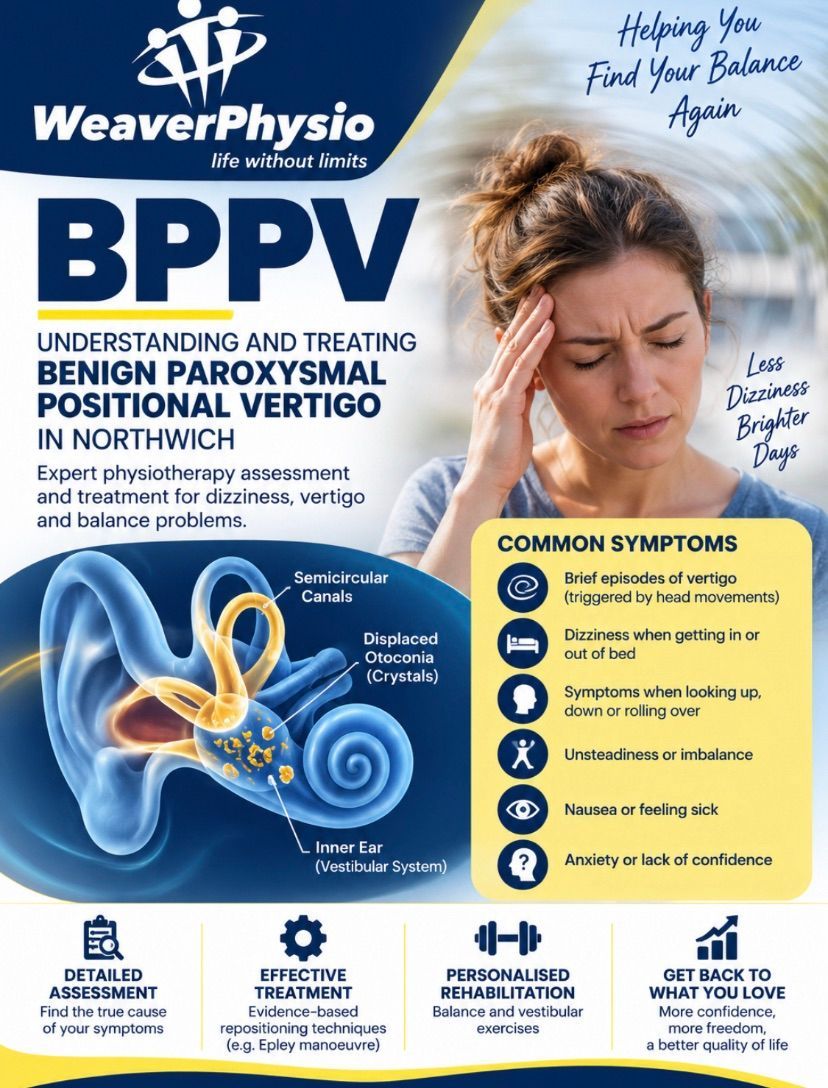
Benign Paroxysmal Positional Vertigo (BPPV) is a common cause of positional vertigo.
People with BPPV typically describe short episodes of spinning triggered by particular head movements. Symptoms may occur when:
Rolling over in bed
Looking upwards
Bending forwards
Getting into or out of bed
Turning the head quickly
BPPV occurs when tiny calcium carbonate particles, known as otoconia, become displaced into one of the semicircular canals of the inner ear.
Following appropriate assessment and positional testing, BPPV can often be treated using a specific canalith repositioning manoeuvre selected according to the affected canal and clinical findings.
Because different forms of BPPV require different approaches, accurate assessment is important rather than simply attempting manoeuvres found online.
Other Vestibular Problems That May Benefit From Rehabilitation
Vestibular rehabilitation may also form part of the management of certain people recovering from conditions such as vestibular neuritis or labyrinthitis, as well as other causes of vestibular hypofunction or persistent imbalance.
After an acute vestibular problem, some people continue to feel unsteady even after the initial severe symptoms have improved. Busy environments, rapid head movements, walking outdoors or visually complex situations may remain challenging.
This is where an individualised rehabilitation programme can be valuable.
Rather than avoiding movement indefinitely, rehabilitation can progressively expose the nervous system to appropriate movement and sensory challenges, encouraging adaptation while rebuilding confidence.
How Does Vestibular Rehabilitation Work?
Vestibular rehabilitation makes use of the brain’s ability to adapt and reorganise in response to altered sensory information—a process associated with neuroplasticity.
Depending on your assessment findings, treatment may include several different rehabilitation strategies.
Gaze Stabilisation Exercises
Some vestibular problems make it difficult to maintain clear vision while the head is moving.
Gaze stabilisation exercises are designed to retrain coordination between head movement and eye movement. This can be particularly useful when activities such as walking while looking around or turning your head make your surroundings appear unstable.
Habituation Exercises
Some people become particularly sensitive to specific movements or environments.
Carefully controlled and repeated exposure to appropriate movements can help reduce this sensitivity over time.
The objective isn’t to make you as dizzy as possible. Exercises are selected and progressed according to your presentation and tolerance.
Balance and Postural Rehabilitation
Your programme may incorporate exercises designed to challenge balance under progressively more demanding conditions.
These may involve changes in:
Foot position
Surface
Vision
Head movement
Direction of movement
Dual-task activities
Functional movement
Exercises can then become increasingly relevant to your normal activities as your ability improves.
More Than an Inner-Ear Problem
Balance is influenced by considerably more than the vestibular system alone.
At Weaver Physio, we take a broader physiotherapy approach to your recovery. Where clinically appropriate, your assessment can consider factors such as lower-limb strength, mobility, coordination, postural control and cervical spine function.
For an older adult concerned about falling, for example, improving lower-limb strength and functional balance may be an important part of rehabilitation.
For a physically active person, treatment may eventually progress towards more demanding balance, coordination and movement tasks.
This allows rehabilitation to focus not only on reducing symptoms but also on improving your ability to function confidently in everyday life.
Vestibular Rehabilitation and Falls Prevention
Persistent balance problems can lead people to reduce their activity because they’re worried about falling.
Unfortunately, becoming less active can contribute to reduced strength and physical conditioning, potentially making everyday movement even more difficult.
For appropriate patients, vestibular and balance rehabilitation can therefore include progressive work on:
Lower-limb strength
Static and dynamic balance
Walking confidence
Turning and changing direction
Coordination
Functional tasks
Confidence on different surfaces
The aim is to create a programme that reflects the challenges you actually encounter outside the treatment room.
What Happens at Your Vestibular Assessment at Weaver Physio?
Your initial appointment provides an opportunity to understand your symptoms in detail.
We’ll discuss when your dizziness started, what it feels like, how long episodes last and what movements or situations make symptoms better or worse.
This distinction matters. A brief spinning sensation when rolling over in bed, for example, can require a very different management approach from persistent unsteadiness following a vestibular illness.
Following your history, appropriate clinical tests may be used to investigate your symptoms.
Once the assessment is complete, we’ll explain our findings and discuss whether physiotherapy is suitable. Where appropriate, you’ll receive an individualised treatment and rehabilitation programme.
A Personalised Vestibular Exercise Programme
There is no single vestibular exercise programme that is right for everybody.
Your rehabilitation should reflect your diagnosis, symptoms, physical abilities and personal goals.
Someone who wants to regain confidence walking independently may require a very different programme from someone who wants to return to running, sport or a physically demanding occupation.
Exercises can be progressively modified as your symptoms and abilities change.
Your programme may combine:
Gaze stabilisation – improving visual stability during head movement.
Habituation – gradually reducing sensitivity to appropriate symptom-provoking movements.
Balance retraining – improving control in different positions and environments.
Strength and conditioning – improving the physical capacity needed for everyday movement.
Functional rehabilitation – progressively preparing you for activities that are important to you.
Why Choose Weaver Physio for Vestibular Rehabilitation in Northwich?
At Weaver Physiotherapy & Sports Injury Clinic, we believe effective rehabilitation starts with listening carefully, assessing thoroughly and explaining clearly.
Our team has 70+ years of combined clinical experience, and our approach is centred on individual assessment and evidence-informed physiotherapy.
When you choose Weaver Physio for vestibular rehabilitation in Northwich, you can expect:
A comprehensive clinical assessment
An individual approach rather than generic exercises
Clear explanations about your symptoms and rehabilitation
BPPV assessment and appropriate repositioning techniques where indicated
Gaze stabilisation and vestibular exercises when clinically appropriate
Balance and falls-prevention rehabilitation
Strength, stability and functional rehabilitation where required
Progressive exercises based around your personal goals
Ongoing review and modification of your programme
Most importantly, we’ll work with you to understand what you want to get back to doing.
Local Vestibular Physiotherapy in Northwich & Cheshire
Weaver Physio provides convenient access to physiotherapy in Northwich, Cheshire, with patients also travelling to us from surrounding areas including Hartford, Weaverham, Winsford, Middlewich, Knutsford, Tarporley, Frodsham and across Mid-Cheshire.
For someone experiencing dizziness or poor balance, travelling long distances for treatment can be particularly challenging. Access to specialist assessment closer to home can make starting rehabilitation considerably easier.
When Should Dizziness Be Medically Assessed?
Dizziness has many possible causes, and physiotherapy is not appropriate for every presentation.
New, severe or unusual dizziness—particularly when accompanied by symptoms such as new weakness or numbness, facial drooping, difficulty speaking, severe headache, loss of consciousness, new significant visual disturbance, chest pain or other concerning neurological or cardiovascular symptoms—requires urgent medical assessment.
If you’re unsure whether vestibular physiotherapy is appropriate, our team can discuss your presentation and advise you on the appropriate next step.
Regain Your Balance, Movement and Confidence
Persistent dizziness can gradually change the way you live. You may stop turning your head quickly, avoid busy environments, become nervous on stairs or lose confidence walking outdoors.
Appropriate rehabilitation aims to reverse that pattern.
Through specialist assessment, targeted vestibular exercises and progressive balance rehabilitation, Weaver Physio in Northwich can help suitable patients improve stability, build confidence and return to everyday activities.
Your rehabilitation isn’t simply about performing exercises in a treatment room. It’s about developing the physical and neurological capacity you need to function confidently in the real world.
Book a Vestibular Rehabilitation Assessment in Northwich
If dizziness, vertigo or poor balance is affecting your daily life, consider arranging an assessment with Weaver Physiotherapy & Sports Injury Clinic.
No GP referral is normally required for a private physiotherapy assessment, meaning you can contact the clinic directly.
Weaver Physiotherapy & Sports Injury Clinic
110 Middlewich Road
Northwich, Cheshire
CW9 7DP
Website: http://www.weaverphysio.com
Move better. Feel steadier. Regain confidence.
Frequently Asked Questions About Vestibular Rehabilitation
Can vestibular rehabilitation help with vertigo?
It can help certain causes of vertigo, but treatment depends on the underlying problem. BPPV, for example, is generally managed using specific repositioning manoeuvres, while other vestibular conditions may require gaze stabilisation, habituation and balance rehabilitation. An assessment helps determine the most appropriate approach.
Can physiotherapy treat BPPV?
Appropriately trained clinicians can assess positional vertigo and use canalith repositioning techniques where BPPV is identified. The precise technique depends on the clinical findings and the part of the vestibular system involved.
Will vestibular exercises make me dizzy?
Some exercises intentionally provide a controlled challenge to the vestibular system, so a temporary increase in symptoms can occur. Exercises should be individually prescribed and progressed according to your response rather than simply pushing through severe dizziness.
How many vestibular physiotherapy sessions will I need?
This varies considerably. Some uncomplicated cases of BPPV may respond quickly to appropriate repositioning treatment, whereas longer-standing vestibular or balance problems can require a progressive rehabilitation programme over several appointments.
Your physiotherapist can provide a more individual indication after assessing your condition and response to treatment.
Should I drive to my first vestibular appointment?
If you’re currently experiencing significant dizziness or unpredictable vertigo, it may be safer to arrange for somebody else to bring you. Assessment or treatment can sometimes temporarily provoke symptoms. You should only drive when you are safe and legally fit to do so.
Do I need a GP referral for vestibular rehabilitation at Weaver Physio?
Private physiotherapy can generally be accessed directly without a GP referral. However, if your assessment indicates that your symptoms require medical investigation or management outside the scope of physiotherapy, you’ll be advised accordingly.
What is the difference between dizziness and vertigo?
Dizziness is a broad term that can describe light-headedness, imbalance, disorientation or a feeling of instability. Vertigo more specifically describes an illusion of movement—often a sensation that you or your surroundings are spinning.
Understanding exactly what you are experiencing is an important part of your vestibular assessment.