
Return to Sport Rehabilitation in Northwich:
A Comprehensive Guide to Safe Recovery and Peak Performance
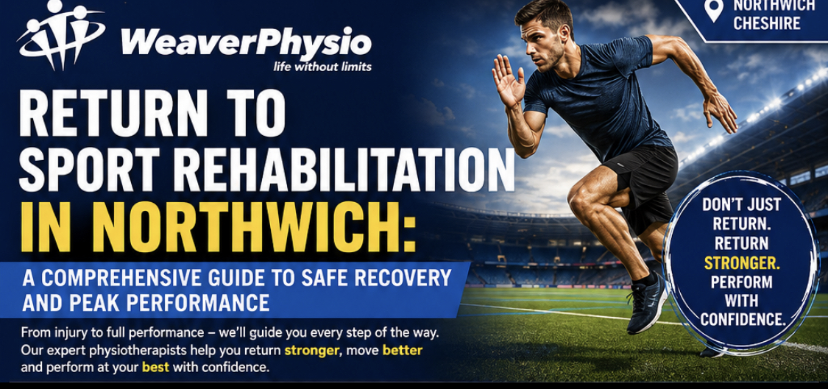
Returning to sport after an injury is about far more than becoming pain-free. Whether you are a footballer preparing for your first match back, a runner rebuilding towards a marathon, a rugby player returning after a knee injury or simply someone determined to get back to the activity you love, the final stages of rehabilitation can be some of the most important.
It is also completely understandable to feel uncertain. Your injury may have settled, your movement may have improved and you may even have returned to some training, but questions often remain. Is the injured area strong enough? Can it tolerate sprinting, jumping, cutting and rapid changes of direction? What happens when fatigue sets in? And, perhaps most importantly, can you trust your body again?
At Weaver Physiotherapy & Sports Injury Clinic in Northwich, our approach to return to sport rehabilitation is designed to answer those questions. Rather than relying solely on pain levels or an arbitrary number of weeks since injury, our Chartered Physiotherapists use progressive rehabilitation, functional assessment, strength testing, movement analysis and sport-specific exercise to determine whether your body is genuinely prepared for the demands ahead.
Our goal is not simply to help you return to sport. We want to help you Recover Stronger, Move Better and return with confidence.
What Is Return to Sport Rehabilitation?
Return to sport rehabilitation is the structured process of progressing from injury recovery back to unrestricted training, competition and ultimately your previous level of performance.
One of the biggest misconceptions in sports injury recovery is that the disappearance of pain means rehabilitation is complete. Pain reduction is certainly an important milestone, but it does not necessarily mean that strength, power, endurance, coordination and tissue capacity have fully recovered.
This is particularly important in sports involving sprinting, jumping, landing, twisting, kicking or sudden changes of direction. The physical demands placed on your body during competition can be considerably greater than those encountered during everyday activities.
At Weaver Physio, we therefore view return to sport as a continuum rather than a single event.
The first stage is often a return to participation, where you begin taking part in selected or modified elements of training. You might complete warm-ups, technical drills or controlled running while temporarily avoiding the most demanding activities.
The next stage is a return to sport, where you progressively resume normal training and begin tolerating the physical demands associated with your activity.
The final objective is a return to performance. At this point, the focus moves beyond simply participating. Rehabilitation aims to restore the strength, speed, power, endurance, confidence and movement quality required to perform effectively.
This distinction is important because being capable of completing a training session is not necessarily the same as being ready to perform at your best.
Why Being Pain-Free Doesn’t Automatically Mean You Are Ready
Pain is only one part of the return-to-sport picture.
After an injury, reductions in strength, mobility, power, balance, coordination and cardiovascular conditioning may remain even after symptoms have improved significantly.
For example, following a knee injury you may be able to walk and jog comfortably while still lacking the single-leg strength required to absorb force during landing or changing direction. Similarly, a runner recovering from Achilles tendinopathy may feel comfortable during everyday activities but still lack the calf capacity required for repeated running loads.
This creates an important gap between feeling recovered and being physically prepared.
A comprehensive return to sport programme aims to close that gap.
Criteria-Based Return to Sport vs Time-Based Rehabilitation
One of the most important principles in modern sports rehabilitation is that recovery should not be determined by time alone.
Healing time still matters. Different muscles, tendons, ligaments and bones have biological recovery processes that cannot simply be accelerated. However, reaching a particular week after injury does not automatically demonstrate that you are ready for unrestricted sport.
Two people with apparently similar injuries can recover at very different rates depending on factors such as injury severity, previous injury history, training background, age, strength, sporting demands and rehabilitation consistency.
That is why Weaver Physio uses a criteria-based approach alongside appropriate healing times.
Instead of asking only:
“How many weeks has it been?”
we also ask:
“What can your body safely do now?”
Depending on the injury and sport, this may involve assessing strength, range of movement, balance, jumping, hopping, running tolerance, acceleration, deceleration, agility and sport-specific movement.
Limb symmetry can be one useful part of this assessment. In some circumstances clinicians may look for values around 90% or greater compared with the opposite limb. However, no single percentage should be treated as universal clearance for every injury or athlete. Test quality, absolute strength, previous performance and the demands of the individual sport all need to be considered.
The Key Foundations of Successful Return to Sport Rehabilitation
A safe return requires several areas of physical performance to work together.
Mobility and Movement
Restoring appropriate mobility is often one of the foundations of rehabilitation.
Restricted movement can alter how forces travel through the body. If the ankle cannot move effectively, for example, compensations may occur at the knee, hip or elsewhere in the kinetic chain.
We therefore assess the movement requirements relevant to your injury and sport rather than assuming that every athlete requires identical flexibility.
The aim is functional movement appropriate for the activities you need to perform.
Strength and Tissue Capacity
Strength is one of the most important components of sports injury rehabilitation.
During periods of reduced activity, muscles can lose strength and capacity. Simply waiting for pain to disappear does not automatically restore these qualities.
Rehabilitation therefore progressively rebuilds the injured area and the surrounding kinetic chain.
Depending on your injury, this could include calf strengthening following an Achilles problem, quadriceps and hamstring rehabilitation following a knee injury, hip strengthening for runners, shoulder conditioning for overhead athletes or progressive loading following tendon injuries.
As your recovery develops, exercises can progress from controlled strengthening towards heavier resistance, faster movements and more demanding functional tasks.
Power and Explosive Performance
Competitive sport rarely happens slowly.
Running, jumping, tackling, throwing, accelerating and rapidly changing direction all require the ability to generate and absorb force quickly.
Someone may demonstrate good strength during a slow exercise but still struggle to produce force rapidly enough for competitive sport.
Later-stage rehabilitation therefore often incorporates appropriately progressed jumping, hopping, plyometrics, acceleration, deceleration and explosive exercises where relevant.
Balance, Coordination and Neuromuscular Control
Your nervous system must coordinate movement efficiently, particularly during unpredictable situations.
This becomes increasingly important when performing single-leg movements, landing, changing direction or reacting to another player.
Rehabilitation may therefore progress from controlled balance exercises towards dynamic tasks involving speed, reaction, direction changes and decision-making.
The objective is to prepare you for the less predictable environment of real sport rather than only exercises performed in a controlled clinic setting.
Cardiovascular and Sport-Specific Fitness
Being strong enough to play does not necessarily mean you are fit enough to play.
Reduced training during injury can lead to a decline in cardiovascular conditioning. Fatigue can then influence movement quality, decision-making and physical performance.
Return to sport rehabilitation should therefore include a gradual rebuilding of fitness appropriate to your activity.
A footballer may require repeated high-intensity running and changes of direction, while a distance runner needs progressive endurance and tolerance to repeated running loads.
Your rehabilitation programme should reflect your sport rather than a generic fitness plan.
Bridging the Gap Between Rehabilitation and Competition
One of the biggest challenges in sports injury rehabilitation is bridging the gap between controlled clinical exercises and the unpredictable demands of competition.
Early rehabilitation might involve relatively simple movements performed at a controlled speed. Competitive sport is very different.
You may have to accelerate suddenly, brake aggressively, jump, land, rotate, react to another player and repeat those movements while tired.
This is why the later stages of rehabilitation are so important.
At Weaver Physio, we progressively increase the demands placed on your body so that rehabilitation begins to resemble the movements and physical challenges of your sport.
A footballer may progress towards running, sprinting, cutting and ball-related drills. A runner may progress through structured running loads, hills, faster sessions and sport-specific conditioning. Other athletes may require jumping, landing, rotational movement, throwing or repeated explosive efforts.
The exact progression depends on the athlete, injury and sport.
Psychological Readiness: Learning to Trust Your Body Again
Physical recovery is only one part of returning to sport.
Fear of re-injury can be a significant barrier, particularly following a serious or recurrent injury.
An athlete may have recovered adequate strength but still hesitate during a tackle, sprint, landing or sudden change of direction. This fear can sometimes lead to guarded movement and reduced confidence.
Return to sport rehabilitation should therefore consider psychological readiness alongside physical performance.
One useful approach is graded exposure.
Rather than immediately asking an athlete to reproduce the movement they fear most at maximum intensity, rehabilitation progressively introduces increasingly challenging versions of that movement.
As you successfully complete each stage, confidence can gradually rebuild.
Objective assessment can also be valuable. Seeing measurable improvements in strength, running tolerance, hopping or functional performance can provide reassurance that progress is occurring.
The goal is for your return to sport to feel earned through preparation rather than based on hope.
Return to Running After Injury
Running deserves particular attention because simply being able to walk without pain does not automatically mean your body is prepared for running.
Running involves repeated loading through the feet, ankles, calves, knees and hips. Depending on speed and terrain, these forces can be substantial and are repeated thousands of times during a training session.
For runners recovering from injuries such as Achilles tendinopathy, plantar fasciitis, calf strains, shin pain, runner’s knee, hamstring injuries or hip pain, a progressive return-to-running programme can therefore be extremely valuable.
We typically consider factors such as symptoms, strength, mobility, training history, previous running volume and the demands of your target event.
Running volume and intensity are then gradually progressed according to your individual response.
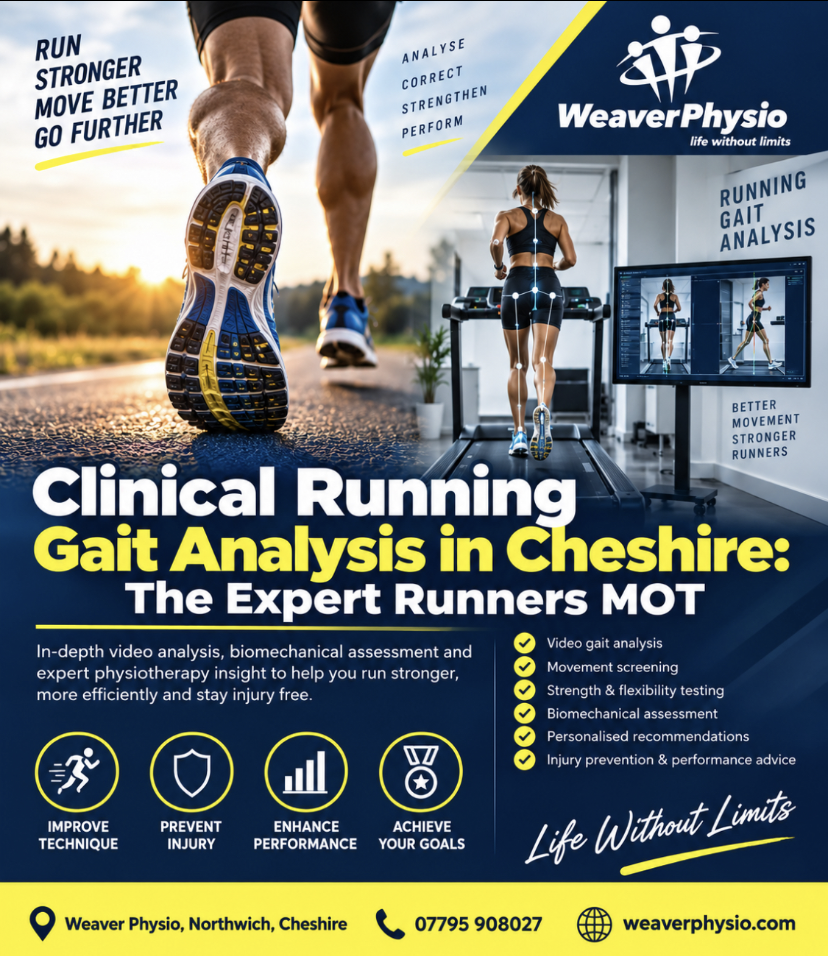
Running Gait Analysis and the Weaver Physio Runner’s MOT
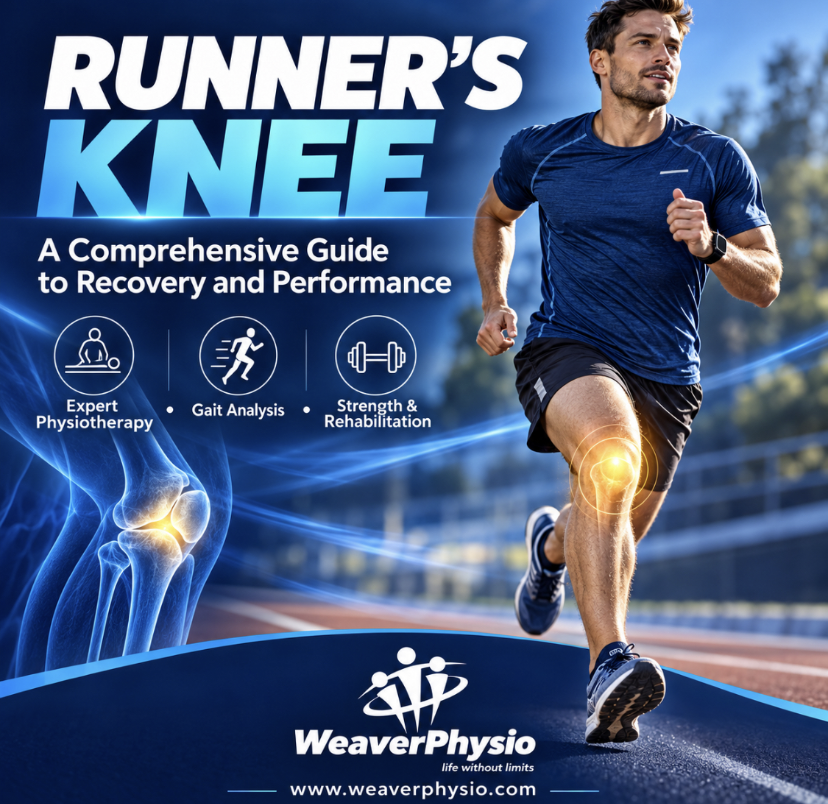
For runners requiring a more detailed assessment, Weaver Physio offers a specialist Runner’s MOT and running gait analysis in Northwich.
Running injuries are rarely explained by one factor alone. Training load, strength, mobility, previous injury, recovery, footwear and running mechanics may all contribute.
Our Runner’s MOT allows us to examine these areas in greater detail.
Using slow-motion video gait analysis alongside strength, flexibility and movement assessment, we can identify potentially relevant factors that may be influencing your running efficiency or contributing to recurrent problems.
Rather than trying to force every runner into an identical running style, recommendations are personalised according to your individual findings, symptoms and goals.
The information gathered can then be incorporated into a targeted rehabilitation and performance programme.
Returning After Common Sports Injuries
Weaver Physio provides rehabilitation for a wide range of sporting and musculoskeletal injuries, including:
Ankle sprains
Calf and hamstring strains
Achilles tendinopathy
Patellar tendinopathy
Plantar fasciitis and plantar heel pain
Runner’s knee
IT band-related problems
Shin pain and running injuries
Knee ligament injuries
Shoulder injuries
Rotator cuff problems
Tennis and golfer’s elbow
Hip and groin pain
Muscle strains
Tendon injuries
Overuse injuries
Recurring sports injuries
The return-to-sport pathway will differ considerably between conditions, which is why an individual assessment is important.
The Role of Physiotherapy in Sports Injury Rehabilitation
Sports physiotherapy is not simply about treating the painful area.
A comprehensive assessment looks at the injury itself alongside the physical demands that caused it or continue to aggravate it.
At Weaver Physio, treatment may include a combination of hands-on physiotherapy, progressive exercise rehabilitation, strength and conditioning, sports massage, acupuncture, dry needling, Shockwave Therapy, movement assessment and running gait analysis where clinically appropriate.
These interventions are selected according to your assessment rather than being used as a one-size-fits-all package.
Exercise rehabilitation and appropriate load progression remain particularly important because ultimately your body needs sufficient capacity to tolerate the demands of your sport.
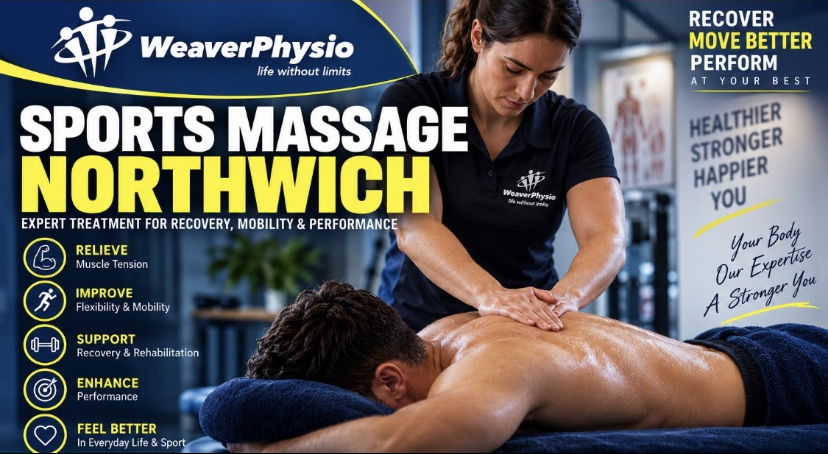
Sports Massage During Return to Sport
Sports massage can be a useful adjunct during rehabilitation, particularly for athletes experiencing muscular tightness or soreness as training loads increase.
Techniques may be used to address muscle tension, support mobility and help athletes feel more comfortable between demanding rehabilitation or training sessions.
However, sports massage should not replace progressive strengthening and sport-specific rehabilitation.
At Weaver Physio, it can form one part of a broader rehabilitation strategy where clinically appropriate.
Shockwave Therapy for Persistent Tendon Problems
Some athletes experience persistent tendon-related problems that interfere with their return to training.
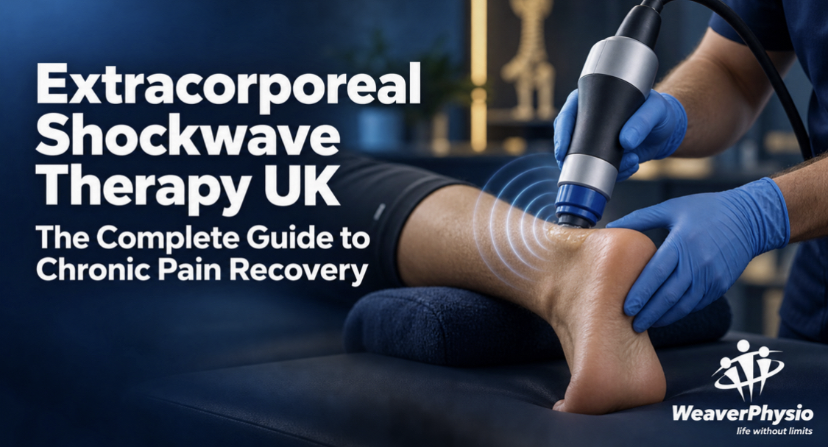
Radial Extracorporeal Shockwave Therapy may be considered for selected conditions such as plantar fasciitis, Achilles tendinopathy, patellar tendinopathy, lateral elbow tendinopathy and certain other persistent tendon problems.
Shockwave Therapy is generally most useful as part of an appropriate overall rehabilitation programme rather than as a standalone solution.
Progressive loading, strength restoration and gradual exposure to sporting demands remain essential components of returning to performance.
Preventing the Next Injury
Good rehabilitation should not finish when your original pain disappears.
The final stages provide an opportunity to identify areas that could potentially influence future performance or injury risk.
This may include insufficient strength, poor tolerance to training load, limited conditioning or deficits in movement capacity.
No rehabilitation programme can guarantee that an athlete will never be injured again. Sport inherently involves physical risk.
However, improving strength, conditioning, movement capacity and training-load tolerance can help build a more robust athlete who is better prepared for sporting demands.
Why Choose Weaver Physio for Sports Injury Rehabilitation in Northwich?
At Weaver Physiotherapy & Sports Injury Clinic, we believe athletes deserve more than a quick treatment followed by instructions to simply “see how it goes.”
Our team provides comprehensive assessment, individual rehabilitation and progressive return-to-sport programmes designed around the demands of your injury, activity and goals.
With over 70 years of combined clinical experience, our team helps recreational athletes, runners and active individuals from Northwich and across Cheshire return to the activities that matter to them.
Our Northwich clinic regularly welcomes patients from Northwich, Hartford, Weaverham, Winsford, Middlewich, Knutsford, Tarporley, Frodsham, Sandbach and surrounding Cheshire areas.
Whether your goal is returning to Sunday league football, completing your next 10K, preparing for a marathon or simply getting back to the gym without worrying about another setback, we can develop a rehabilitation pathway around you.
Return to Sport With Confidence
The final stages of injury rehabilitation should not be based on guesswork.
Being pain-free is important, but true sporting readiness also requires appropriate strength, mobility, power, coordination, conditioning and confidence.
A structured, criteria-based return to sport programme helps bridge the gap between recovering from an injury and being physically prepared to perform.
At Weaver Physio in Northwich, we combine clinical assessment with progressive rehabilitation and sport-specific testing to help you understand exactly where you are in your recovery and what still needs to improve.
The objective is simple:
Don’t just return. Return prepared.
Book a Sports Injury Rehabilitation Assessment in Northwich
If an injury is keeping you away from running, training, the gym or competitive sport, Weaver Physio can help you develop a clear pathway back.
Our Chartered Physiotherapists will assess your injury, identify your current physical capabilities and create a personalised rehabilitation programme based on the demands of your sport.
Whether you are dealing with a new injury, struggling with a recurring problem or have reached the stage where you are unsure whether you are ready to return, professional assessment can provide the clarity you need.
Weaver Physiotherapy & Sports Injury Clinic – Northwich, Cheshire
Recover Stronger. Move Better. Return With Confidence.
Frequently Asked Questions About Returning to Sport
How do I know when I am ready to return to sport?
Readiness should usually be assessed using several factors rather than pain or time alone. Depending on your injury, these may include range of movement, strength, power, balance, running tolerance, jumping or hopping ability, agility and sport-specific performance. Your confidence in the injured area should also be considered.
Should I wait until I am completely pain-free before returning to sport?
This depends on the injury. Some conditions require symptoms to settle before particular activities are introduced, while rehabilitation for some persistent tendon and musculoskeletal problems may involve carefully controlled activity despite mild symptoms. A physiotherapist can advise what is appropriate for your individual condition.
What happens if I return to sport too early?
Returning before your body has developed adequate strength, tissue capacity, movement control and conditioning may increase the likelihood of aggravating the existing problem or sustaining another injury. A graded return allows physical demands to increase progressively rather than suddenly.
Is 90% strength enough to return to sport?
A limb symmetry value of around 90% is sometimes used as one component of return-to-sport testing, but it should not be viewed as a universal pass mark. Absolute strength, quality of movement, sport-specific testing, injury type and psychological readiness also matter. Return-to-sport decisions should consider the whole athlete rather than one test result.
Can sports massage help me return to sport?
Sports massage may help manage muscle tension, soreness and mobility during rehabilitation, particularly as training loads increase. It is usually best used alongside progressive exercise, strength training and sport-specific rehabilitation rather than instead of them.
Can Shockwave Therapy help sports injuries?
Shockwave Therapy may be appropriate for selected persistent tendon-related conditions, including Achilles and patellar tendinopathy and plantar fasciitis. It is normally incorporated into a broader rehabilitation programme that includes progressive loading and strengthening.
Is it normal to be nervous about returning after an injury?
Yes. Fear of re-injury can occur after significant or recurrent injuries. Progressive exposure to sporting movements combined with objective physical testing can help rebuild confidence as rehabilitation progresses.
What is the difference between physiotherapy and sports rehabilitation?
Early physiotherapy may focus on diagnosing the problem, reducing symptoms and restoring basic movement and function. Sports rehabilitation extends this process towards the higher physical demands required for training and competition, including strength, power, running, agility, jumping and sport-specific conditioning where appropriate.
How long does return to sport rehabilitation take?
There is no single timeline. Recovery depends on the type and severity of injury, biological healing, previous injuries, your sport, training demands and how your body responds to rehabilitation. Minor injuries may resolve relatively quickly, while major ligament, tendon, muscle or bone injuries can require considerably longer rehabilitation.
Can Weaver Physio help with recurring sports injuries?
Yes. Recurrent injuries are particularly suited to comprehensive assessment because the aim is to understand why the problem continues to return. This may involve examining strength, mobility, movement, training load and sport-specific demands before creating a personalised rehabilitation strategy.
Do I need running gait analysis after a running injury?
Not every running injury requires gait analysis. However, it can be useful where running mechanics may be relevant, particularly for recurrent or persistent running-related problems. Weaver Physio’s Runner’s MOT combines video gait analysis with physical assessment to build a more complete picture of the runner.
Where can I get sports injury rehabilitation in Northwich?
Weaver Physiotherapy & Sports Injury Clinic provides sports injury assessment, physiotherapy, rehabilitation, strength and conditioning, running gait analysis, sports massage and other appropriate treatments in Northwich, Cheshire. We work with runners, recreational athletes and active individuals who want to return safely to training, competition and everyday exercise.