
Restoring Load Capacity in the Injured Runner
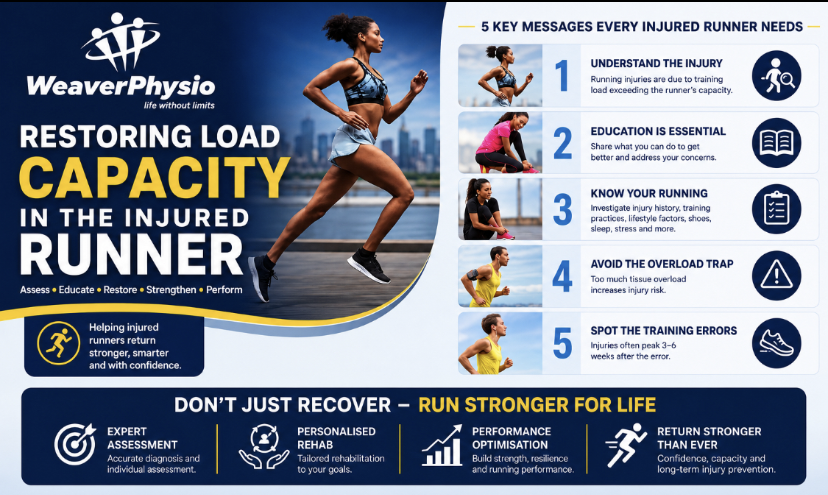
5 Key Principles for Running Injury Rehabilitation
Running injuries can be incredibly frustrating. One week you are training consistently, building fitness and enjoying your running; the next, pain in your knee, Achilles tendon, shin, hip or foot is making every run feel uncertain. For many runners, the immediate reaction is to stop running completely and wait for the pain to disappear. While reducing training may sometimes be necessary, simply resting does not always address the reasons an injury developed or prepare your body for the demands of running again.
At Weaver Physiotherapy & Sports Injury Clinic in Northwich, we believe successful running injury rehabilitation should focus on more than reducing pain. The aim is to understand the injury, identify the factors contributing to it and progressively rebuild the runner’s capacity to tolerate the demands of training.
This concept of load versus capacity is central to modern sports injury rehabilitation. Running places repeated mechanical demands on muscles, tendons, joints and bones. Your body normally adapts remarkably well to those demands. Problems can arise when training demands increase faster than your body can adapt, or when your current capacity has been reduced by factors such as previous injury, inadequate recovery, illness or prolonged periods of reduced activity.
For runners searching for running injury physiotherapy in Northwich or Cheshire, understanding this relationship can completely change the way you approach recovery.
What Does Load Capacity Mean for a Runner?
Every runner has a certain physical capacity—the amount and type of training their body can currently tolerate while recovering and adapting appropriately.
Importantly, capacity is not fixed.
Strength training can increase it. Progressive running can increase it. Appropriate recovery supports it. Conversely, injury, illness, extended inactivity and sudden changes in training may temporarily reduce it.
Training load is also much more complicated than weekly mileage. A 30-mile training week containing mostly easy running creates a very different stimulus from 30 miles containing hill repetitions, intervals and a hard long run.
Running speed, distance, frequency, hills, terrain, footwear changes, strength training and competition can all influence the demands placed on your body.
This is why rehabilitation should not simply ask:
“When will the pain disappear?”
A more useful question is:
“How do we progressively prepare your body to tolerate the running you want to do?”
That distinction is extremely important.
1. Understand the Relationship Between Training Load and Injury
Running injuries rarely have one simple explanation.
A common pattern is a mismatch between the demands being placed on a runner and their current ability to tolerate those demands. However, it would be an oversimplification to say that every running injury is simply caused by “doing too much.”
Training history, previous injuries, tissue capacity, biomechanics, strength, sleep, recovery, nutrition and other individual factors may all contribute.
Consider a runner who has comfortably completed 20 miles per week for several months. They suddenly increase their mileage while simultaneously introducing faster intervals and hill training.
Their cardiovascular fitness may cope surprisingly well.
Their tissues, however, may require longer to adapt to the increased mechanical demands.
This can potentially contribute to conditions such as:
- Achilles tendinopathy
- plantar heel pain
- patellar tendinopathy
- runner’s knee
- medial tibial stress syndrome (shin splints)
- calf strains
- hamstring injuries
- hip and gluteal pain
- iliotibial band-related pain
- bone stress injuries
At Weaver Physio, our approach to running injury rehabilitation in Northwich therefore considers much more than the painful area. Understanding what changed before symptoms developed can provide valuable information when building an appropriate rehabilitation programme.
2. Runner Education Is an Essential Part of Rehabilitation
A runner who understands their injury is usually in a much better position to manage it.
Unfortunately, runners are often surrounded by conflicting advice.
“Stop running.”
“Stretch more.”
“Never stretch.”
“Change your shoes.”
“Your running technique is wrong.”
“Just strengthen your glutes.”
“Rest for six weeks.”
Advice without appropriate assessment can create confusion and sometimes unnecessary fear around movement.
At Weaver Physio, patient education forms an important part of our approach. We want runners to understand what we believe is happening, which activities may currently need modifying, what they can continue doing and how rehabilitation will progress.
Pain does not automatically mean that every movement is causing further tissue damage. Equally, attempting to repeatedly “push through” significant or worsening symptoms is not always appropriate.
The answer often lies in finding the correct level of activity for the individual.
For some runners this may involve temporarily reducing running volume. Others may tolerate shorter or easier runs while completing rehabilitation. Certain injuries may require a more substantial reduction in impact before running is gradually reintroduced.
The decision should be based on the individual runner, their diagnosis and their response to loading rather than a generic rule.
Good rehabilitation should replace uncertainty with a clear plan.
3. Understand the Runner, Not Just the Injury
Treating a runner effectively requires understanding the person behind the injury.
Two runners with Achilles pain may require very different rehabilitation programmes because their training histories, strength, symptoms and goals may be completely different.
This is why a comprehensive running injury assessment matters.
At Weaver Physio, assessment may consider the nature and behaviour of symptoms, previous injuries, recent changes in training, running frequency, weekly mileage, intensity, hills, speed sessions, races, strength training, footwear and recovery.
Where clinically appropriate, we can also assess mobility, strength, balance, control and functional movements relevant to running.
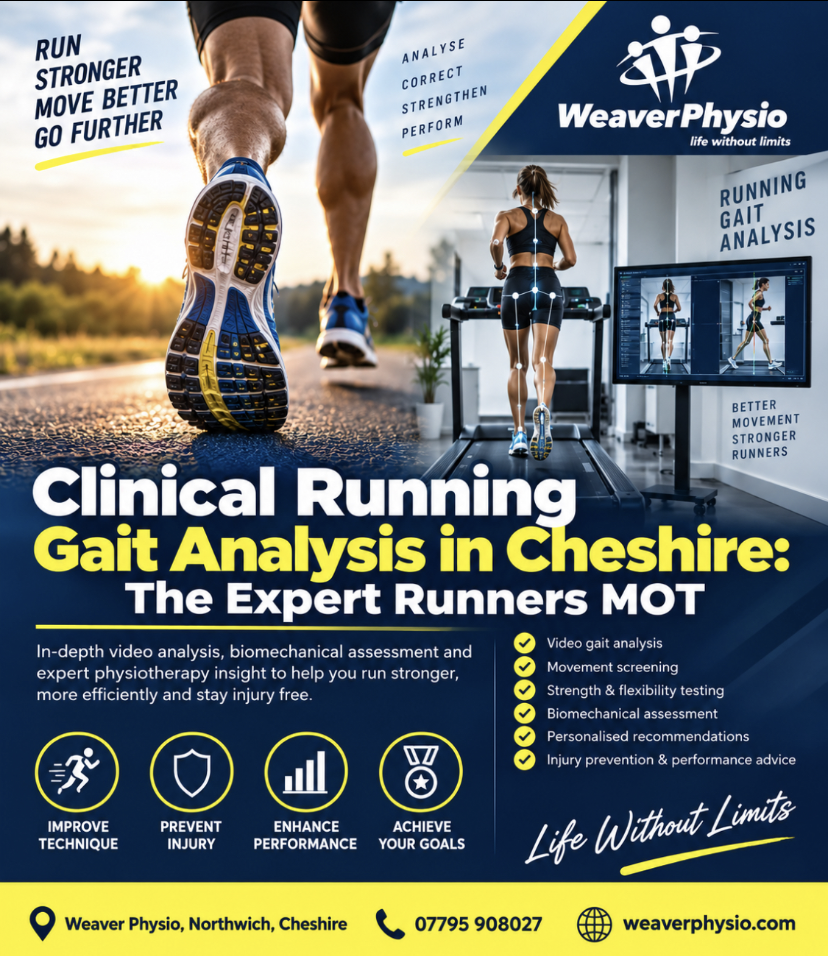
For selected runners, video running gait analysis can provide additional information about how they move while running.
This should not be about trying to create a mythical “perfect running style.” Human movement varies enormously, and many biomechanical differences are completely normal.
Instead, gait analysis can help identify potentially relevant characteristics within the context of the runner’s injury, training demands and physical assessment.
Our Runner’s MOT in Northwich takes this broader approach by examining the runner rather than simply focusing on the site of pain.
The objective is straightforward:
Understand what your running demands require, determine your current capacity and build the bridge between the two.
4. Avoid the Underloading Trap During Running Injury Recovery
One of the most important concepts in rehabilitation is that avoiding excessive loading does not mean avoiding loading altogether.
Rest can settle symptoms, particularly during an irritated phase of an injury. However, extended periods of unnecessary unloading may reduce physical capacity.
Muscles can lose strength. Tendons may become less accustomed to demanding activity. Cardiovascular fitness can decline. Confidence in the injured area may also decrease.
Then comes a familiar situation.
The runner rests until their symptoms improve, attempts their normal run again and the problem returns because the body has not been progressively prepared for the original training demands.
This is why progressive loading is such an important component of modern running rehabilitation.
Depending on the injury and stage of recovery, rehabilitation might progress through controlled strengthening, heavier resistance exercises, single-leg exercises, jumping and landing drills, plyometrics and increasingly demanding running.
The precise progression depends on the condition.
For example, an Achilles tendon rehabilitation programme may eventually need to prepare the calf and tendon for storing and releasing energy repeatedly during running. A runner recovering from knee pain may require sufficient lower-limb strength and control to tolerate their desired mileage, speed and terrain.
Rehabilitation should therefore progressively become more specific to the runner’s goals.
The end point is not simply completing exercises in the treatment room.
The end point is being physically prepared for running.
5. Identify Training Errors and Manage Progression
When assessing an injured runner, one of the most useful questions we can ask is:
“What changed?”
Sometimes the answer is obvious.
Perhaps weekly mileage increased rapidly.
But mileage is only one variable.
A runner might maintain exactly the same weekly distance while suddenly introducing track sessions. Another might start running steep hills. Someone preparing for a marathon may substantially increase their long run while maintaining similar weekly mileage.
Changes can include increased frequency, intensity, duration, hills, speed work, terrain, racing, strength training or a return to running after a break.
Several relatively small changes introduced simultaneously can also produce a substantial overall increase in training demand.
Importantly, symptoms do not necessarily appear immediately after a training change. The relationship between training and injury is complex, and there is no universal timetable predicting when an injury will emerge.
For that reason, reviewing several weeks of training history can often be useful.
GPS watches and training applications can help provide valuable information, but numbers should always be interpreted alongside the individual runner.
Rather than chasing a single “safe” percentage increase or universal formula, sensible progression should consider how the runner is responding.
Restoring Capacity: From Rehabilitation to Running Performance
Once symptoms begin improving, rehabilitation should continue progressing.
This is where rehabilitation can become much more exciting for runners.
The focus gradually moves from managing an injury towards developing the physical qualities required for performance.
Strength is important because running repeatedly requires the body to generate and absorb force. Depending on the individual, rehabilitation may therefore include exercises targeting the calf complex, quadriceps, hamstrings, gluteal muscles and other relevant structures.
Balance, coordination and single-leg control may also be developed.
Later stages may introduce faster movements, hopping, jumping and plyometric exercises when appropriate.
Finally, running itself needs to be progressively restored.
This might begin with a walk-run programme before progressing towards continuous easy running. Distance can then increase before more demanding variables such as hills, tempo running, intervals and race-specific sessions are gradually reintroduced according to the individual situation.
A marathon runner and a recreational 5K runner do not need identical rehabilitation.
Neither do a trail runner and a road runner.
Rehabilitation should ultimately reflect the sport you are returning to.
Why Pain-Free Doesn’t Always Mean Ready to Return to Full Training
One of the biggest mistakes runners can make is treating the disappearance of pain as the finish line.
Symptoms are important, but they are only one part of the picture.
Imagine that a runner stops running for several weeks and their knee pain disappears. They may understandably assume the problem has healed and immediately return to their previous mileage.
But has their quadriceps strength been restored?
Can they tolerate repeated single-leg loading?
Have they rebuilt running volume?
Are they prepared for hills and faster running?
If not, returning directly to previous training may create another large jump in demand.
This is why return-to-running rehabilitation should ideally be criteria-led and progressive, rather than based solely on waiting a predetermined number of weeks.
At Weaver Physio, our goal is not simply to help you feel better on the treatment table.
We want to help you return stronger, move confidently and build the capacity required for your running goals.
Running Injury Physiotherapy in Northwich
If you are struggling with a persistent or recurring running injury, professional assessment can help establish a clearer path forward.
At Weaver Physiotherapy & Sports Injury Clinic, our Chartered Physiotherapists provide assessment and rehabilitation for runners across Northwich, Hartford, Weaverham, Winsford, Middlewich, Knutsford, Tarporley, Frodsham, Sandbach and the wider Cheshire area.
We regularly assess runners experiencing Achilles tendon pain, plantar fasciitis and plantar heel pain, shin splints, runner’s knee, patellar tendon problems, calf and hamstring injuries, hip pain and other running-related musculoskeletal problems.
Depending on your assessment and clinical needs, treatment may incorporate physiotherapy, progressive exercise rehabilitation, strength and conditioning, manual therapy, running gait analysis and Shockwave Therapy where clinically appropriate.
With over 70 years of combined clinical experience, our focus is on providing an individual rehabilitation programme rather than applying the same solution to every runner.
Don’t Just Recover — Build the Capacity to Run Stronger
Successful running injury rehabilitation should answer more than one question.
It shouldn’t only ask:
“How do we get rid of the pain?”
It should also ask:
What contributed to the problem? What can you safely do now? What physical qualities need rebuilding? What demands will your future training place on your body? And how can we progressively prepare you for them?
That is the difference between simply settling an injury and rebuilding a runner.
The five key principles are simple: understand the relationship between training demand and capacity, educate the runner, understand the whole person and their running, avoid unnecessary underloading, and identify relevant training changes before progressively rebuilding capacity.
If an injury keeps interrupting your running, you don’t necessarily need endless rest. You need the right diagnosis, appropriate load management and a structured rehabilitation plan designed around where you are now and where you want to go.
Book a Running Injury Assessment at Weaver Physio
If you’re searching for a running injury clinic in Northwich, sports physiotherapy in Cheshire, running gait analysis in Northwich or expert help returning to running after injury, Weaver Physio can help you build a clear route back.
Weaver Physiotherapy & Sports Injury Clinic
Northwich, Cheshire
Tel: 01606 227484
Web: www.weaverphysio.com
Assess. Educate. Restore. Strengthen. Perform.
Don’t just recover. Build the capacity to run stronger.