
Runner’s MOT Cheshire: Expert Running Gait Analysis, Injury Screening & Performance Assessment
Whether you are preparing for your first 5K, chasing a new marathon personal best or simply trying to run consistently without recurring aches and injuries, understanding how your body moves can make a significant difference. At Weaver Physiotherapy & Sports Injury Clinic in Northwich, our Runner’s MOT Cheshire service provides a detailed assessment of your running biomechanics, strength, mobility, stability and movement control.
Running injuries are rarely as simple as one tight muscle or the wrong pair of trainers. Problems can develop through a combination of training load, previous injury, strength deficits, reduced mobility, running mechanics and the body’s ability to tolerate repeated impact.
That is why our Runner’s MOT looks beyond the painful area.
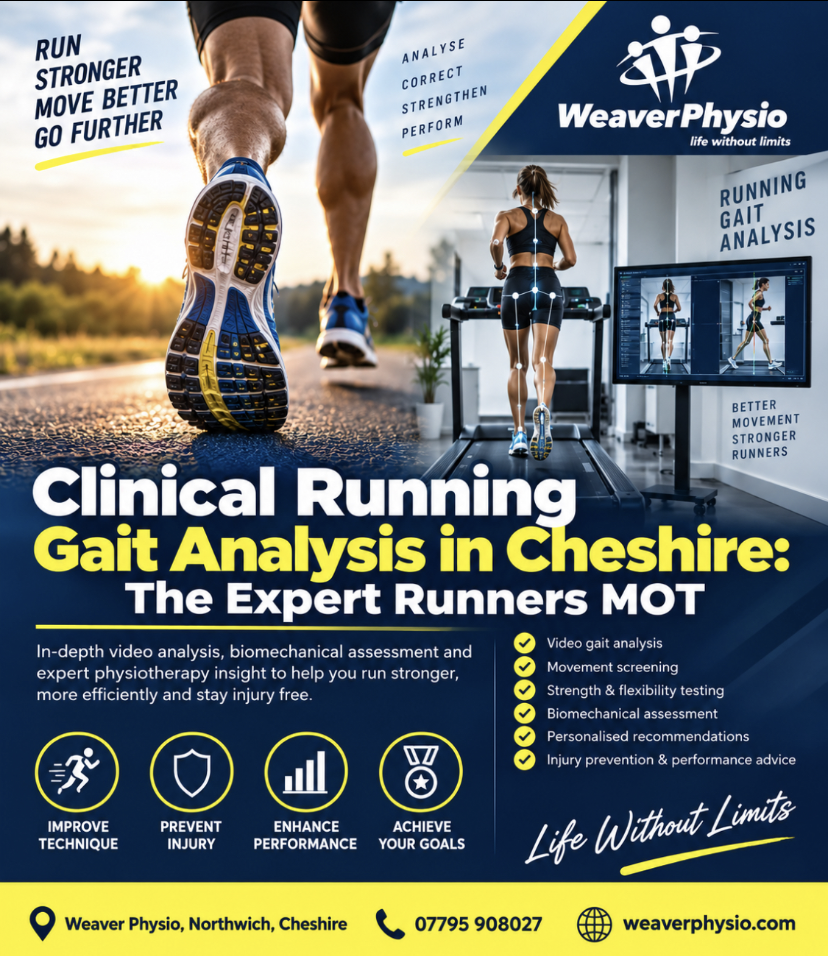
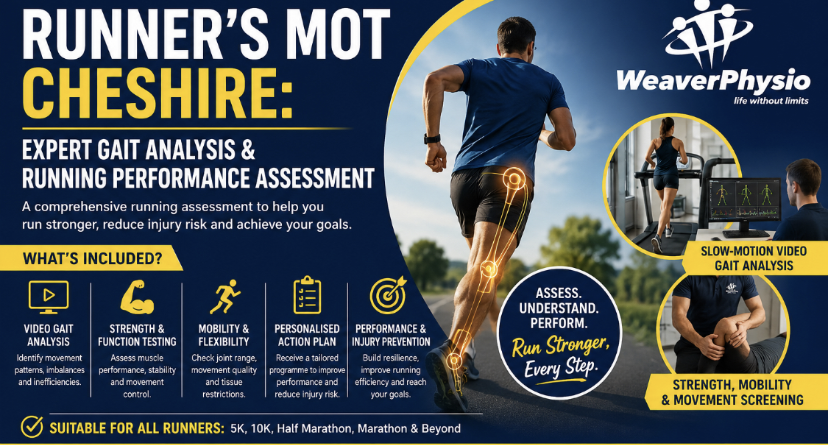
Using slow-motion video gait analysis, functional movement screening, strength testing and mobility assessment, we build a detailed picture of how your body performs when you run. The aim is to identify factors that may be contributing to injury, limiting performance or preventing you from progressing your training.
Whether you run around Northwich and the Cheshire countryside, belong to a local running club or are training for a 10K, half marathon, marathon or ultra, our goal is simple: help you run stronger, move more efficiently and become more resilient.
What Is a Runner’s MOT?
A Runner’s MOT in Cheshire is a comprehensive clinical and performance assessment specifically designed for runners.
Rather than waiting until an injury stops you running, a Runner’s MOT can identify areas that may benefit from improvement before they become significant problems. It can also be extremely valuable for runners already struggling with recurring pain, unexplained performance limitations or repeated injuries.
At Weaver Physio, we assess the runner as a whole.
Your running technique is only one part of the picture. We also consider your training history, previous injuries, current symptoms, goals, strength, mobility, stability, coordination and capacity to tolerate the demands of running.
This provides far more useful information than simply looking at whether your foot pronates or what type of running shoe you wear.
The objective isn’t to create a theoretically “perfect” running style. Every runner moves differently. Instead, we look for potentially modifiable factors that are relevant to your body, your symptoms and your running goals.
Clinical Running Gait Analysis vs Running Shop Gait Analysis
Many runners first experience gait analysis when buying running shoes. Retail assessments can be useful when selecting footwear, but a clinical running gait analysis has a different purpose.
At Weaver Physio, we are interested in the entire movement chain.
Your foot and ankle matter, but so do your knees, hips, pelvis and trunk. We consider how these areas interact as you repeatedly absorb and generate force while running.
For example, a runner experiencing knee pain may have perfectly reasonable foot mechanics but demonstrate reduced hip control, insufficient calf capacity, restricted ankle movement or a training load that has progressed faster than their body can currently tolerate.
Simply changing trainers may therefore fail to address the main contributing factors.
Our Runner’s MOT Cheshire combines video analysis with clinical testing to help determine why particular movement patterns may be occurring and whether they are actually relevant to your symptoms or performance.
Slow-Motion Video Running Gait Analysis
Running happens quickly, and many important movement patterns are difficult to assess accurately with the naked eye.
Slow-motion video allows our clinicians to examine your running technique in considerably greater detail.
We can review different stages of your running cycle and assess features such as cadence, stride characteristics, foot placement, knee position, hip and pelvic control, trunk movement and overall running posture.
Importantly, these findings are interpreted alongside your physical assessment.
A movement pattern seen on video isn’t automatically a problem. Running biomechanics vary considerably between individuals, so our job is to determine whether a particular finding is relevant to your injury history, symptoms, physical capacity or performance goals.
This clinical interpretation is one of the most important elements of a professional running gait analysis in Cheshire.
Strength, Mobility and Movement Screening for Runners
Video analysis tells us what happens when you run. Physical testing can help us understand why.
Running requires the body to repeatedly absorb and produce force thousands of times during a single training session. Adequate strength, control and mobility are therefore essential.
Your Runner’s MOT may examine areas including calf capacity, hip strength, single-leg control, balance, ankle mobility, lower-limb flexibility, pelvic stability and functional movement.
Where appropriate, we can also assess more demanding movements relevant to running performance.
This helps us identify differences between sides and areas where your current physical capacity may not match the demands of your training.
For example, reduced calf capacity may be particularly relevant to a runner experiencing recurrent Achilles problems, while poor single-leg control could potentially influence the management of some knee or hip complaints.
Rather than relying on generic exercises, we use your assessment findings to create a programme specifically targeted to you.
Runner’s MOT for Running Injury Prevention
No assessment can guarantee that a runner will never become injured. Running injuries are influenced by multiple factors, including training load, recovery, sleep, previous injury, strength and overall health.
However, identifying modifiable risk factors can help runners make more informed decisions about their training.
One of the biggest advantages of a Runner’s MOT Cheshire is that you do not necessarily need to wait until something hurts.
If you are planning to significantly increase your mileage, return to running after time away or move from shorter distances towards a half marathon or marathon, a running assessment can help establish whether your body is adequately prepared for the increased workload.
We can identify areas where additional strength, mobility or conditioning may be beneficial and develop a structured plan to improve your physical capacity.
The goal is not simply injury prevention. It is to build a body capable of tolerating the running you want to do.
Runner’s MOT for Existing Running Injuries
Our Runner’s MOT can also form part of the assessment and rehabilitation of persistent or recurring running injuries.
We regularly assess runners experiencing problems such as:
Achilles tendon pain and Achilles tendinopathy
Plantar heel pain and plantar fasciitis
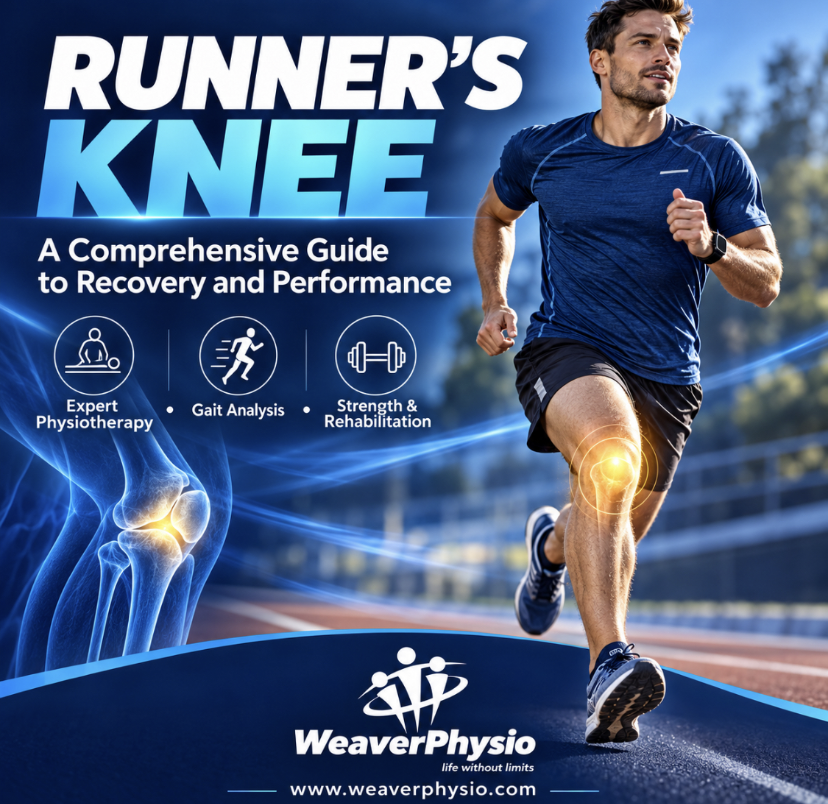
Runner’s knee and patellofemoral pain
Shin pain and medial tibial stress syndrome
IT band-related pain
Calf strains
Hamstring injuries
Hip and gluteal pain
Knee pain
Ankle and foot problems
Recurring muscle injuries
The location of your pain does not always tell us why the problem developed.
For example, persistent knee symptoms may be influenced by several factors involving training load, lower-limb strength, movement strategy or previous injury.
A comprehensive assessment allows us to investigate these possibilities rather than repeatedly treating the painful area in isolation.
Personalised Running Rehabilitation and Performance Plan
The most valuable part of a Runner’s MOT is what happens after the assessment.
Information is only useful when it leads to meaningful action.
We use your findings to develop an individual plan designed around your current ability, running goals and assessment results.
Depending on what we identify, this may involve improving calf strength, developing hip and gluteal capacity, increasing single-leg stability, restoring ankle mobility, improving coordination or introducing running-specific strength and plyometric exercises.
Where appropriate, we may also suggest modifications to aspects of your running technique or training progression.
The aim is to provide clear, practical recommendations that you can incorporate into your normal training rather than overwhelming you with dozens of unnecessary exercises.
Improve Running Performance – Not Just Injury Recovery
A Runner’s MOT isn’t exclusively for injured runners.
Many healthy runners choose a running performance assessment in Cheshire because they want to understand their body better and identify areas that could potentially improve their running.
You may feel that your times have plateaued despite increasing your training. You might struggle to maintain good form when fatigued or notice that one side feels considerably stronger than the other.
Strength and conditioning can be an important component of running performance. Developing appropriate lower-limb strength, stiffness, stability, coordination and power can help prepare the body for the demands of faster and longer running.
Our approach therefore extends beyond simply getting you pain-free.
We want to help you develop the physical qualities required to run stronger, tolerate greater training demands and perform with confidence.
Preparing for a 5K, 10K, Half Marathon or Marathon?
Increasing distance changes the demands placed on your body.
A runner comfortable completing a weekly 5K may discover that weaknesses become more apparent when training volume increases for a 10K, half marathon or marathon.
This is where a Runner’s MOT in Cheshire can be particularly useful.
Having your strength, mobility and running mechanics assessed before a major training block gives you time to address potential limitations while progressively increasing your mileage.
Whether your target is a local Cheshire race, your first marathon or a new personal best, we can help you develop a more structured approach to preparing your body for the challenge ahead.
Why Choose Weaver Physio for Your Runner’s MOT in Cheshire?
Weaver Physiotherapy & Sports Injury Clinic provides specialist assessment, physiotherapy and rehabilitation for runners from Northwich and across Cheshire.
Our experienced clinical team combines physiotherapy knowledge with running-specific biomechanical assessment, rehabilitation and strength and conditioning principles.
With more than 70 years of combined clinical experience, our focus is not simply on identifying what hurts. We aim to understand the factors contributing to the problem and develop a clear pathway towards your individual running goals.
We regularly work with runners from Northwich, Hartford, Weaverham, Winsford, Middlewich, Knutsford, Tarporley, Frodsham, Sandbach and surrounding areas of Cheshire.
Whether you’re an experienced competitive runner or have only recently completed Couch to 5K, your assessment is based on your individual needs rather than your running ability.
Run Stronger. Move Better. Perform With Confidence.
You invest hours in your training. A Runner’s MOT Cheshire can help you understand whether your body is prepared for what you are asking it to do.
Through clinical assessment, slow-motion video gait analysis, strength and mobility testing and individual rehabilitation planning, Weaver Physio can help identify the factors that may be limiting your running.
If recurring injuries keep interrupting your training, you’re returning to running following an injury or you simply want to understand your biomechanics and performance in greater detail, our Northwich team is here to help.
Book your Runner’s MOT at Weaver Physiotherapy & Sports Injury Clinic in Northwich and take a more informed approach to your running.
Assess. Strengthen. Improve. Perform.
Frequently Asked Questions About Our Runner’s MOT Cheshire
Who is a Runner’s MOT suitable for?
Almost any runner can benefit from a running assessment. You don’t need to be competitive or particularly fast. We assess beginners, recreational runners, club athletes and experienced marathon runners. A Runner’s MOT can be useful if you’re experiencing an injury, returning after time away from running, increasing your mileage or simply looking to improve your performance.
Can a Runner’s MOT help with recurring running injuries?
It can help identify factors that may be contributing to recurring problems. Rather than looking only at where you experience pain, we assess your running mechanics, strength, mobility and movement control alongside your training history. This helps us develop a more individual rehabilitation strategy.
Can running gait analysis help with knee pain?
Running-related knee pain can have multiple contributing factors. Video gait analysis allows us to examine how your hip, knee, ankle, pelvis and trunk behave during running. We combine this information with strength and mobility testing to determine which findings may be relevant to your symptoms.
What should I bring to my Runner’s MOT?
Bring comfortable running clothing and the running shoes you normally use. If you regularly alternate between different trainers, you may wish to bring those too. Information about your current weekly mileage, typical running pace, recent training and previous injuries can also be useful.
Is the assessment only for injured runners?
No. Many runners attend while completely pain-free because they want to understand their biomechanics, identify potential weaknesses or prepare for increased training demands. A Runner’s MOT can therefore be used for both rehabilitation and performance development.
When should I have a running assessment?
There is no fixed schedule that suits everyone. An assessment can be particularly valuable when returning from injury, beginning a new training programme, substantially increasing running distance or preparing for an important event. A review can also be useful if your running goals or training demands change significantly.
Where can I get a Runner’s MOT in Cheshire?
Weaver Physiotherapy & Sports Injury Clinic provides Runner’s MOT assessments and running gait analysis from our Northwich clinic, making the service accessible to runners throughout Mid Cheshire and surrounding areas.
If you’re searching for a Runner’s MOT Cheshire, running gait analysis Northwich, running injury assessment Cheshire or biomechanical running assessment, contact Weaver Physio to arrange your assessment and start building a stronger foundation for your running.