
Injury Prevention for Runners
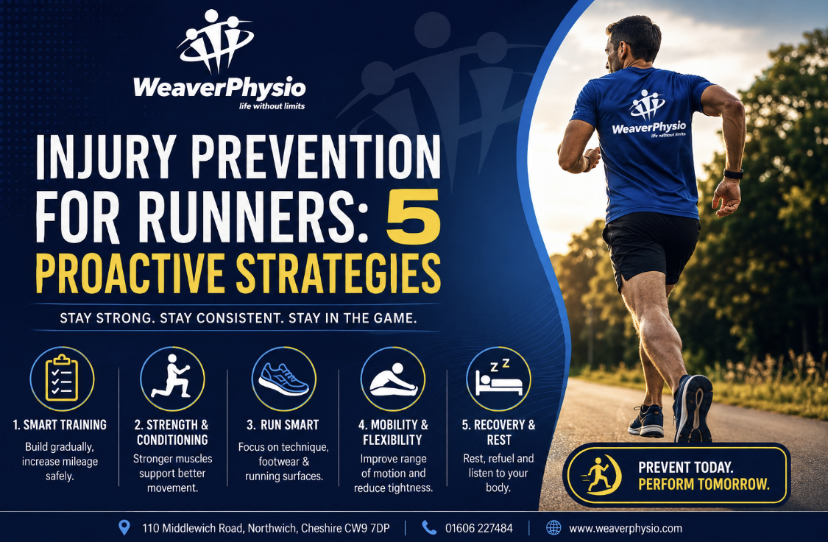
5 Proactive Strategies to Stay Strong, Consistent and Injury-Free
Running is one of the simplest and most rewarding forms of exercise. Whether you are training for your first 5K, chasing a marathon personal best or simply enjoying a few miles each week, running can improve cardiovascular fitness, strength, mental wellbeing and overall health.
However, running also places repeated demands on the body. When training load increases faster than your body’s ability to adapt, or when strength, stability, recovery and movement capacity are insufficient, aches and injuries can begin to appear.
At Weaver Physio in Northwich, we regularly assess and treat runners experiencing knee pain, Achilles tendon problems, shin pain, plantar heel pain, calf injuries, hamstring problems and other running-related conditions. While it is impossible to prevent every injury, there are practical steps runners can take to reduce injury risk and build a body that is better prepared for the demands of running.
The key is not simply stretching more or buying different running shoes. Effective injury prevention for runners requires a broader approach incorporating intelligent training, strength and conditioning, appropriate running mechanics, mobility and sufficient recovery.
Here are five proactive strategies to help you run stronger, train more consistently and spend less time sidelined by injury.
⸻
1. Build Your Running Training Gradually
One of the most important principles in running injury prevention is appropriate training-load management.
Your muscles, tendons, bones and joints need time to adapt to the repeated forces generated during running. Problems can develop when the demands placed on these tissues exceed their current capacity.
This is why runners sometimes become injured shortly after increasing their mileage, adding speed sessions, introducing hills or suddenly returning to running following a break.
Importantly, training load is about much more than weekly mileage. Consider changes in:
Running frequency
Distance
Speed and intensity
Hill training
Interval sessions
Running surface
Strength training
Competition frequency
Recovery between sessions
For example, your weekly mileage may remain unchanged, but replacing two easy runs with a hard interval session and a hilly tempo run can significantly alter the demands placed on your body.
Avoid sudden spikes in training
There is no single percentage rule that guarantees injury prevention. Instead, progression should reflect your individual training history, current conditioning, recovery and response to exercise.
A runner accustomed to 40 miles per week will generally tolerate a training change differently from somebody who has recently started running.
Pay attention to how your body responds. Persistent soreness, declining performance, unusual fatigue or discomfort that progressively worsens during successive runs may indicate that your current workload needs adjusting.
Consistency is generally more valuable than repeatedly alternating between very high training volumes and periods of forced rest.
Build gradually. Adapt. Recover. Then progress.
⸻
2. Strength & Conditioning: Build the Foundation for Better Running
Strength and conditioning should be an important part of a runner’s overall programme.
Running itself is excellent exercise, but running alone does not necessarily develop every physical quality required to tolerate increasing mileage, faster speeds, hills and competition.
At Weaver Physio, our approach to strength and conditioning for runners starts by establishing a great physical foundation through the combination of:
Balance + Strength + Stability + Coordination
These four qualities work together rather than existing independently.
Balance
Running is effectively a repeated series of single-leg movements.
Every stride requires you to accept your body weight on one leg, control your position and then generate enough force to propel yourself forwards.
Developing balance provides an important foundation from which more challenging strength and running-specific exercises can progress.
Exercises may include single-leg standing variations, dynamic balance drills and progressively more demanding single-leg tasks.
Strength
Runners need sufficient muscular strength to absorb and generate force repeatedly.
Particular attention may be given to the:
Gluteals • Quadriceps • Hamstrings • Calves • Soleus • Hip musculature • Trunk
Strength training should also be progressive. Once an exercise becomes easy, simply repeating the same exercise indefinitely may provide limited additional adaptation.
Depending upon the runner, rehabilitation or conditioning may progress from basic exercises towards heavier resistance and increasingly running-specific movements.
Examples can include squats, split squats, calf raises, soleus strengthening, deadlift variations and step-based exercises.
Stability
Strength alone does not tell the complete story.
Runners also need the ability to control movement while force is being generated and absorbed.
Hip and pelvic stability can be particularly relevant during single-leg loading. Appropriate trunk and lower-limb control can help runners maintain efficient movement as training demands increase.
At Weaver Physio, stability exercises can therefore be incorporated alongside strength rather than treated as an isolated part of rehabilitation.
Coordination
Coordination connects the other elements.
A runner may possess good strength when performing a controlled gym exercise but still need to learn how to apply that capacity during faster, more dynamic movements.
Coordination drills can challenge timing, rhythm and movement control.
As the runner develops an appropriate foundation of balance, strength, stability and coordination, rehabilitation can progress towards more dynamic exercises, potentially including hopping, jumping, landing drills and plyometric training where appropriate.
The objective is not simply to make runners stronger in the gym.
It is to develop physical qualities that transfer into better running capacity, resilience and performance.
⸻
3. Run Smart: Technique, Footwear and Running Surfaces
There is no single “perfect” running technique that every runner should copy.
Human movement varies considerably, and many runners have individual running styles without experiencing pain or injury.
However, when someone experiences a recurring running injury, assessing how they move can provide useful information.
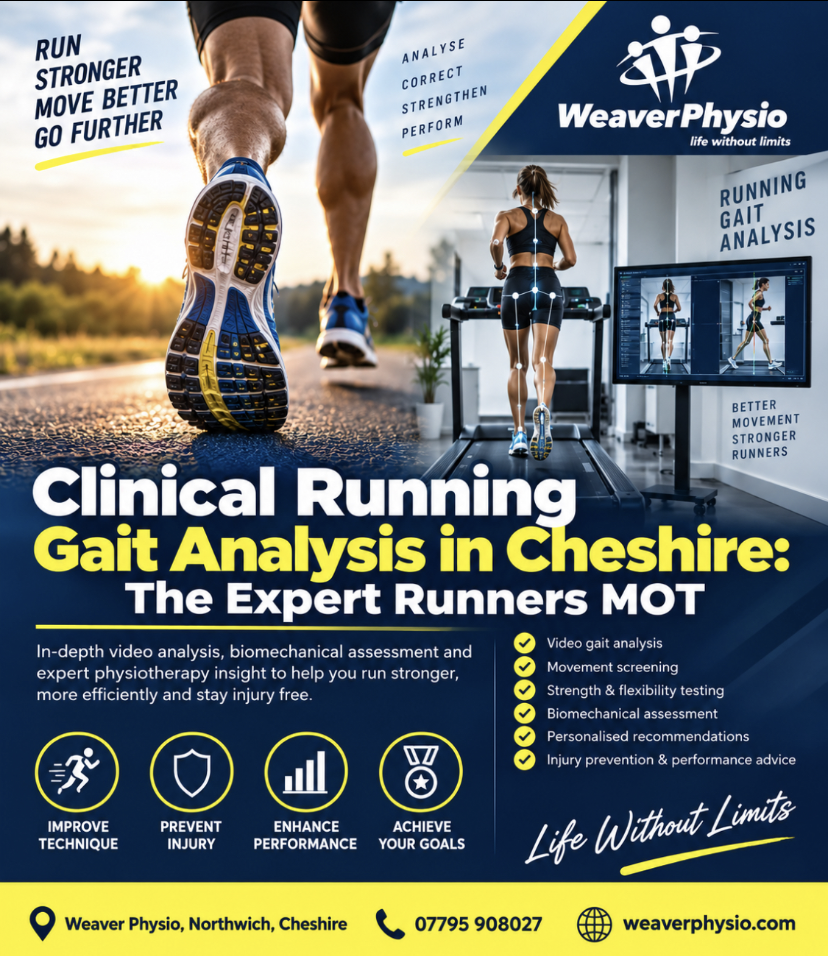
At Weaver Physio, running gait analysis in Northwich can form part of a broader clinical assessment. Rather than looking only at the feet, we can consider the entire kinetic chain.
This may include:
Foot strike • Cadence • Step length • Pelvic control • Knee position • Trunk movement • Lower-limb alignment • Running technique
Slow-motion video can make movement patterns easier to observe and discuss.
The important point is that gait findings should be interpreted alongside symptoms, training history, strength, mobility and clinical examination. A movement pattern seen on video does not automatically mean it is the cause of an injury.
Running footwear
Running shoes are another area where runners are often overwhelmed by conflicting advice.
There is rarely one universally “best” running shoe.
Comfort, fit, previous experience, running demands and individual biomechanics may all influence footwear choice.
If you are comfortable and running well in your existing footwear, changing shoes simply because another runner recommends a particular model may be unnecessary.
Vary your running intelligently
Running exclusively on the same route at the same pace is not inherently harmful, but variety can be useful when introduced appropriately.
Depending on your goals, training could incorporate:
Easy aerobic running
Longer runs
Tempo sessions
Intervals
Hills
Different surfaces
The key word is appropriately. Introducing several new training stresses simultaneously can make it difficult for your body to adapt.
⸻
4. Maintain the Mobility You Need to Run Well
Mobility is frequently discussed in running injury prevention, but more flexibility is not automatically better.
You do not need to become exceptionally flexible to be a successful runner.
Instead, you need sufficient mobility for your individual running mechanics and training demands.
Areas commonly considered during a running assessment include ankle movement, calf flexibility, hip mobility and general lower-limb range of motion.
For example, restricted ankle movement may influence how an individual performs a squat or manages certain running mechanics. Equally, restrictions elsewhere may result in compensatory movement strategies.
The solution is not automatically prolonged static stretching.
Depending upon the individual, mobility work might include dynamic movement exercises, targeted stretching, strengthening through range and specific mobility drills.
At Weaver Physio, we prefer to identify whether a restriction is actually relevant before prescribing exercises.
Mobility and strength should work together
An important distinction is the difference between having movement available and being able to control it.
Increasing range of motion without developing strength and control through that range may not address the underlying problem.
That is why our approach can combine mobility with the foundation of balance, strength, stability and coordination.
The goal is useful movement—not flexibility for flexibility’s sake.
⸻
5. Recovery Is Part of Your Training
One of the easiest aspects of running to underestimate is recovery.
Adaptation does not occur purely because you completed a difficult workout. Your body also needs sufficient opportunity to recover from that stimulus.
Hard training followed by inadequate recovery can eventually affect performance and your ability to tolerate subsequent sessions.
Recovery includes more than taking an occasional rest day.
Think about your overall lifestyle, including:
Sleep • Nutrition • Hydration • Stress • Training intensity • Rest • Recovery between hard sessions
Easy runs should generally feel easy enough to fulfil their intended purpose. Turning every session into a race can increase fatigue without necessarily producing additional benefit.
Listen to patterns rather than isolated sensations
Runners often experience temporary stiffness or muscle soreness, particularly following a new training stimulus.
Not every ache means you are injured.
However, symptoms deserve more attention when they become progressively worse, persist, significantly alter your running mechanics or begin interfering with normal daily activities.
Seeking assessment earlier can sometimes prevent a relatively manageable problem from becoming a prolonged interruption to training.
⸻
Common Running Injuries We See at Weaver Physio
Running-related injuries can affect runners of every level, from complete beginners to experienced marathon athletes.
At Weaver Physio in Northwich, commonly assessed problems include:
Runner’s knee and patellofemoral pain
Achilles tendinopathy
Plantar heel pain and plantar fasciitis
Shin pain
Calf strains
Hamstring injuries
ITB-related lateral knee pain
Hip pain
Gluteal tendinopathy
Patellar tendon problems
Ankle and foot pain
Muscle and tendon overload injuries
Successful treatment should involve more than simply reducing symptoms.
Where appropriate, rehabilitation needs to identify the factors contributing to the problem and progressively rebuild the runner’s capacity to meet their training demands.
⸻
What About Sports Massage?
Sports massage in Northwich can also complement a runner’s wider training and recovery programme.
Soft tissue techniques may help some runners manage temporary muscular soreness, stiffness or feelings of tightness. However, massage should not replace progressive rehabilitation when an injury requires improvements in strength, capacity or training-load management.
At Weaver Physio, sports massage can therefore sit alongside physiotherapy, exercise rehabilitation and strength and conditioning rather than being viewed as a standalone method of preventing every running injury.
The objective is always to choose interventions appropriate to the individual runner.
⸻
When Should a Runner See a Physiotherapist?
You do not necessarily need to wait until pain stops you running completely.
Consider a professional assessment when pain:
Continues despite reducing or modifying training
Becomes progressively worse
Repeatedly returns when mileage increases
Changes the way you walk or run
Causes significant swelling
Affects everyday activities
Prevents normal training
Fails to improve as expected
An assessment can help establish what may be contributing to the symptoms and provide a structured plan for recovery.
⸻
Running Injury Assessment at Weaver Physio Northwich
There is rarely one single explanation for every running injury.
For that reason, our assessment may consider multiple factors, including your symptoms, previous injury history, running goals, weekly mileage, recent training changes, strength, mobility, movement control and running mechanics.
Where appropriate, video running gait analysis can provide additional information about how you move while running.
From there, rehabilitation can be individualised.
Depending upon the findings, treatment may incorporate physiotherapy, progressive exercise rehabilitation, strength and conditioning, mobility work, gait retraining, sports massage or other appropriate interventions.
Most importantly, rehabilitation should progress with you.
The exercises appropriate during the early stages of an injury may be very different from those required when preparing to return to faster running or competition.
⸻
The Weaver Physio Approach: Build Capacity, Not Fear
Injury prevention should not make runners frightened of movement.
Running is not inherently bad for your knees, and every minor biomechanical variation does not need to be “corrected”.
A better approach is to build a body capable of handling the demands you place upon it.
That means creating an appropriate foundation, gradually exposing your body to training stress and allowing sufficient recovery for adaptation.
For many runners, the process can be summarised as:
Train Smart → Build Balance → Develop Strength → Improve Stability → Challenge Coordination → Progress Running Load → Recover → Perform
Once that foundation is established, more advanced strength, power and plyometric work can be introduced when appropriate.
⸻
Injury Prevention for Runners in Northwich: The 5 Key Strategies
If you want to reduce your likelihood of running-related problems and train more consistently, focus on these five fundamentals:
1. Smart Training – Progress your mileage and intensity sensibly rather than making sudden changes.
2. Strength & Conditioning – Establish a strong foundation by combining balance, strength, stability and coordination, then progress towards increasingly running-specific demands.
3. Run Smart – Consider technique, footwear, training intensity and running surfaces as part of the overall picture.
4. Mobility & Flexibility – Develop the movement you genuinely need while maintaining strength and control.
5. Recovery & Rest – Give your body sufficient sleep, nutrition, hydration and recovery to adapt to training.
There is no programme that can guarantee you will never become injured. But improving your physical capacity and managing training intelligently can put you in a much better position to enjoy consistent running.
Prevent Today. Perform Tomorrow.
If recurring pain, injury or uncertainty about your running is preventing you from progressing, Weaver Physio provides specialist physiotherapy, running injury rehabilitation, strength and conditioning and running gait analysis in Northwich, Cheshire.
Our aim is not simply to get you pain-free. We want to help you understand your body, establish a strong foundation and progressively develop the physical capacity needed to return to running with confidence.
Weaver Physio
110 Middlewich Road, Northwich, Cheshire CW9 7DP
01606 227484
http://www.weaverphysio.com
Serving runners across Northwich, Hartford, Weaverham, Winsford, Middlewich, Knutsford, Tarporley, Frodsham, Sandbach and the wider Cheshire area.
Run stronger. Stay consistent. Keep doing what you love.