
Knee Pain After Running
Common Causes, Treatment & Prevention
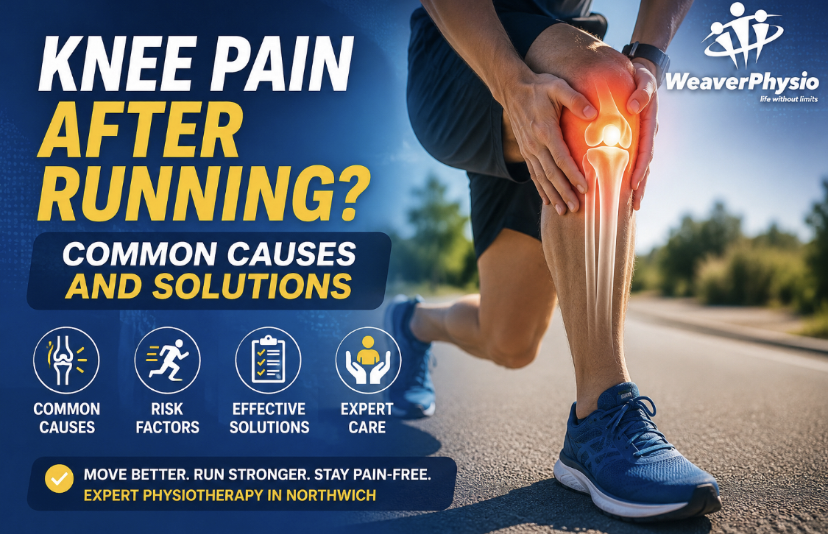
Knee pain after running is one of the most common problems experienced by recreational and competitive runners. Whether you are preparing for your first 5K, increasing your weekly mileage or training for a marathon, persistent knee pain can quickly disrupt your training and leave you wondering whether you should continue running or stop altogether.
The good news is that knee pain does not automatically mean running is damaging your joints. In many cases, running-related knee pain develops when the demands of training temporarily exceed the capacity of your muscles, tendons and joints to tolerate that load.
At Weaver Physiotherapy & Sports Injury Clinic in Northwich, we assess and treat runners experiencing knee pain, recurring injuries and problems preventing them from progressing with their training. Our Specialist Running Injury Clinic in Northwich (https://www.weaverphysio.com/running-injuries-clinic) combines detailed clinical assessment, rehabilitation and running-specific analysis to help identify why problems develop—not simply where they hurt.
Why Does My Knee Hurt After Running?
There is rarely one universal cause of knee pain after running.
Running places repeated demands on the lower limbs, and the body normally adapts extremely well to these forces. Problems can occur when there is a mismatch between the amount of load being placed on the knee and its current ability to tolerate that load.
This may be influenced by a sudden increase in running volume, greater training intensity, additional hill sessions, changes in footwear or terrain, inadequate recovery, previous injury, reduced lower-limb strength or aspects of running technique.
For a more detailed explanation, read our guide: Why Do My Knees Hurt When I Run? (https://www.weaverphysio.com/why-do-my-knees-hurt-when-i-run)
Common Causes of Knee Pain in Runners
Patellofemoral Pain – Runner’s Knee
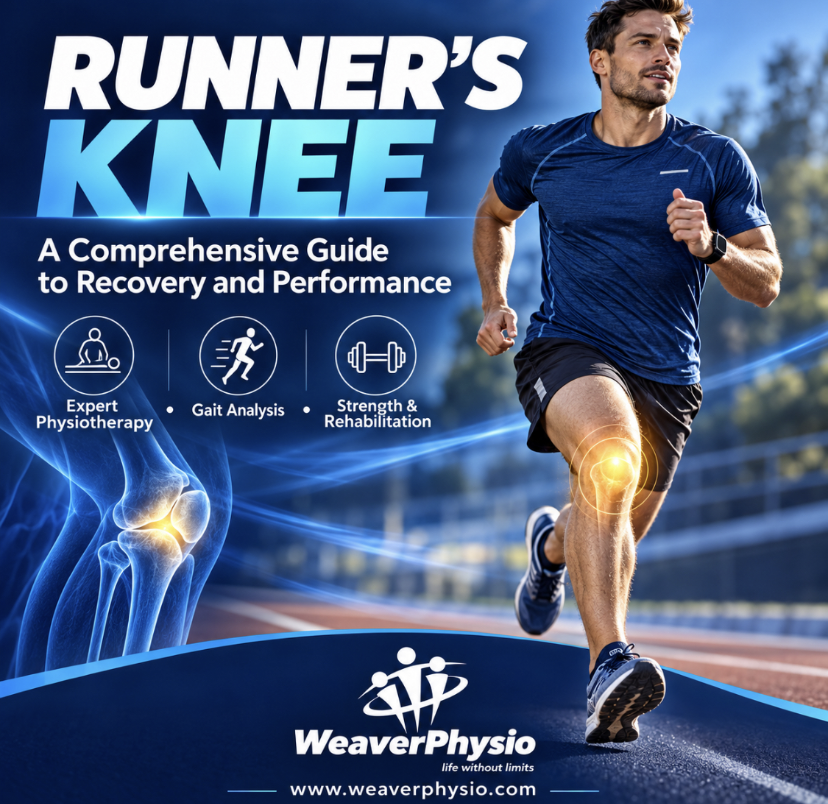
Patellofemoral pain is frequently referred to as Runner’s Knee and commonly produces discomfort around or behind the kneecap.
Symptoms may become noticeable during running but can also occur when squatting, using stairs or sitting with the knee bent for prolonged periods.
Rather than being caused by a single structural problem, patellofemoral pain is often associated with several interacting factors, including training load, lower-limb strength and movement patterns.
If your symptoms sound familiar, read our complete guide to Runner’s Knee – Symptoms, Treatment & Prevention (https://www.weaverphysio.com/runners-knee-explained).
Iliotibial Band Syndrome
Iliotibial Band Syndrome (ITBS) typically produces pain around the outside of the knee.
It is commonly associated with repetitive running and may become increasingly noticeable as a run progresses. Changes in training volume, hill running and reduced capacity of the muscles controlling the hip and pelvis can contribute to symptoms.
Our Sports Injury Clinic in Northwich (https://www.weaverphysio.com/sports-injuries) assesses and rehabilitates ITB syndrome alongside a wide range of other running and sports injuries.
Patellar Tendinopathy
The patellar tendon connects the kneecap to the tibia and plays an important role in transferring force through the knee.
Patellar tendinopathy is generally a load-related condition. Symptoms commonly develop gradually and may be aggravated by running, jumping, squatting and other activities involving repeated loading of the knee.
Appropriate rehabilitation usually involves carefully managing load while progressively improving the tendon’s ability to tolerate force.
Learn more about Weaver Physio’s approach to Running & Tendon Rehabilitation (https://www.weaverphysio.com/running-and-tendon-rehab).
Meniscal and Ligament Injuries
Not every painful knee in a runner is an overuse injury.
A twisting movement, fall or sudden change of direction can occasionally result in injury to structures such as the meniscus or knee ligaments.
Significant swelling, instability, inability to fully move the knee or persistent locking should be professionally assessed.
Is It Normal Muscle Soreness or a Running Injury?
Mild muscular soreness following an unfamiliar or particularly demanding training session can be normal. Joint pain that repeatedly appears during or after running deserves greater attention.
One useful indicator is how symptoms respond during the 24 hours following exercise.
If discomfort remains mild and returns towards its previous level relatively quickly, the training load may have been tolerable. If symptoms become progressively worse, persist into the following day or increase each time you run, your current training load may need modifying.
Seek professional assessment sooner if you experience significant swelling, marked loss of movement, repeated giving way, inability to weight-bear normally, persistent locking or substantial pain following an acute injury.
Why Do Running Injuries Develop?
One of the most important factors we investigate at Weaver Physio is training load.
Your body needs sufficient time to adapt to increases in running stress. Problems can develop when mileage, speed, frequency or hill work increases faster than the body’s capacity to recover and adapt.
Other contributing factors may include:
Reduced quadriceps or calf strength
Reduced hip and gluteal strength
Limited ankle or hip mobility
Changes in running volume or intensity
Previous lower-limb injury
Inadequate recovery
Changes in footwear or running surface
Running technique and movement patterns
This is why simply resting until the pain disappears does not always prevent the problem from returning.
For more advice on building running resilience, read our Physiotherapist’s Guide to Running Pain-Free (https://www.weaverphysio.com/how-to-run-pain-free-a-physiotherapists-guide).
Running Gait Analysis in Northwich
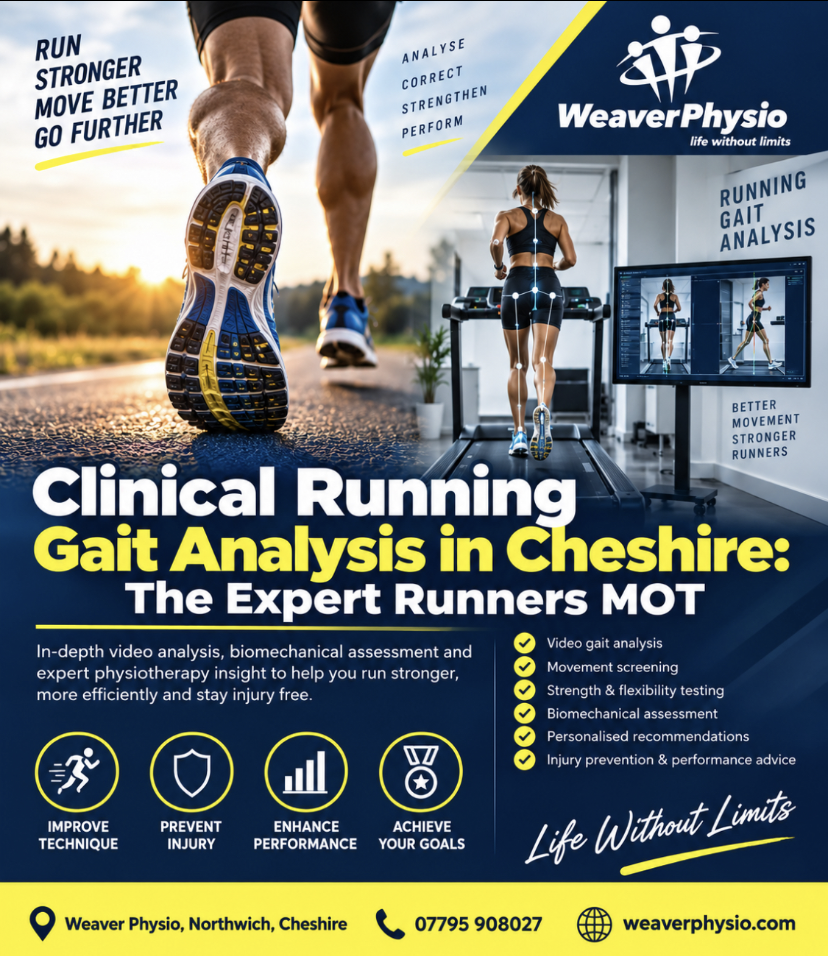
For runners experiencing persistent or recurring knee pain, running gait analysis can provide valuable information about how the body moves during running.
At Weaver Physio in Northwich, video analysis can be used alongside a comprehensive clinical assessment to examine your running mechanics.
We may assess factors including cadence, stride characteristics, foot placement, trunk position, pelvic control and lower-limb movement.
Importantly, there is no single “perfect” running technique.
The objective is not to make every runner move identically. Instead, gait analysis helps identify whether particular movement patterns may be contributing to an individual’s symptoms and whether carefully selected modifications could help manage running load.
Discover more about Running Gait Analysis at Weaver Physio (https://www.weaverphysio.com/gait-analysis).
Runner’s MOT in Northwich
Our Runner’s MOT takes the assessment beyond simply watching you run.
Depending on your individual presentation, we may examine:
Running gait and technique
Lower-limb strength
Balance and stability
Hip, knee and ankle mobility
Single-leg control
Flexibility
Functional movement
Training history
Previous injuries
Current running goals
Bringing this information together allows us to develop a rehabilitation and performance plan based on the demands of your running rather than relying on generic exercises.
Find out more about our Runner’s MOT and Specialist Running Injury Clinic (https://www.weaverphysio.com/running-injuries-clinic).
Physiotherapy for Running-Related Knee Pain in Northwich
Treatment should be based on your diagnosis and the factors contributing to your symptoms.
At Weaver Physiotherapy & Sports Injury Clinic, rehabilitation may include education and load management, progressive strengthening, mobility work, hands-on physiotherapy where appropriate, running gait retraining and a structured return-to-running programme.
Our objective is not simply to reduce your symptoms temporarily. We want to improve your body’s capacity to tolerate the demands of running.
If you are looking for a Physiotherapist in Northwich (https://www.weaverphysio.com/northwich-physio), our team provides assessment and rehabilitation for running injuries, sports injuries and a wide range of musculoskeletal conditions.
Strength and Conditioning for Runners
Progressive strengthening is often central to successful running injury rehabilitation.
Depending on your assessment, exercises may target the quadriceps, hamstrings, gluteal muscles, calves and other muscles involved in controlling and producing force during running.
Rehabilitation should eventually progress beyond simple isolated exercises. Runners need sufficient strength, control and physical capacity to tolerate the repetitive demands of their chosen distance, terrain and training intensity.
Shockwave Therapy for Persistent Tendon Problems
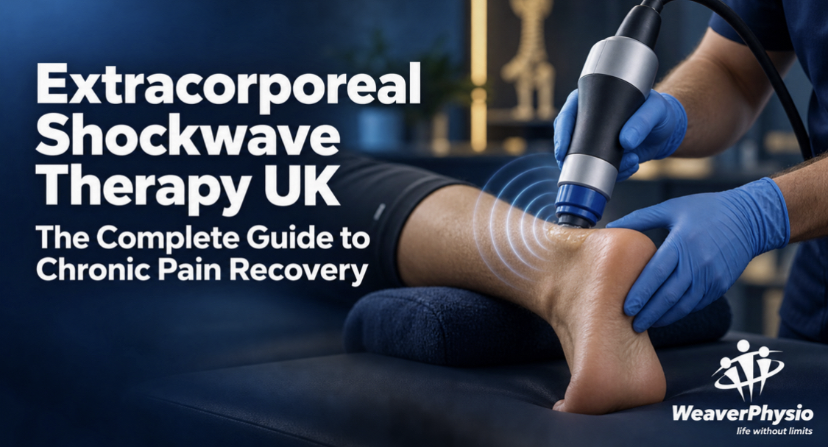
For selected persistent tendon conditions, Extracorporeal Shockwave Therapy (ESWT) may be considered as part of a broader rehabilitation programme.
Weaver Physio provides Shockwave Therapy in Northwich (https://www.weaverphysio.com/shockwave-therapy) for appropriate musculoskeletal and tendon conditions.
Shockwave therapy should not be viewed as a substitute for rehabilitation. Where clinically appropriate, it can be combined with progressive loading and strength work as part of an individual treatment programme.
Should You Completely Stop Running?
Not necessarily.
For many running-related knee problems, complete rest is not required. Instead, relative rest and load modification may allow you to remain active while symptoms settle.
This might involve temporarily reducing distance, removing speed sessions, avoiding provocative hills, increasing recovery between runs or replacing some running sessions with lower-impact cardiovascular exercise.
The appropriate approach depends on your diagnosis and symptom severity.
Returning to Running After Knee Pain
Returning to running should be progressive rather than based purely on the absence of pain.
A structured walk-run programme can be useful following a period away from running because it allows impact exposure to increase gradually.
As capacity improves, running duration can be progressed before gradually reintroducing additional training demands such as continuous running, increased distance, faster sessions and hills.
Your rehabilitation should prepare you for the actual demands of your sport—not simply make you pain-free in the treatment room.
Preventing Knee Pain From Returning
Reducing the likelihood of future running injuries involves improving your body’s ability to tolerate training.
Useful strategies include:
Progressing training appropriately
Maintaining lower-limb strength
Allowing sufficient recovery
Introducing hills and speed work progressively
Maintaining adequate calf and quadriceps capacity
Building hip and gluteal strength
Monitoring significant changes in training load
Responding early to persistent symptoms
Addressing relevant movement or biomechanical factors
Your training programme should reflect your individual running experience, goals and previous injury history.
Specialist Running Injury Physiotherapy in Northwich
If knee pain keeps returning every time you increase your running, simply treating the painful area may not provide the complete answer.
At Weaver Physiotherapy & Sports Injury Clinic, our Chartered Physiotherapists combine clinical assessment, progressive rehabilitation and running gait analysis to identify factors that may be contributing to your symptoms.
Our Northwich clinic supports runners from Northwich, Hartford, Weaverham, Winsford, Middlewich, Knutsford, Tarporley, Frodsham, Sandbach and surrounding areas across Cheshire.
Whether you are trying to complete your first 5K, return following an injury or prepare for your next marathon, our goal is to help you recover, rebuild and return to running with confidence.
Book a Runner’s MOT & Running Gait Analysis in Northwich
If knee pain is disrupting your training, a detailed running assessment can help establish what may be contributing to the problem and what you can do about it.
Discover Weaver Physio’s Runner’s MOT, Running Gait Analysis & Running Injury Clinic in Northwich (https://www.weaverphysio.com/running-injuries-clinic).
Book your assessment with Weaver Physio and take the next step towards stronger, more confident running.
Frequently Asked Questions About Knee Pain After Running
How long should I rest my knee if it hurts after running?
There is no single rest period appropriate for every runner. Mild symptoms may settle following a short reduction in training load, while persistent or worsening pain may require assessment. Complete inactivity is not always necessary, and maintaining suitable activity can form part of rehabilitation.
Can I continue running with mild knee pain?
Some runners can continue with modified training when symptoms remain mild and stable. However, pain that progressively increases, alters your running technique or remains substantially worse after training suggests the load may be excessive. Persistent symptoms should be professionally assessed.
What exercises are best for Runner’s Knee?
There is no universal exercise programme for patellofemoral pain. Rehabilitation frequently includes progressive strengthening of the quadriceps, hips, glutes and calves. Exercises such as squats, split squats, step-ups, calf raises and appropriately progressed single-leg exercises may be useful, but the programme should reflect the individual runner’s assessment.
Is running on tarmac bad for your knees?
Running on tarmac does not automatically cause knee injuries. Running surface is only one component of overall training load. Problems are more likely to occur when changes in terrain, distance or intensity exceed the body’s current ability to adapt.
Do running shoes cause knee pain?
There is rarely a simple relationship between one type of running shoe and knee pain. Comfort, previous experience, training demands and individual biomechanics should all be considered when choosing footwear.
When should I see a physiotherapist about running-related knee pain?
Consider a physiotherapy assessment when knee pain repeatedly returns, is worsening, prevents you from running normally or fails to improve despite sensible modifications to your training.
Significant swelling, instability, locking, substantial restriction of movement or difficulty weight-bearing should be assessed promptly.
Will a knee brace help with running pain?
A brace or support may provide temporary symptom relief for some conditions, but it rarely addresses all the factors contributing to running-related knee pain. Where appropriate, it is usually better considered as one component of a wider rehabilitation programme involving strength, load management and movement assessment.
Knee Pain After Running? Find the Cause and Build Back Stronger
Recurring knee pain does not have to dictate your running.
With an accurate assessment, appropriate load management, progressive strengthening and, where indicated, professional running gait analysis, many runners can successfully return to training.
At Weaver Physiotherapy & Sports Injury Clinic in Northwich, we provide specialist assessment and rehabilitation for runners experiencing knee pain and other running-related injuries.
Knee pain after running? Book your Runner’s MOT or Running Injury Assessment with Weaver Physio (https://www.weaverphysio.com/running-injuries-clinic) and start building towards stronger, more resilient running.