
Kids Physiotherapy in Northwich
Expert Physiotherapy for Children & Young Athletes
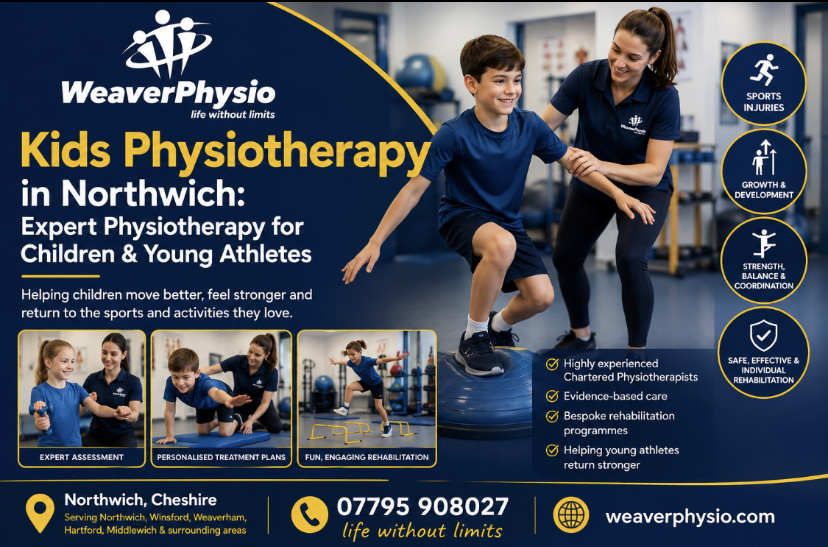
When your child is experiencing pain, struggling with a sports injury or finding that a physical problem is preventing them from enjoying normal activities, it can be difficult to know what to do next. Children and teenagers are active, growing and constantly adapting, which means their injuries and musculoskeletal problems often need to be assessed differently from those of adults.
At Weaver Physio in Northwich, we provide professional physiotherapy assessment, treatment and rehabilitation for children and young people experiencing musculoskeletal pain, sports injuries and growth-related conditions.
Our aim is straightforward: understand what is causing the problem, explain it clearly to both the child and parent, and develop an individual rehabilitation programme that helps them move comfortably, regain strength and return safely to the activities they enjoy.
Whether your child wants to get back to football, athletics, gymnastics, dance or simply everyday activity without pain, our approach focuses on building confidence as well as physical recovery.
Why Physiotherapy for Children Is Different
A growing body is not simply a smaller version of an adult body.
During childhood and adolescence, bones, muscles, tendons and joints are continually developing. Periods of rapid growth can temporarily alter flexibility, strength, coordination and the way forces are distributed through the body.
This becomes particularly important for active children who participate regularly in sport.
Training volume, sudden increases in activity, repetitive loading, growth spurts and inadequate recovery can all contribute to pain or injury. Certain problems can also occur around areas where growing tendons attach to bone.
For this reason, physiotherapy for children and teenagers should consider much more than the painful area alone.
At Weaver Physio, assessment may consider:
The history and behaviour of the symptoms
Joint movement and flexibility
Muscle strength and control
Balance and coordination
Functional movement
Walking or running mechanics where appropriate
Sporting technique and physical demands
Recent growth or changes in activity
Training frequency and workload
Previous injuries
The child’s individual goals
By building a clearer picture of the factors contributing to the problem, we can develop rehabilitation around the individual rather than simply treating symptoms.
Kids Sports Injury Physiotherapy in Northwich
Sport provides enormous physical and social benefits for children, but active youngsters can occasionally experience injuries.
Football, rugby, running, athletics, gymnastics, dance, swimming, tennis and other activities can all place different demands on a developing body.
Some injuries occur suddenly following a tackle, fall, awkward landing or rapid movement. Others develop gradually when repeated loading exceeds the body’s current capacity to recover and adapt.
At Weaver Physio, we regularly assess young people experiencing sporting and activity-related musculoskeletal problems.
The priority is not simply getting them back to sport quickly. We want to help them return safely, progressively and with appropriate strength and physical capacity.
Common Conditions We Can Assess
Every child’s symptoms should be assessed individually, but problems seen in active children and teenagers can include:
Osgood-Schlatter Disease
Osgood-Schlatter disease is a common cause of pain around the front of the knee in growing and physically active young people.
Pain is usually felt around the bony prominence just below the kneecap and can become aggravated by activities involving repeated running, jumping, kicking or squatting.
Management does not necessarily mean stopping all activity.
A physiotherapy programme may include appropriate load modification, flexibility work, progressive strengthening and advice about managing sporting activity while symptoms settle.
Sever’s Disease and Heel Pain
Heel pain can occur during periods of growth, particularly in children involved in running and jumping sports.
Symptoms may become more noticeable during or after football, athletics and other high-impact activities.
Assessment can help determine whether the symptoms are consistent with a growth-related problem or whether another cause of heel pain needs to be considered.
Treatment and rehabilitation can then focus on reducing aggravating loads while maintaining appropriate activity wherever possible.
Knee Pain in Children and Teenagers
Knee pain is relatively common among active young people and can arise for several reasons.
Rather than assuming all knee pain has the same cause, we assess the individual presentation and consider factors including strength, flexibility, movement control and sporting demands.
Rehabilitation may include progressive exercises targeting the hips, knees and lower limbs alongside a structured return to activity.
Muscle Strains
Young athletes can experience muscle injuries involving areas such as the hamstrings, quadriceps, calf or groin.
Rehabilitation should progress beyond simply waiting for pain to disappear.
The affected muscle needs to regain appropriate strength and gradually develop the capacity to tolerate running, acceleration, deceleration, jumping and other demands of the child’s sport.
Ankle Injuries
Ankle sprains are common in sports involving rapid changes of direction, jumping or contact.
Once the initial symptoms have settled, rehabilitation may focus on restoring:
Ankle movement
Strength
Balance
Proprioception
Coordination
Running ability
Jumping and landing control
Change-of-direction capacity
This progression can be particularly important before returning to competitive sport.
Running-Related Injuries
Young runners and athletes may occasionally develop pain associated with increased training volume, competition schedules or rapid changes in physical workload.
Our assessment can examine factors such as lower-limb strength, mobility, running mechanics, training history and recent changes in activity.
Where appropriate, rehabilitation can incorporate running-specific strength and conditioning alongside a carefully graded return to training.
Growth Spurts, Sport and Injury
One factor that is sometimes overlooked when treating young athletes is growth.
During periods of rapid growth, bones and surrounding tissues do not necessarily adapt at exactly the same rate. A teenager who previously moved extremely well may temporarily experience changes in flexibility, coordination or movement control.
At the same time, sporting demands may be increasing.
A young footballer, runner or gymnast might suddenly be training several times each week while also participating in school sport and weekend competition.
The combination of growth and increased physical load can sometimes contribute to symptoms.
Rather than automatically telling a young athlete to stop everything, our goal is to understand what they can currently tolerate and adjust activity appropriately while building their physical capacity.
Our Approach at Weaver Physio
We believe effective rehabilitation begins with a thorough assessment.
Your child’s physiotherapist will take time to understand what happened, how long the symptoms have been present and what activities make the problem better or worse.
We also want to understand what your child wants to return to.
For one youngster that might mean being able to play comfortably at school. For another, it could mean returning to competitive football, athletics, dance or another demanding sport.
1. Understand the Problem
We begin by discussing the symptoms, activity levels, sporting demands, previous injuries and relevant history.
2. Assess Movement and Function
Depending on the problem, assessment may include joint movement, flexibility, strength, balance, functional movements and sport-specific tasks.
3. Explain Our Findings
Both parents and children should understand what we have found.
We aim to explain the problem in straightforward language and discuss what is likely to be required for recovery.
4. Build an Individual Rehabilitation Programme
Treatment is tailored to the child rather than following a generic exercise sheet.
Depending on their needs, rehabilitation may incorporate:
Mobility exercises
Progressive strengthening
Balance and stability work
Coordination exercises
Functional rehabilitation
Running rehabilitation
Jumping and landing exercises
Agility and change-of-direction work
Sport-specific exercises
Advice regarding training and activity levels
5. Progress Towards Their Goals
Exercises should become progressively more demanding as the child improves.
For a young athlete, this can mean moving from basic strength exercises through to running, jumping, acceleration, deceleration and sport-specific movement before returning fully to competition.
Making Rehabilitation Engaging
Children are more likely to participate consistently when rehabilitation feels achievable and relevant.
A programme consisting of exercises that feel repetitive or unrelated to their sport can quickly become frustrating.
We therefore aim to make rehabilitation progressive, functional and engaging.
For younger children, exercises can be adapted to make movement enjoyable. For teenagers involved in sport, rehabilitation can increasingly resemble the physical demands they need to perform.
This also gives young people measurable goals.
Seeing improvements in balance, strength, jumping, running or sporting movements can help rebuild confidence following an injury.
The Importance of Parents in Rehabilitation
Parents can play an important role in helping a child recover.
We explain what we believe is contributing to the problem, what activities may need temporarily modifying and how the rehabilitation programme should be completed.
The aim is not to create anxiety around movement.
In many musculoskeletal conditions, maintaining an appropriate level of physical activity can be beneficial. The challenge is finding the right balance between doing too much and unnecessarily avoiding activity.
Clear advice can help families make those decisions with greater confidence.
Returning Your Child Safely to Sport
Being pain-free is important, but it isn’t always the only requirement for returning to sport.
Sport places significant demands on the body.
A young footballer may need to sprint, turn, tackle, jump and kick. A runner needs to tolerate repeated impact over distance. A gymnast or dancer may require substantial strength, control and flexibility.
This is why our rehabilitation programmes can progress towards the specific demands of the child’s chosen activity.
Depending on the injury, we may assess:
Strength
Balance
Single-leg control
Running tolerance
Jumping and landing
Agility
Change of direction
Sport-specific movements
Confidence performing those movements
A gradual progression provides a much clearer pathway from rehabilitation back to normal training and competition.
When Should You Consider a Physiotherapy Assessment?
It may be worth arranging an assessment if your child has:
Pain that isn’t improving
Pain repeatedly returning during sport
A sports injury affecting normal participation
Knee, ankle, heel, hip or muscular pain
Difficulty running or jumping comfortably
Reduced confidence following an injury
Persistent symptoms following a growth spurt
Difficulty returning to sport after an injury
A noticeable change in movement following injury
Symptoms that are becoming progressively worse
If we identify anything during assessment that requires medical investigation or another healthcare professional’s opinion, we can advise you about the appropriate next step.
Why Choose Weaver Physio in Northwich?
At Weaver Physiotherapy & Sports Injury Clinic, our team has 70+ years of combined clinical experience.
We take an evidence-informed approach to musculoskeletal assessment and rehabilitation, combining clinical examination with progressive exercise and functional rehabilitation.
For young athletes in particular, our aim extends beyond reducing pain.
We want to help them develop the strength, stability, coordination and physical confidence needed to return successfully to their activity.
Our Northwich location also makes us accessible to families from surrounding areas including Hartford, Weaverham, Winsford, Middlewich and across Cheshire.
Helping Young People Move With Confidence
An injury can be frustrating at any age, but it can be particularly difficult for a child or teenager who suddenly finds themselves unable to participate in the sport or activities they enjoy.
The right rehabilitation can provide a clear pathway forward.
At Weaver Physio, we combine careful assessment, individualised treatment and progressive rehabilitation to help children and young athletes understand their injury, regain physical capacity and return to activity with confidence.
Rather than focusing solely on where it hurts, we look at movement, strength, physical demands, training and the factors that may have contributed to the problem.
The result is a rehabilitation programme built around the individual child and what they need to achieve.
Book a Kids Physiotherapy Assessment in Northwich
If your child is struggling with a sports injury, growth-related pain or another musculoskeletal problem, contact Weaver Physio in Northwich to arrange an assessment.
Weaver Physiotherapy & Sports Injury Clinic
110 Middlewich Road
Northwich, Cheshire
CW9 7DP
Telephone: 07795 908027
Website: http://www.weaverphysio.com
Frequently Asked Questions
What age children do you treat at Weaver Physio?
We assess children and teenagers experiencing appropriate musculoskeletal, sporting and activity-related problems. If you’re unsure whether physiotherapy is suitable for your child’s particular symptoms, contact the clinic and we can advise you.
Does my child need a GP referral?
Private physiotherapy can generally be accessed directly without a GP referral. If assessment suggests that further medical investigation or specialist input would be appropriate, we can explain the recommended next steps.
Can physiotherapy help Osgood-Schlatter disease?
Physiotherapy can help young people manage the physical and sporting demands associated with Osgood-Schlatter disease. Management may include education, appropriate activity modification, flexibility work and progressive strengthening based on the individual presentation.
Can my child continue playing sport while having physiotherapy?
This depends on the condition, severity of symptoms and demands of the sport. Complete rest is not automatically necessary for every injury. Where appropriate, we aim to identify a manageable level of activity while rehabilitation progresses.
How do you know when a young athlete is ready to return to sport?
Return-to-sport decisions should consider more than pain alone. Depending on the injury and sport, we may assess strength, balance, running tolerance, jumping, landing, agility, functional movement and confidence before progressing towards unrestricted participation.
What should my child wear to their assessment?
Comfortable clothing that allows the affected area to be assessed is recommended. Shorts and a T-shirt are often ideal. For running or sports-related problems, bringing the footwear normally used for the activity can also be useful.
Do you only treat children who play competitive sport?
No. Physiotherapy can be appropriate for children and teenagers experiencing musculoskeletal pain or injury whether they compete at a high level, participate recreationally or simply want to return comfortably to everyday physical activity