
Restoring Load Capacity in the Injured Runner: The Key to a Stronger, Safer Return to Running
By Weaver Physio & Sports Injury Clinic – Cheshire’s Running & Tendon Rehabilitation Specialists
Running is one of the most rewarding ways to stay fit, improve mental wellbeing and challenge yourself. Yet for many runners, injury becomes an unwelcome part of the journey. Whether you’re training for your first 5K, chasing a marathon personal best or simply enjoying regular runs, recurring injuries can stop your progress and dent your confidence.
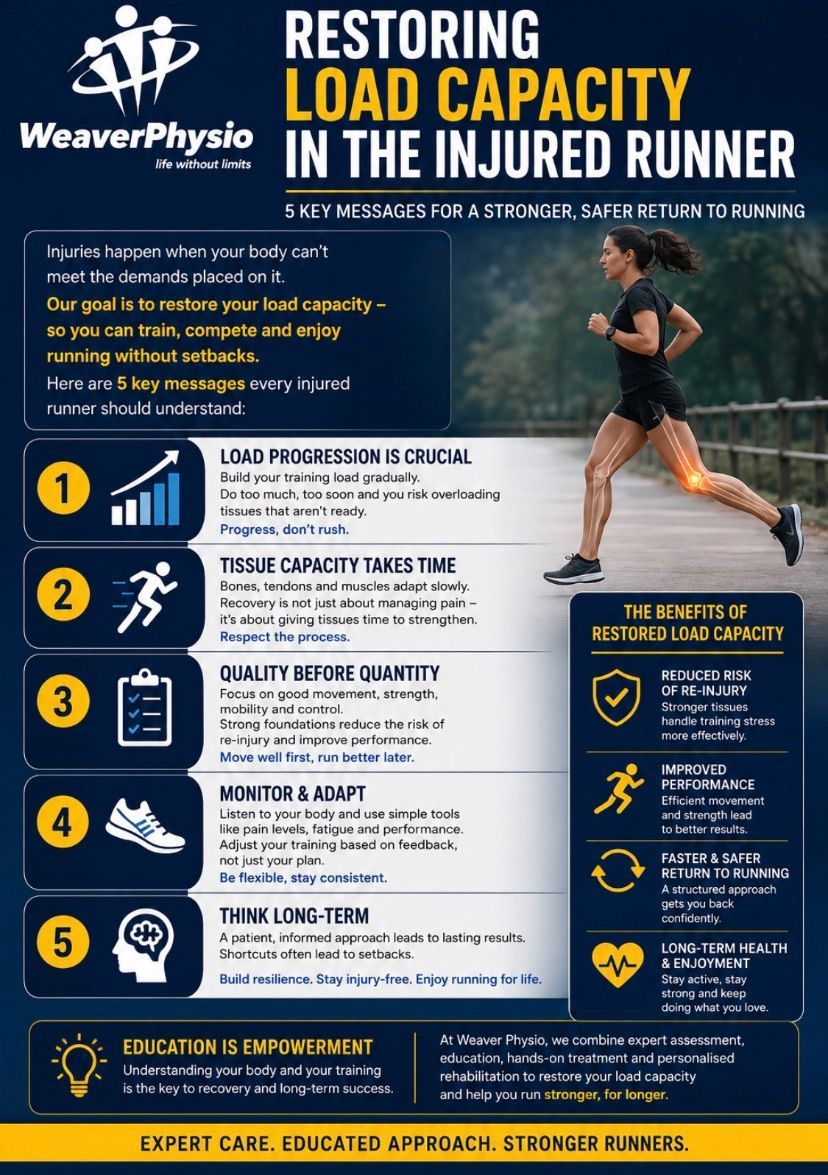
The good news is that most running injuries are not simply caused by “bad luck.” They occur when the demands placed on your body exceed its ability to cope. In rehabilitation, this is known as load capacity.
At Weaver Physio & Sports Injury Clinic, we believe successful rehabilitation isn’t just about reducing pain—it’s about restoring your body’s ability to tolerate training so you can return stronger than before.
This guide explains the five essential principles every injured runner should understand to build resilience, reduce re-injury risk and enjoy running for years to come.
What Is Load Capacity?
Load capacity refers to the amount of stress your muscles, tendons, bones, joints and ligaments can safely tolerate.
Every run places mechanical load through your body. When your tissues have adapted appropriately, this stress stimulates positive changes, making you stronger and more efficient.
Problems occur when:
Training increases too quickly
Recovery is inadequate
Strength is lacking
Previous injuries haven’t fully recovered
Running technique is inefficient
When the training load exceeds tissue capacity, injuries begin to develop.
Common examples include:
Achilles Tendinopathy
Plantar Fasciitis
Shin Splints
IT Band Syndrome
Patellofemoral Pain (Runner’s Knee)
Hamstring Injuries
Calf Strains
Stress Fractures
Rather than simply treating symptoms, rehabilitation should focus on increasing your body’s ability to tolerate running again.
Why Rest Alone Isn’t the Answer
Many runners stop running completely once pain develops.
Although a short period of reduced activity may help calm symptoms, prolonged rest rarely solves the underlying issue.
Without appropriate loading:
Tendons become weaker.
Muscles lose strength.
Bones lose conditioning.
Running fitness declines.
Confidence falls.
When runners eventually return, their tissues often tolerate even less than before, creating a frustrating cycle of repeated injury.
Instead of avoiding load, rehabilitation should gradually rebuild your body’s tolerance to it.
1. Load Progression Is Crucial
One of the biggest mistakes runners make is increasing training too quickly after injury.
The excitement of feeling better often leads to:
Running further
Running faster
Adding hills
Entering races too soon
Unfortunately, healing tissues may not yet be capable of managing those demands.
Successful rehabilitation follows the principle of progressive overload.
This means gradually increasing:
Running distance
Weekly mileage
Pace
Time on feet
Intensity
Strength training load
Small, consistent improvements allow tissues to adapt safely.
Progress isn’t about rushing.
It’s about building long-term resilience.
2. Tissue Capacity Takes Time
Bones, tendons, muscles and ligaments all heal differently.
Muscles often recover relatively quickly.
Tendons and bones require considerably longer.
For example:
Muscle strains may recover within several weeks.
Achilles tendinopathy may require several months of structured loading.
Patellar tendinopathy often needs progressive strengthening over many months.
Recovery is not simply about becoming pain-free.
It is about allowing tissues to become stronger than they were before injury.
This is why structured rehabilitation matters.
Pain reduction is only one stage.
Capacity building is the long-term goal.
3. Prioritise Quality Before Quantity
Many runners focus heavily on mileage.
However, running further isn’t always running better.
Movement quality has a huge influence on injury risk.
A strong running foundation includes:
Strength
Powerful hips, glutes and calves improve force absorption.
Stability
Single-leg control reduces excessive movement.
Balance
Good balance improves coordination and efficiency.
Mobility
Adequate joint movement reduces unnecessary compensations.
Coordination
Efficient movement conserves energy.
Plyometric Ability
Elastic spring-like function is essential for running economy.
At Weaver Physio, our Runner’s MOT and Running Assessments evaluate these important areas to identify weaknesses that may be contributing to injury.
4. Monitor and Adapt
One training plan doesn’t suit every runner.
Recovery should never rely on blindly following a schedule.
Instead, runners should regularly monitor:
Pain levels
Fatigue
Sleep quality
Muscle soreness
Running performance
Recovery between sessions
Some discomfort during rehabilitation can be acceptable.
However, significant increases in pain or prolonged soreness may indicate your tissues need more time.
Learning to listen to your body is one of the most valuable skills any runner can develop.
Consistency beats perfection every time.
5. Think Long-Term
The aim isn’t simply to complete next week’s run.
The goal is to continue running happily for years.
Long-term runners build habits that support lifelong health.
These include:
Regular strength training
Appropriate recovery
Gradual progression
Quality nutrition
Good sleep
Injury prevention exercises
Sensible race scheduling
Shortcuts often lead to setbacks.
Patience builds resilience.
The Benefits of Restoring Load Capacity
When your rehabilitation focuses on rebuilding tissue capacity rather than simply reducing pain, the benefits extend far beyond injury recovery.
Reduced Risk of Re-Injury
Stronger tissues tolerate higher training loads.
This means fewer recurring injuries.
Improved Performance
Strength, coordination and efficient movement improve running economy.
You often become faster without increasing effort.
Faster Return to Running
Structured rehabilitation provides a clear pathway back to training.
Instead of guessing when you’re ready, you progress with confidence.
Long-Term Running Enjoyment
Healthy runners remain active for decades.
Building resilience today protects your future performance.
Common Running Injuries We Treat
At Weaver Physio we regularly help runners recover from:
Achilles Tendinopathy
Plantar Fasciitis
Shin Splints
Runner’s Knee
IT Band Syndrome
Patellofemoral Pain
Hamstring Strains
Calf Injuries
Hip Pain
Gluteal Tendinopathy
Stress Fractures
Foot Pain
Tendon Injuries
Lower Back Pain affecting running
Every rehabilitation programme is tailored specifically to the individual runner.
Our Approach at Weaver Physio
With 70+ years of combined clinical experience, our Chartered Physiotherapists and Sports Injury Specialists provide evidence-based rehabilitation designed specifically for runners.
Your assessment may include:
Comprehensive injury assessment
Running history review
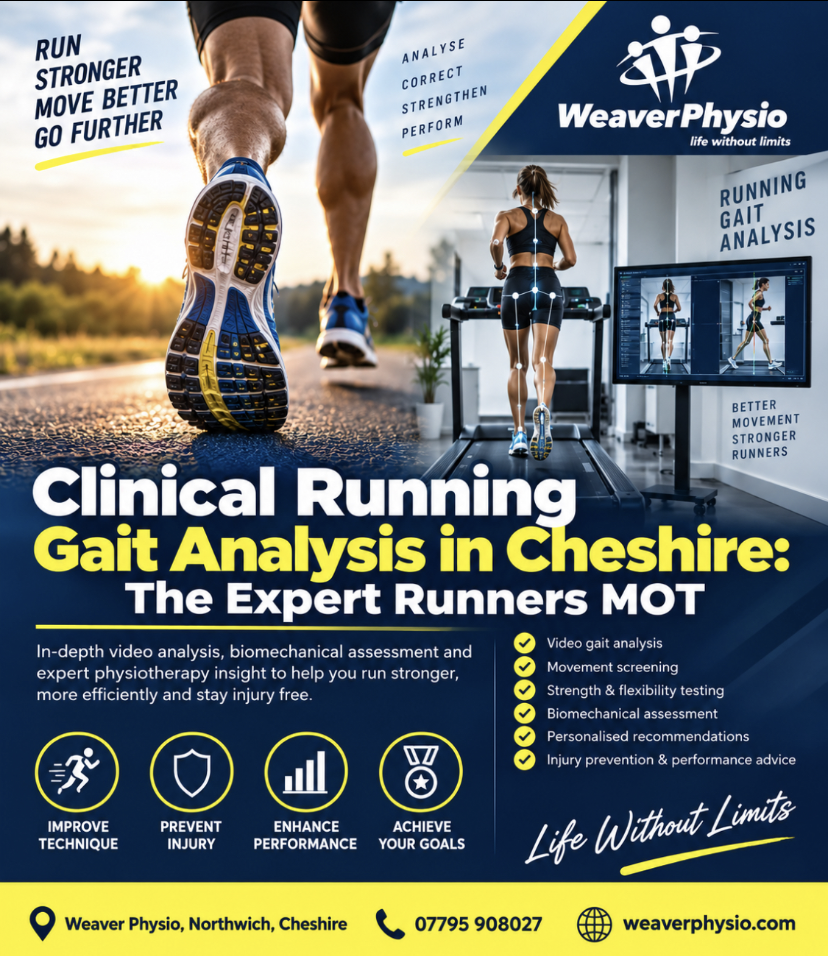
Video gait analysis
Strength testing
Mobility assessment
Balance and stability screening
Functional movement assessment
Load capacity evaluation
Personalised rehabilitation programme
Treatment may include:
Hands-on physiotherapy
Manual therapy
Progressive strength training
Tendon loading programmes
Running gait retraining
Shockwave Therapy (where appropriate)
Sports massage
Acupuncture
Return-to-running planning
Injury prevention education
Education Is Empowerment
Understanding why an injury occurred gives you control over your recovery.
Rather than fearing movement, you’ll learn:
How much running is appropriate
When to progress training
Which exercises matter most
How to monitor recovery
How to prevent recurrence
Knowledge builds confidence.
Confidence builds better runners.
Why Choose Weaver Physio?
At Weaver Physio, we don’t believe in quick fixes.
We believe in building stronger runners.
Our aim is not only to get you back running but to help you become:
Stronger
More resilient
More efficient
More confident
Less likely to suffer repeat injuries
Whether you’re a beginner or an experienced marathon runner, we provide the expert assessment, rehabilitation and support needed to restore your load capacity and keep you running for years to come.
Ready to Return to Running Stronger?
If you’re struggling with a running injury, don’t settle for simply masking the pain. Discover how restoring your load capacity can help you recover fully, improve your performance and reduce your risk of future injuries.
At Weaver Physio & Sports Injury Clinic, we’re proud to be Cheshire’s Running & Tendon Rehabilitation Specialists, helping runners of all abilities move better, recover stronger and stay injury free.
📞 Call: 01606 227484
🌐 Website: http://www.weaverphysio.com
📍 Address: 110 Middlewich Road, Northwich, Cheshire, CW9 7DP
Weaver Physio – Expert Care. Educated Approach. Stronger Runners.