
When to See a Physio for a Sports Injury:
Warning Signs You Shouldn’t Ignore

Aches, stiffness and tired muscles can be a normal part of training. But how do you know when discomfort is simply your body adapting to exercise — and when it could be the early sign of an injury?
For runners, gym-goers and athletes, this can be difficult to judge. Stop training unnecessarily and you may lose valuable fitness. Continue loading an injury without understanding what is happening and a relatively manageable problem could become more persistent.
At Weaver Physiotherapy & Sports Injury Clinic in Northwich, our approach is to assess the problem properly, identify the factors contributing to it and develop a rehabilitation plan designed around your sport, training demands and goals.
If pain is affecting the way you run, train, compete or move, early physiotherapy assessment can provide clarity and help you make better decisions about what to do next.
When Should You See a Physio for a Sports Injury?
You don’t necessarily need physiotherapy every time something aches after exercise. Mild muscular soreness following an unfamiliar or particularly demanding session will often settle naturally.
However, pain that persists, repeatedly returns or changes how you move deserves closer attention.
Consider booking a sports physiotherapy assessment if:
Pain is not improving despite reducing or modifying your training.
Symptoms repeatedly return when you increase your mileage, speed, weight or intensity.
You experience sharp or localised pain during a particular movement.
Swelling, bruising or joint stiffness is present.
You have noticeably lost strength, mobility or function.
You cannot comfortably walk, run, jump or bear weight.
A joint feels unstable, catches, locks or repeatedly gives way.
Pain is affecting sleep or normal everyday activities.
You develop unexplained numbness, tingling or weakness.
You are unsure whether continuing to train is safe.
Severe pain, significant trauma, obvious deformity, inability to bear weight, rapidly increasing swelling, or significant neurological symptoms may require urgent medical assessment rather than routine physiotherapy.
DOMS or Sports Injury? Understanding the Difference
One of the most common questions athletes ask is whether their discomfort is simply Delayed Onset Muscle Soreness (DOMS).
DOMS typically develops after a challenging or unfamiliar training session. Symptoms often become noticeable several hours after exercise and can include general muscle tenderness, stiffness and fatigue.
A sports injury may behave differently.
Pain can be more localised, appear during a specific movement, progressively worsen with loading or repeatedly return whenever training intensity increases.
For example, general soreness through both quadriceps after a demanding strength session may be consistent with normal post-exercise muscle soreness. A sharp pain in one hamstring every time you accelerate deserves greater attention.
The key is not simply how much it hurts, but how the symptoms behave and whether they are affecting normal movement or sporting performance.
Why Repeatedly Resting an Injury May Not Solve the Problem
Rest can be appropriate during certain stages of injury management, particularly immediately following some acute injuries. But complete rest is not automatically the best long-term solution.
A common pattern is:
Pain develops → training stops → symptoms settle → training resumes → pain returns.
When this keeps happening, the underlying issue may not have been adequately addressed.
Depending on the injury, contributing factors can include reduced tissue capacity, strength deficits, mobility restrictions, poor load management, previous injury, sudden changes in training volume or inadequate recovery.
This is why modern sports rehabilitation often focuses on appropriate progressive loading, rather than simply waiting for pain to disappear.
Our sports injury physiotherapy in Northwich aims to help athletes understand what they can safely continue doing while progressively rebuilding the capacity required for their sport.
The Nagging Sports Injury You Shouldn’t Ignore
Recurring injuries are particularly important.
If the same calf, Achilles, knee, hamstring or shoulder problem disappears with rest but returns whenever you resume harder training, there is usually value in investigating why.
Persistent problems can also influence movement and loading elsewhere in the body.
For runners, for example, a combination of strength, mobility, training load and running mechanics may contribute to ongoing symptoms.
Rather than focusing exclusively on the painful structure, a comprehensive assessment considers the whole athlete.
At Weaver Physio, this can include assessment of:
Muscle strength and capacity
Joint mobility
Flexibility
Balance and stability
Functional movement
Training history
Previous injuries
Running biomechanics
Sport-specific demands
The aim is to build a clearer picture of what may be contributing to the problem and what needs to change.
Common Sports Injuries We Treat in Northwich
Our Northwich sports injury clinic regularly assesses and rehabilitates problems including:
Achilles tendinopathy
Plantar heel pain / plantar fasciitis
Runner’s knee and patellofemoral pain
Iliotibial band syndrome (ITBS)
Calf and hamstring strains
Shin pain and medial tibial stress syndrome
Ankle sprains
Knee injuries
Hip and groin pain
Shoulder and rotator cuff injuries
Tennis and golfer’s elbow
Tendon injuries
Muscle strains
Running-related injuries
Overuse and training-load injuries
Whether your goal is returning to recreational exercise, completing your first 5K or competing at a high level, rehabilitation should reflect what your body needs to be capable of doing.
Sports Injury Physiotherapy in Northwich: What Does an Assessment Involve?
A high-quality sports injury assessment should involve considerably more than identifying where it hurts.
At Weaver Physiotherapy & Sports Injury Clinic, we begin by understanding your symptoms, training history, previous injuries, current activity levels and sporting goals.
Your physical assessment may then examine movement, mobility, strength, balance, functional control and sport-specific tasks.
For appropriate patients, objective strength testing can also help identify meaningful differences between limbs and provide measurable benchmarks during rehabilitation.
This creates something extremely valuable: objective information rather than guesswork.
Running Injury Assessment & Video Gait Analysis
Running injuries require a particularly detailed approach because symptoms are often influenced by a combination of tissue capacity, training load, strength and running mechanics.
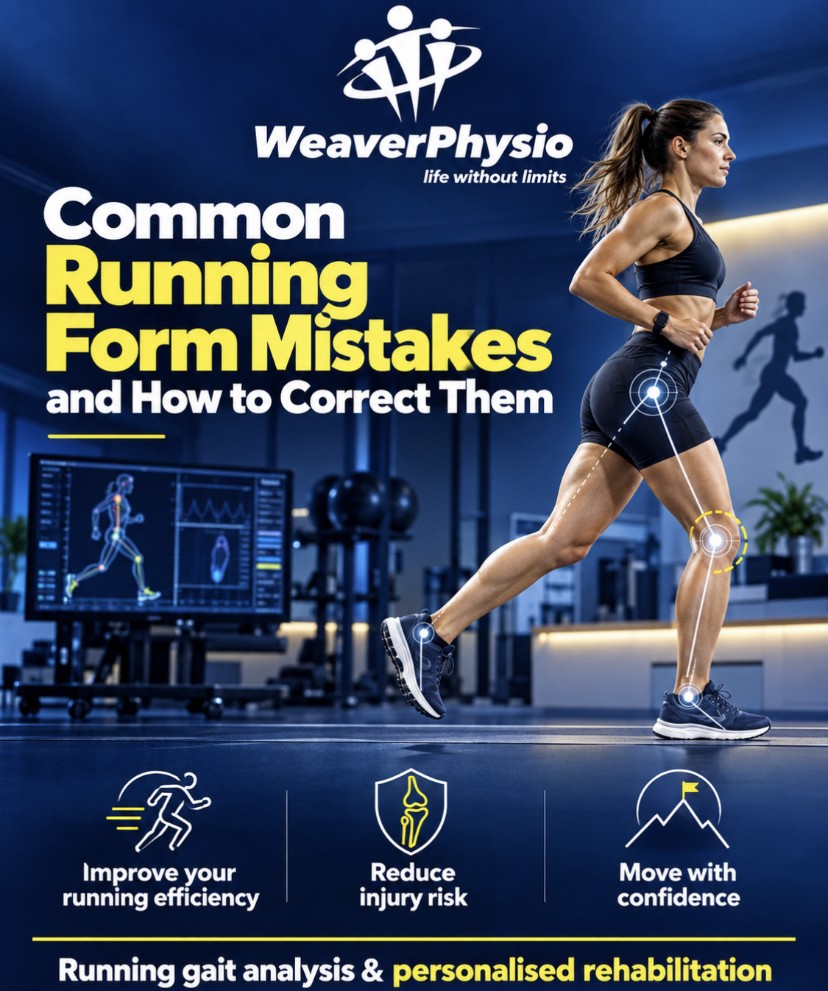
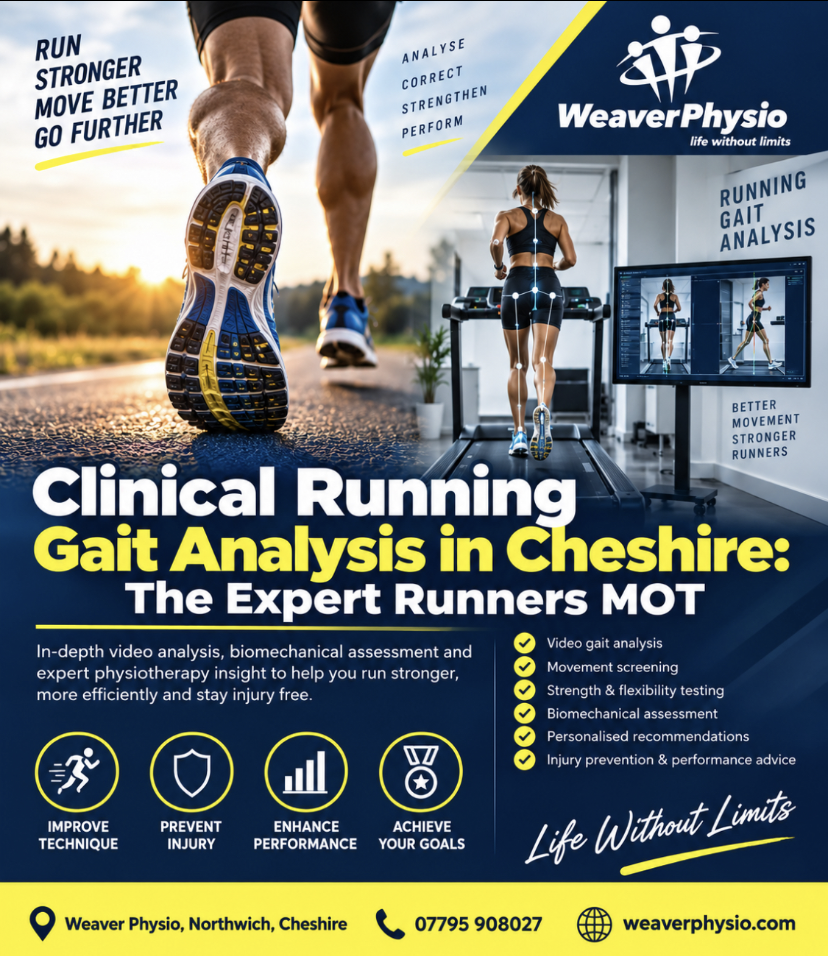
Our specialist Runner’s MOT and running gait analysis provides a more detailed assessment for runners experiencing recurring injuries or wanting to improve the physical foundations of their running.
Assessment can include slow-motion video gait analysis alongside strength, mobility, flexibility and functional testing.
Rather than trying to create one supposedly “perfect” running technique, the aim is to identify potentially relevant factors and determine whether changes could improve load management, efficiency or rehabilitation.
Treatment Goes Beyond the Massage Table
Sports physiotherapy should not simply be something that is done to you.
Hands-on treatment can have a useful role in managing symptoms and improving movement, but long-term rehabilitation frequently requires progressive exercise and carefully managed loading.
Depending on your assessment, treatment at Weaver Physio may incorporate:
Exercise rehabilitation
Strength and conditioning
Progressive tendon or muscle loading
Movement retraining
Mobility work
Manual therapy
Sports massage (https://www.weaverphysio.com/)
Acupuncture or dry needling where appropriate
Running gait retraining
Sport-specific rehabilitation
Return-to-running programmes
Return-to-sport testing
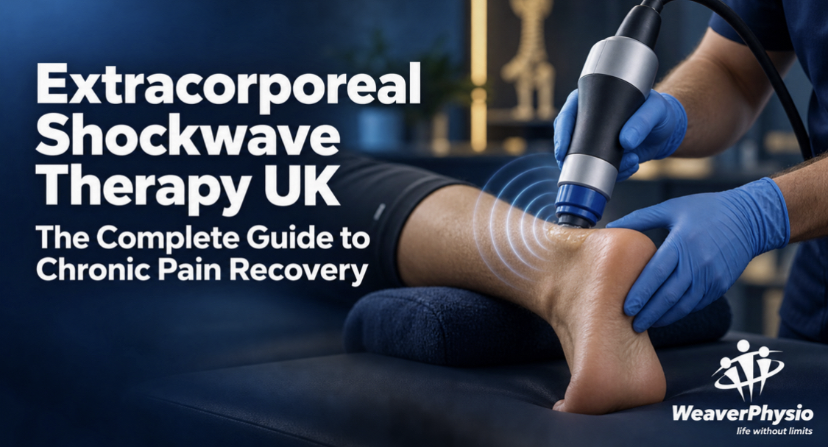
For certain persistent tendon problems, Shockwave Therapy in Northwich (https://www.weaverphysio.com/) may also be considered as part of a wider rehabilitation programme when clinically appropriate.
The objective isn’t simply to make an injury temporarily feel better.
It is to help restore the strength, movement, capacity and confidence required for the demands of your sport.
Relative Rest: Can You Keep Training During Rehabilitation?
Often, yes.
One of the biggest misconceptions surrounding sports injuries is that rehabilitation automatically means stopping everything.
Where clinically appropriate, relative rest can allow you to reduce or temporarily remove the activities aggravating the injury while maintaining other forms of exercise.
A runner might temporarily reduce mileage or speed work while maintaining cardiovascular fitness through another suitable activity. A field-sport athlete may continue strength training while temporarily modifying sprinting or change-of-direction work.
The appropriate approach depends entirely on the injury.
Our goal is therefore not simply:
“How do we stop the pain?”
It is:
“How much can you safely continue doing while we progressively rebuild your capacity?”
Building a Structured Return to Sport
Feeling better does not necessarily mean you are ready for unrestricted competition.
An effective return-to-sport programme should progressively bridge the gap between rehabilitation exercises and the demands of your activity.
Depending on your sport, this could include:
Mobility → Strength → Stability → Coordination → Running → Plyometrics → Speed → Sport-specific loading → Full return
Progression should be based on how you respond to increasing demands rather than simply reaching an arbitrary date on the calendar.
This approach can provide greater confidence when returning to training and competition.
Don’t Wait Until a Small Problem Becomes a Bigger One
Sports injuries are often easier to manage when the factors contributing to them are identified early.
You don’t necessarily need to stop training because something feels uncomfortable. But persistent pain, recurring symptoms, loss of function, weakness or pain that changes the way you move shouldn’t simply be ignored.
A professional sports physiotherapy assessment can help establish:
What is likely to be injured?
Why might it have happened?
What can you safely continue doing?
What needs to improve?
How do you progress back to your sport?
At Weaver Physiotherapy & Sports Injury Clinic in Northwich, we combine clinical assessment with progressive rehabilitation and sport-specific testing to help you recover effectively and return with confidence.
Book a Sports Injury Assessment in Northwich
If an injury is affecting your running, training, gym programme or sport, arrange an assessment with the team at Weaver Physiotherapy & Sports Injury Clinic.
Recover stronger. Move better. Return with confidence.
Frequently Asked Questions
Can I continue exercising while having physiotherapy for a sports injury?
Often, yes. Complete rest isn’t necessary for every sports injury. Where appropriate, your physiotherapist can modify your training and establish an acceptable level of loading while rehabilitation progresses. The aim is to maintain as much fitness and function as safely possible without repeatedly aggravating the injury.
Do I need a GP referral for private physiotherapy in Northwich?
Generally, you can self-refer directly for private physiotherapy without first seeing your GP. If your assessment identifies symptoms requiring further medical investigation, your physiotherapist can advise you on the appropriate next step.
How many physiotherapy sessions will a sports injury need?
There isn’t a universal number. Recovery depends on the type and severity of injury, how long symptoms have been present, your physical capacity and the demands of the activity you want to return to. Following assessment, your physiotherapist should be able to explain the likely rehabilitation process and appropriate milestones.
Is sports massage the same as sports physiotherapy?
No. Sports massage is primarily a soft-tissue treatment that may be used to help manage muscle tension, soreness and recovery. Sports physiotherapy involves clinical assessment, diagnosis and rehabilitation of musculoskeletal and sporting injuries. Sports massage can form part of a wider treatment programme, but it does not replace a comprehensive physiotherapy assessment when an injury is suspected.
When should a runner see a physiotherapist?
Consider assessment when pain persists, repeatedly returns, alters your running gait, prevents you completing normal training or worsens as mileage or intensity increases. Recurrent Achilles, calf, knee, hip, hamstring, shin or foot problems can particularly benefit from assessment of both physical capacity and training demands.
Should I see a physiotherapist for an injury even if the pain is mild?
Pain intensity alone doesn’t determine the significance of an injury. Mild symptoms that repeatedly return, gradually worsen or prevent you progressing your training can still justify assessment. Identifying and addressing a problem early may allow rehabilitation to begin while you remain active.