
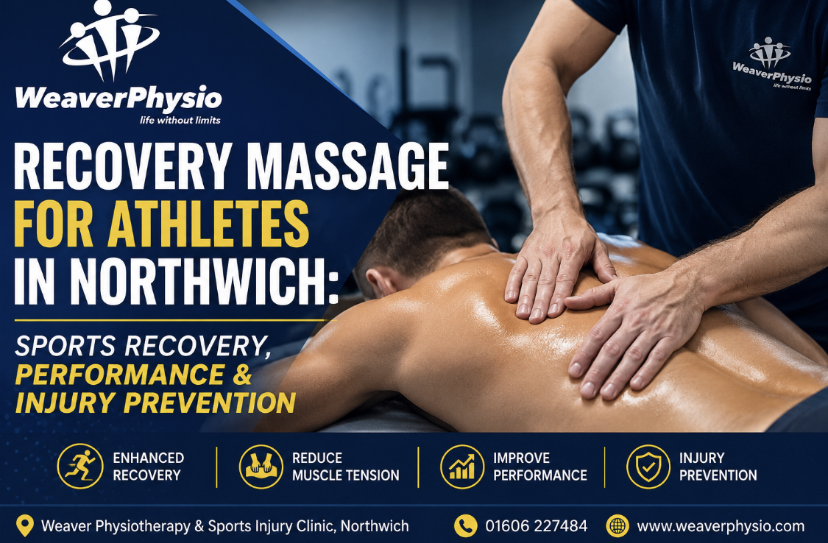
Recovery Massage for Athletes in Northwich:
Sports Recovery, Performance & Injury Prevention
Hard training is where performance is challenged. Recovery is where your body gets the opportunity to adapt.
Whether you are building towards a marathon, increasing your weekly running mileage, returning to competitive sport or pushing harder in the gym, demanding training can leave your muscles feeling heavy, stiff and sore. Sometimes that settles quickly. At other times, persistent tightness, reduced movement or recurring discomfort can begin to interfere with the quality of your next training session.
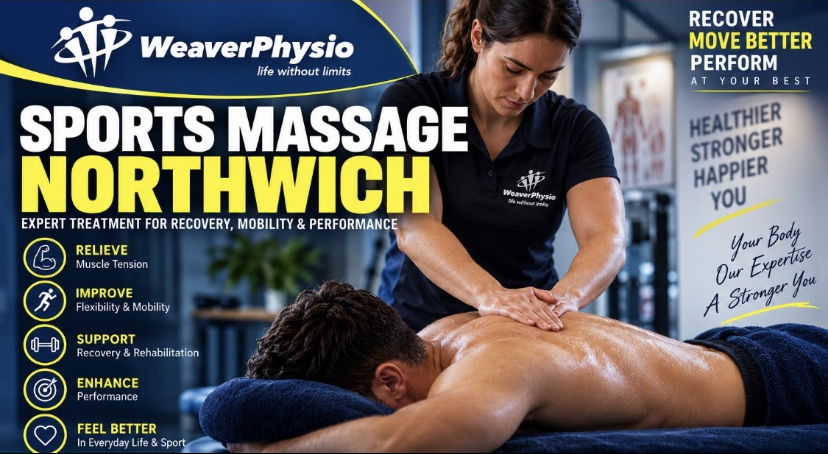
At Weaver Physiotherapy & Sports Injury Clinic in Northwich, recovery massage for athletes is approached as more than simply a way to relax tired muscles.
Our sports massage and soft-tissue treatments can form part of a wider recovery and performance strategy designed around your sport, training load, symptoms and individual goals.
From runners and cyclists to footballers, rugby players, triathletes and strength athletes, our aim is simple: help you recover effectively, move confidently and stay consistent with your training.
What Is Recovery Massage for Athletes?
Recovery massage is a form of sports-focused soft-tissue treatment used around training and competition.
Unlike a general relaxation massage, sports recovery treatment can be adapted according to the athlete, their training phase and the demands placed on particular muscle groups.
Depending on your needs, treatment may incorporate techniques such as:
Sports massage
Deep-tissue techniques
Soft-tissue mobilisation
Myofascial techniques
Trigger-point treatment
Assisted stretching
Neuromuscular techniques
Muscle energy techniques
Instrument-assisted soft-tissue techniques
The objective isn’t simply to apply as much pressure as possible.
Effective treatment should have a purpose.
For one runner, that may mean addressing calf stiffness during a high-mileage marathon block. For another athlete, it could involve managing quadriceps and hip muscle soreness following competition. Someone returning from injury may require a completely different approach.
This individualised approach is particularly important because recovery is influenced by far more than one muscle or one training session.
What Does the Research Say About Sports Massage and Recovery?
Sports massage is sometimes surrounded by exaggerated claims. A more useful approach is to look at what the research actually suggests.
A systematic review and meta-analysis published in BMJ Open Sport & Exercise Medicine examined massage in relation to sporting performance and recovery. The research found that massage was not associated with significant improvements in several direct performance measures, but it did identify small improvements in flexibility and delayed onset muscle soreness (DOMS).
This is important because sports massage should not be marketed as a magical way of instantly making an athlete faster or stronger.
Its potential value lies more realistically within recovery, soreness management, movement and how an athlete feels between training sessions.
You can explore the research here:
BMJ Open Sport & Exercise Medicine – Effect of Sports Massage on Performance and Recovery
Another systematic review and meta-analysis published in Frontiers in Physiology reported reductions in muscle soreness following massage after strenuous exercise, including at 24, 48 and 72 hours.
Frontiers in Physiology – Massage and Delayed Onset Muscle Soreness Research
For athletes, this provides a more evidence-based reason for incorporating massage into recovery: not because massage replaces sleep, nutrition or appropriate training management, but because it may complement them.
Recovery Massage and DOMS
That familiar aching sensation one or two days after an unusually demanding workout is commonly known as Delayed Onset Muscle Soreness (DOMS).
DOMS frequently follows exercise containing a high eccentric component or a training stimulus the body isn’t accustomed to.
You may notice:
Muscle tenderness
Stiffness
Reduced range of movement
Heavy or tired legs
Temporary reductions in force production
Discomfort when walking downstairs
Soreness when stretching or contracting the affected muscles
One important misconception is that DOMS is simply caused by “lactic acid trapped in the muscles”.
It isn’t.
Lactate produced during exercise is cleared relatively rapidly and isn’t responsible for soreness that develops the following day.
Recovery massage therefore isn’t about physically “flushing lactic acid” out of your muscles.
A more accurate explanation is that massage may help influence soreness, perceived recovery and muscle tension, potentially making the period between demanding sessions feel more manageable.
Does Sports Massage Improve Circulation?
Massage mechanically compresses and releases soft tissues, and changes in local blood flow can occur during and following treatment.
However, athletes should be cautious of simplistic claims that massage somehow “detoxifies” muscles or dramatically accelerates the removal of waste products.
The human body already possesses sophisticated circulatory, lymphatic, renal and metabolic systems for dealing with these processes.
At Weaver Physio, we prefer to explain treatment using realistic physiology rather than marketing myths.
The potential benefits of recovery massage are better considered alongside factors such as:
reduced perceived muscle soreness, temporary improvements in flexibility or movement, relaxation, reduced feelings of muscular tension and improved perception of recovery.
For an athlete training several times each week, those effects can still be extremely useful.
Sports Massage Should Complement Training — Not Replace Good Recovery
No massage treatment can compensate for poor recovery habits.
Athletes should think of massage as one component of a much larger performance system.
The foundations remain:
Appropriate training progression
Adequate sleep
Sufficient energy intake
Protein and carbohydrate intake appropriate to training demands
Hydration
Strength and conditioning
Planned recovery
Sensible management of training load
Sports massage can then sit alongside these strategies.
The Chartered Society of Physiotherapy describes physiotherapy as a science-based profession incorporating movement and exercise, manual therapy, education and advice.
That philosophy closely reflects how we approach athletic recovery at Weaver Physio: hands-on treatment where appropriate, combined with rehabilitation and training advice when required.
Recovery Massage for Runners
Running repeatedly loads the muscles, tendons and joints of the lower limb.
During periods of increased mileage, speed training, hill work or competition, runners may notice tightness or fatigue particularly around the:
Calves
Hamstrings
Quadriceps
Gluteal muscles
Hip flexors
Adductors
Foot and ankle complex
This doesn’t automatically mean something is injured.
However, persistent soreness, deteriorating movement or pain that worsens as training continues deserves closer attention.
This is where receiving treatment within a physiotherapy and sports injury clinic offers an important advantage.
If something appears to be more than normal post-training soreness, we can determine whether further assessment may be appropriate.
Sports Massage and Injury Prevention: An Important Distinction
It is tempting to say that regular sports massage “prevents injuries”.
The reality is more nuanced.
No single treatment can guarantee that an athlete will remain injury-free.
Running and sporting injuries are influenced by numerous interacting factors including previous injury, training exposure, sudden changes in workload, strength, recovery, sleep, competition demands and individual biomechanics.
Massage can nevertheless play a useful supporting role.
Regular contact with a sports rehabilitation professional provides an opportunity to discuss changing symptoms, recovery patterns and training demands.
If persistent pain or functional changes are identified, they can be investigated rather than simply repeatedly massaged.
This distinction is fundamental to the Weaver Physio approach.
We don’t want to repeatedly loosen a muscle without asking why it continually feels overloaded.
When Should You Have a Recovery Massage?
There isn’t a universal schedule that suits every athlete.
Treatment should reflect your training cycle.
During Heavy Training
A recovery-focused session may be useful during demanding training blocks when accumulated soreness and muscle tension are increasing.
Treatment intensity can be adjusted so the session complements rather than disrupts your training.
Before Competition
Aggressive deep-tissue treatment immediately before an important race or competition isn’t always desirable.
If you are accustomed to sports massage, a lighter session may be incorporated before an event, but any unfamiliar or intensive treatment should generally be planned well enough in advance that you know how your body responds.
After Competition
Following a marathon, long-distance triathlon or exceptionally demanding event, tissues may be particularly sensitive.
This isn’t necessarily the time for extremely aggressive massage.
Early treatment may therefore be lighter and recovery-focused, with deeper techniques introduced later if appropriate.
The key principle is straightforward:
More pressure does not automatically mean better recovery.
Should Sports Massage Hurt?
No.
Sports massage can occasionally produce temporary discomfort when working on sensitive areas, but effective treatment does not need to be excruciating.
If an athlete is bracing against the table because the pressure is unbearable, more force isn’t necessarily producing a better therapeutic effect.
Treatment intensity should be matched to:
Your tolerance
Your symptoms
Your training schedule
The tissue being treated
The objective of the session
How close you are to competition
Communication between therapist and athlete is therefore essential.
Recovery Massage vs Deep Tissue Massage
The terms sports massage and deep tissue massage are often used interchangeably, but they don’t necessarily describe the same thing.
Deep tissue massage generally refers to treatment involving slower and firmer pressure directed towards deeper layers of muscle and connective tissue.
Sports massage is better defined by its purpose.
The treatment is planned around sporting demands, training, recovery, competition or rehabilitation.
Sometimes sports massage will be deep.
Sometimes it shouldn’t be.
A runner three days after a marathon may require a very different session from a powerlifter experiencing persistent muscular tightness during a strength block.
At Weaver Physio, treatment intensity is therefore determined by what your body needs rather than how much pressure can be tolerated.
The Weaver Physio Approach to Athlete Recovery
At Weaver Physiotherapy & Sports Injury Clinic, we work with recreational exercisers through to competitive athletes from across Northwich and Cheshire.
Our approach extends beyond simply identifying where a muscle feels tight.
Where appropriate, we consider factors such as:
training history → symptoms → movement → strength → mobility → training load → recovery → sporting demands.
This gives us a much more useful picture of what may be contributing to the problem.
For straightforward post-training soreness, sports massage may be all that’s required.
But when symptoms are persistent or recurring, we can take the assessment further.
Combining Sports Massage with Physiotherapy
One of the advantages of receiving recovery treatment within a physiotherapy and sports injury environment is access to a broader rehabilitation pathway.
If persistent discomfort requires further investigation, treatment may incorporate:
Physiotherapy assessment
Manual therapy
Exercise rehabilitation
Strength and conditioning
Acupuncture or dry needling
Running rehabilitation
Video gait analysis
Progressive return-to-sport programming
The Chartered Society of Physiotherapy’s rehabilitation guidance highlights assessment, collaborative goal setting, treatment, advice and ongoing evaluation as important elements of rehabilitation.
This broader approach helps distinguish clinical sports recovery from simply booking an occasional massage whenever your muscles feel tight.
Recovery Massage and Running Gait Analysis
For runners experiencing repeated problems, treating tight muscles alone may not provide the complete answer.
That is why sports massage can be integrated with our running assessment and rehabilitation services.
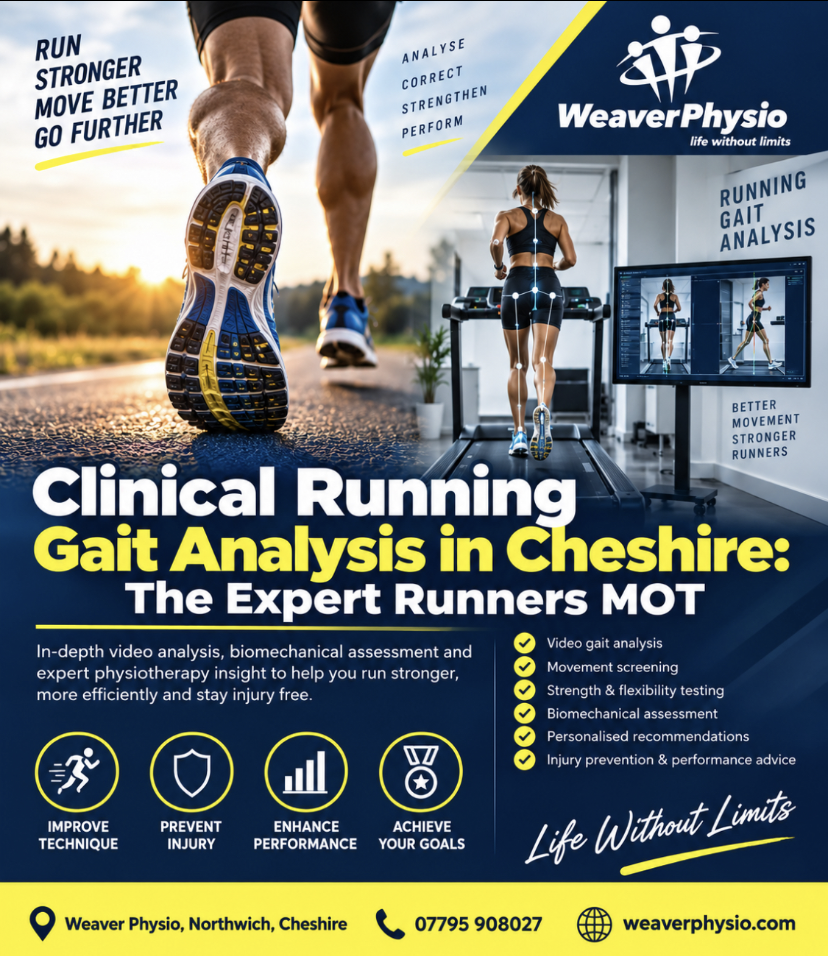
Our Runner’s MOT and video gait analysis can examine how you move while running alongside relevant strength, mobility and movement characteristics.
For example, recurring calf tightness may warrant looking at more than the calf itself.
Depending on the individual, assessment could consider:
Running mechanics
Training progression
Ankle function
Calf strength and endurance
Hip strength
Single-leg control
Previous injury
Foot and ankle function
Running volume and intensity
The objective isn’t to create a “perfect” running style.
It is to identify potentially modifiable factors relevant to that particular runner.
This moves treatment from:
“Where are you tight?”
towards:
“Why might this area repeatedly become overloaded?”
When Muscle Tightness May Actually Be an Injury
One of the risks of repeatedly self-treating muscular tightness is assuming every symptom is simply a knot that needs releasing.
Persistent pain can sometimes reflect an underlying musculoskeletal problem.
Examples may include:
Achilles tendinopathy
Proximal hamstring tendinopathy
Patellar tendinopathy
Plantar heel pain
Muscle strain
Running-related knee pain
Hip or gluteal tendinopathy
Lumbar referred pain
Nerve-related symptoms
In these circumstances, repeated massage alone may not address the problem.
A physiotherapy assessment can help establish a working diagnosis and determine the most appropriate management strategy.
This might include progressive loading, strength rehabilitation, activity modification or another intervention where clinically indicated.
Shockwave Therapy for Persistent Tendon Problems
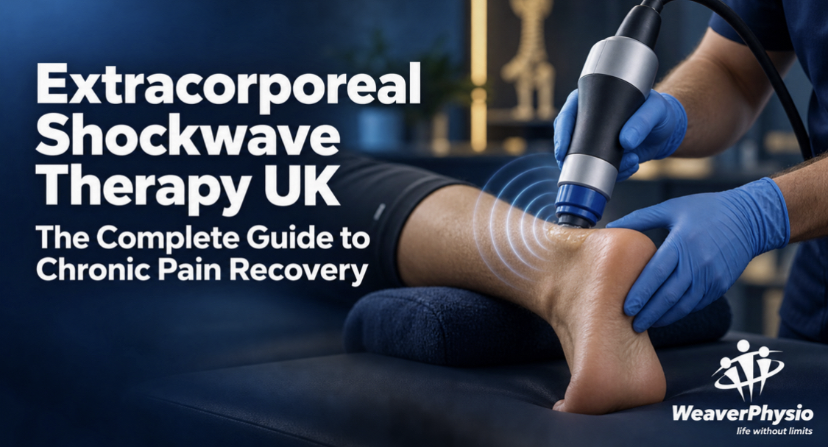
For selected persistent tendon and soft-tissue conditions, extracorporeal shockwave therapy may sometimes form part of treatment.
Extracorporeal Shockwave Therapy (ESWT) uses externally generated acoustic waves applied to the treatment area.
NICE has published guidance relating to ESWT for conditions including refractory plantar fasciitis and Achilles tendinopathy. Importantly, NICE’s guidance for refractory plantar fasciitis states that although there are no major safety concerns, evidence regarding efficacy is inconsistent and recommends specific clinical-governance arrangements.
This is another reason why assessment matters: treatment should be selected according to the clinical presentation rather than assuming that one therapy is appropriate for every athlete.
How Often Should Athletes Have Sports Massage?
There is no evidence-based rule saying every athlete needs massage weekly, fortnightly or monthly.
Frequency should depend on factors including:
Training volume
Competition schedule
Previous injuries
Recovery demands
Current symptoms
Personal preference
Response to treatment
Financial and time considerations
Some athletes prefer occasional sessions during demanding training blocks.
Others find regular maintenance useful.
The important question isn’t:
“How often should every athlete have massage?”
It is:
“Is massage helping this athlete recover, train and function better?”
If the answer is yes, it can be incorporated appropriately.
If symptoms repeatedly return despite treatment, further assessment may be more valuable than simply increasing massage frequency.
Recovery Massage for Marathon Training
Marathon preparation creates an unusual challenge because recovery has to occur while training continues.
As weekly mileage rises, many runners experience increasing muscular fatigue.
Sports massage may be particularly useful around:
High-mileage weeks
Long-run progression
Increased hill training
Introduction of speed work
Training camps
Tune-up races
Taper periods
Post-marathon recovery
However, massage shouldn’t be used to disguise an injury so that training can simply continue unchanged.
Pain that progressively worsens, alters running mechanics or fails to settle deserves assessment.
The goal is not simply to get through the next run. It is to reach the start line healthy enough to perform.
Sports Recovery in Northwich & Cheshire
Weaver Physiotherapy & Sports Injury Clinic provides sports massage, physiotherapy and rehabilitation for active people across Northwich and the wider Cheshire area.
We regularly help runners, gym users, cyclists and athletes who want to:
Recover from demanding training
Reduce post-exercise muscle soreness
Improve movement
Manage persistent muscular tightness
Return following injury
Build strength and resilience
Prepare for competition
Maintain consistent training
Whether you’re preparing for your first 10K, chasing a marathon PB, returning to football or simply training hard in the gym, your recovery strategy should reflect your individual goals.
Why Choose Weaver Physio for Recovery Massage in Northwich?
At Weaver Physio, athlete recovery isn’t treated in isolation.
Our team brings together physiotherapy, sports rehabilitation, sports massage, exercise rehabilitation and performance-focused assessment within one clinic.
That means your appointment can be part of a much broader pathway if required.
Rather than simply asking:
“Which muscle hurts?”
we want to understand:
What are you training for?
What has changed?
How are you recovering?
Is this normal training soreness or something requiring assessment?
What can we do to help you continue progressing?
That is the difference between simply receiving a massage and developing a considered recovery strategy.
Book Recovery Massage in Northwich
Training hard is only one part of improving performance.
Recovering sufficiently to train consistently matters too.
If heavy legs, muscular soreness or persistent tightness are beginning to affect your training, professional sports massage may provide a useful addition to your recovery programme.
And if your symptoms suggest something more than normal training fatigue, our physiotherapy and sports rehabilitation team can assess the problem and help you develop an appropriate plan.
Weaver Physiotherapy & Sports Injury Clinic
Northwich, Cheshire
Recover Stronger. Move Better. Perform with Confidence.
Frequently Asked Questions About Recovery Massage for Athletes
Does sports massage reduce DOMS?
Research suggests massage may reduce perceived delayed onset muscle soreness following strenuous exercise. A systematic review and meta-analysis reported reductions in soreness at 24, 48 and 72 hours following demanding exercise. (Frontiers (https://www.frontiersin.org/journals/physiology/articles/10.3389/fphys.2017.00747/full?utm_source=chatgpt.com))
It shouldn’t, however, be viewed as a substitute for appropriate sleep, nutrition and training recovery.
Does sports massage remove lactic acid?
Not in the way this is sometimes claimed.
Lactate produced during exercise is processed relatively quickly by the body. The soreness experienced 24–48 hours after exercise isn’t caused by lactic acid remaining trapped within muscles.
Massage is better considered for its potential effects on soreness, relaxation, flexibility, muscle tension and perceived recovery.
Is recovery massage good for runners?
It can be.
Runners commonly use sports massage during demanding training periods to help manage muscle soreness and perceived tightness.
However, persistent or recurring pain should not automatically be treated as muscular tightness. Physiotherapy assessment may be appropriate if symptoms continue.
How often should runners have sports massage?
There is no universal schedule.
Some runners use massage occasionally during high-volume training, while others prefer more regular appointments.
Frequency should be based on training load, symptoms, individual response, competition schedule and personal preference rather than an arbitrary timetable.
Should I have sports massage immediately after a marathon?
Treatment immediately following an endurance event should generally be conservative and appropriate to how your body feels.
Extremely aggressive deep-tissue techniques on already sore tissues may not be desirable.
Recovery strategies should be adapted to the athlete rather than following a rigid “48-hour rule”.
Can sports massage prevent running injuries?
Sports massage cannot guarantee injury prevention.
It may contribute to a broader recovery strategy, but injury-risk management should also consider training progression, previous injuries, strength, conditioning, sleep, recovery and sporting demands.
What is the difference between sports massage and physiotherapy?
Sports massage primarily uses soft-tissue techniques to address areas such as muscular soreness, tension and movement.
Physiotherapy has a broader scope encompassing clinical assessment, diagnosis, rehabilitation, exercise, education, manual therapy and strategies to restore movement and function. The CSP describes physiotherapy as helping restore movement and function following injury, illness or disability. (The Chartered Society of Physiotherapy (https://www.csp.org.uk/careers-jobs/what-physiotherapy?utm_source=chatgpt.com))
If pain is persistent, worsening or repeatedly returning, physiotherapy assessment may therefore be more appropriate than massage alone.
Can sports massage help an old injury?
It may help with symptoms such as muscular tension or stiffness associated with a previous injury, but the underlying reason for continuing symptoms should be considered.
Old injuries may require progressive strengthening, mobility work, load management or movement rehabilitation rather than massage alone.
Is sports massage supposed to hurt?
No. More pain does not equal a more effective treatment.
Pressure should be appropriate to the objective of the session, your tolerance and where you are within your training or competition schedule.
When should an athlete see a physiotherapist rather than book a massage?
Consider physiotherapy assessment when pain is persistent, worsening, repeatedly returning, affecting your sporting technique or preventing normal training.
Neurological symptoms, significant trauma, substantial swelling or other concerning symptoms may also require appropriate medical assessment rather than massage.
Trusted Resources & Further Reading
For athletes interested in learning more about recovery, physiotherapy and evidence-based treatment:
Chartered Society of Physiotherapy – What is Physiotherapy?
Chartered Society of Physiotherapy – Rehabilitation
BMJ Open Sport & Exercise Medicine – Sports Massage, Performance and Recovery
Frontiers in Physiology – Massage and DOMS Meta-analysis
NICE – Shockwave Therapy Guidance