
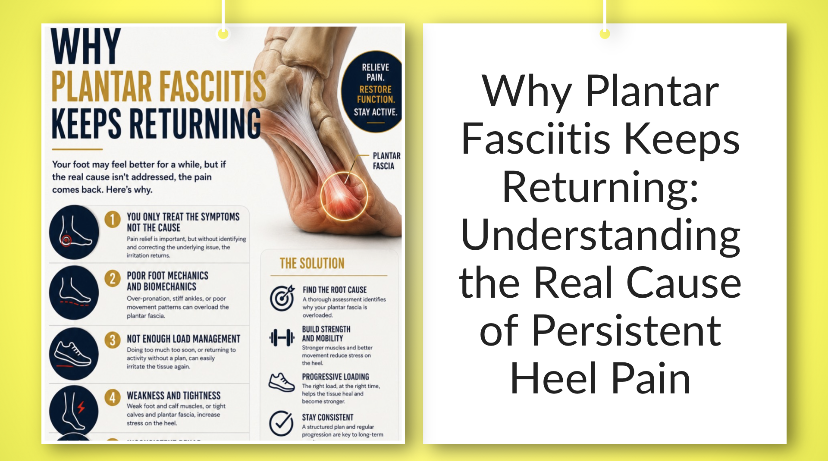
Why Plantar Fasciitis Keeps Returning: Understanding the Real Cause of Persistent Heel Pain
Plantar Fasciitis Treatment in Northwich | Weaver Physiotherapy & Sports Injury Clinic
If you’ve been struggling with plantar fasciitis for weeks, months, or even years, you’re not alone.
Many people experience a frustrating cycle where their heel pain improves for a short period, only to return again when they start walking more, exercising, running, or simply getting back to normal daily activities.
At Weaver Physiotherapy & Sports Injury Clinic in Northwich, plantar fasciitis is one of the most common conditions we treat. One of the biggest misconceptions surrounding plantar fasciitis is that it is purely an inflammation problem that simply needs rest.
In reality, persistent plantar fasciitis is usually far more complex.
If the underlying cause isn’t identified and addressed, symptoms often return repeatedly.
Let’s explore why plantar fasciitis keeps coming back and what you can do to finally break the cycle.
What Is Plantar Fasciitis?
The plantar fascia is a strong band of connective tissue that runs from your heel bone to your toes.
Its role is to:
Support the arch of the foot
Absorb forces during walking and running
Store and release energy
Help maintain efficient movement
When the plantar fascia becomes overloaded, it can become painful and irritated.
Typical symptoms include:
✔ Sharp pain under the heel
✔ Pain during the first steps in the morning
✔ Pain after prolonged sitting
✔ Heel pain when walking barefoot
✔ Pain during running or prolonged standing
Although commonly called plantar fasciitis, many long-standing cases are actually more accurately described as plantar fasciopathy, where tissue overload and degeneration play a larger role than inflammation.
Why Does Plantar Fasciitis Keep Returning?
1. You’re Treating The Symptoms Instead Of The Cause
Many treatments focus purely on pain relief.
Ice, massage guns, anti-inflammatory medication, insoles and stretching may temporarily reduce symptoms, but if the reason the tissue became overloaded remains unchanged, the pain often returns.
Successful treatment requires identifying:
Why the fascia became overloaded
What movement patterns contribute
Whether strength deficits exist
How lifestyle and activity levels affect symptoms
At Weaver Physio, we focus on finding and treating the root cause rather than simply masking pain.
2. Poor Foot Mechanics And Biomechanics
The way your foot moves can significantly influence the load placed through the plantar fascia.
Common contributors include:
Excessive pronation
Stiff ankles
Reduced big toe mobility
Poor walking mechanics
Running technique issues
These factors may increase stress through the heel and plantar fascia every time you take a step.
Our detailed biomechanical assessments and Runner’s MOT evaluations help identify these contributing factors.
3. Weakness In The Foot And Calf Muscles
Many people focus exclusively on stretching when they develop plantar fasciitis.
However, strength is often the missing piece.
Research increasingly shows that weakness in the calf muscles and intrinsic foot muscles can contribute to persistent plantar fascia overload.
Common findings include:
Reduced calf strength
Poor single-leg control
Weak foot stabilisers
Reduced tendon capacity
The plantar fascia works closely with the calf muscles and Achilles tendon. If these structures aren’t functioning efficiently, the fascia may be forced to absorb excessive stress.
4. Resting Too Much
One of the biggest mistakes people make is avoiding all activity.
While reducing aggravating activities may be necessary initially, complete rest rarely solves the problem.
Like tendons, the plantar fascia adapts positively to appropriate loading.
Without gradual reintroduction of load:
Tissue capacity decreases
Strength declines
Symptoms often return when activity resumes
The goal is not complete rest.
The goal is controlled, progressive loading.
5. Returning To Activity Too Quickly
Many people make the mistake of feeling slightly better and immediately returning to normal activity levels.
Examples include:
Returning to running too soon
Suddenly increasing step counts
Long walks after a period of rest
High-intensity gym sessions
The plantar fascia may not yet be capable of handling these demands.
Successful rehabilitation requires a structured progression that gradually rebuilds tissue capacity.
6. Tight Calves And Reduced Ankle Mobility
Restricted ankle movement is one of the most common findings in people with plantar fasciitis.
If the ankle cannot move efficiently during walking and running, additional strain is often transferred into the plantar fascia.
Contributors include:
Tight calf muscles
Stiff ankle joints
Reduced Achilles flexibility
Improving mobility often forms an important part of rehabilitation.
7. Your Training Load Is Too High
For runners, training load is frequently the missing link.
Common mistakes include:
Increasing mileage too quickly
Introducing hill sessions
More speed work
Inadequate recovery
The plantar fascia responds to cumulative stress.
Even small changes in training volume can exceed tissue capacity.
At Weaver Physio, we regularly assess running loads alongside biomechanics and strength deficits.
8. Inappropriate Footwear
Footwear doesn't necessarily cause plantar fasciitis, but it can influence how load is distributed through the foot.
Factors may include:
Worn-out shoes
Poorly fitting footwear
Sudden changes in shoe type
Unsuitable footwear for activity levels
Footwear should support your overall rehabilitation plan rather than be viewed as a standalone solution.
Why Strength Is So Important
Modern rehabilitation increasingly focuses on strengthening rather than simply stretching.
A stronger foot is often a more resilient foot.
Progressive loading programmes can help:
✔ Improve tissue capacity
✔ Reduce pain
✔ Improve foot function
✔ Improve calf strength
✔ Reduce recurrence
✔ Improve walking and running efficiency
How Weaver Physio Treats Plantar Fasciitis
Every patient receives a thorough assessment designed to identify the root cause of symptoms.
Treatment may include:
Physiotherapy Assessment
Comprehensive evaluation of:
Foot biomechanics
Strength deficits
Mobility restrictions
Training load
Lifestyle factors
Progressive Rehabilitation
Individualised programmes targeting:
Foot strength
Calf strength
Load tolerance
Functional movement
Running Gait Analysis
Our Runner's MOT may identify biomechanical factors contributing to heel pain.
Shockwave Therapy
For persistent plantar fasciitis, Shockwave Therapy may help stimulate healing and reduce symptoms when combined with rehabilitation.
Return-To-Activity Plans
Helping patients safely return to walking, exercise and running without repeated flare-ups.
When Should You Seek Professional Help?
You should consider physiotherapy if:
Symptoms persist beyond a few weeks
Heel pain keeps returning
Walking is becoming painful
Running is limited
Home treatments haven't worked
Early intervention can often prevent months of ongoing frustration.
Plantar Fasciitis Treatment In Northwich
If your plantar fasciitis keeps returning, the problem may not be inflammation—it may be that the underlying cause has never been addressed.
At Weaver Physiotherapy & Sports Injury Clinic, we help patients across Northwich, Knutsford, Winsford, Middlewich, Tarporley and Cheshire overcome persistent heel pain through evidence-based physiotherapy, rehabilitation, Shockwave Therapy and movement analysis.
Don't just treat the symptoms.
Identify the cause, rebuild strength and break the cycle.
Book Your Assessment Today
📍 Weaver Physiotherapy & Sports Injury Clinic, Northwich
📞 01606 227484
🌐 www.weaverphysio.com
Move Better. Get Stronger. Stay Pain-Free.