
How to Structure Your Running Week for Better Performance and Fewer Injuries
Cheshire Running Injury Specialists | Weaver Physiotherapy & Sports Injury Clinic

Running is one of the most effective ways to improve fitness, cardiovascular health and mental wellbeing. Whether you’re training for your first 5K, preparing for a marathon or simply running to stay fit, how you structure your training week can significantly influence your performance, recovery and injury risk.
At Weaver Physiotherapy & Sports Injury Clinic in Northwich, we regularly work with runners from across Cheshire who are frustrated by recurring injuries, plateaued performance or inconsistent training. Common conditions such as Achilles tendinopathy, plantar fasciitis, shin splints, runner’s knee and hamstring injuries often develop because of poor training structure rather than a single traumatic event.
The good news is that many running injuries can be prevented by organising your training week correctly.
Why Training Structure Matters
Many runners focus purely on mileage. While distance is important, your body responds to the total stress placed upon it. This includes:
Running volume
Running intensity
Strength training
Sleep quality
Work stress
Recovery strategies
Previous injury history
When training load exceeds the body’s capacity to recover and adapt, injury risk increases.
A well-structured running week helps:
✔ Improve performance
✔ Reduce injury risk
✔ Optimise recovery
✔ Improve consistency
✔ Build long-term resilience
Consistency beats occasional hard training every time.
The 80/20 Running Principle
One of the most effective principles for runners is the 80/20 rule.
Approximately:
80% of running should be easy aerobic running
20% should be harder quality work
Many runners accidentally reverse this ratio by running moderate to hard every session.
Easy running develops:
Aerobic fitness
Recovery capacity
Fat metabolism
Running efficiency
Hard sessions develop:
Speed
Threshold fitness
VO2 Max
Race performance
Both are important, but they must be balanced appropriately.
Example Running Week
A well-balanced training week may look like this:
Monday – Easy Run
30-60 minutes at conversational pace.
Purpose:
Active recovery
Aerobic development
Building volume safely
Tuesday – Strength Training
Focus on:
Glute strength
Calf strength
Hamstring strength
Core stability
Strong runners are more resilient runners.
Research consistently shows that strength training can improve running economy while reducing injury risk.
Wednesday – Quality Session
Examples:
Interval training
Hill repeats
Tempo running
Purpose:
Improve speed
Improve threshold fitness
Enhance race performance
This is one of the hardest sessions of the week and should be followed by recovery.
Thursday – Recovery Run
Keep the pace comfortable.
Many runners struggle because they run recovery days too hard.
Recovery runs should leave you feeling better, not exhausted.
Friday – Strength & Mobility
Focus on:
Single-leg control
Hip stability
Foot strength
Mobility work
At Weaver Physio we frequently identify strength deficits during our Runner’s MOT assessments that contribute to recurring injuries.
Saturday – Long Run
The cornerstone of most running programmes.
Long runs improve:
Endurance
Aerobic capacity
Mental resilience
Fatigue resistance
Most runners should complete this session at an easy conversational pace.
Sunday – Rest or Cross Training
Options include:
Walking
Cycling
Swimming
Mobility work
Recovery is where adaptation occurs.
Why Strength Training is Essential for Runners
Many runners still believe that running alone is enough.
However, strength training improves:
Running Economy
Stronger muscles use less energy during running.
Injury Prevention
Research suggests that targeted strength programmes can reduce common running injuries.
Power Production
Improved strength helps:
Sprint finishes
Hill running
Faster race times
Tendon Health
Conditions such as:
Achilles tendinopathy
Patellar tendinopathy
Plantar fasciitis
respond particularly well to progressive loading programmes.
At Weaver Physio we often combine strength testing with running gait analysis to identify weaknesses limiting performance.
The Most Common Mistake Runners Make
The biggest mistake we see is increasing training load too quickly.
Examples include:
Increasing mileage dramatically
Adding multiple speed sessions
Returning from injury too fast
Training through pain
Your tissues adapt gradually.
Muscles adapt relatively quickly.
Tendons and bones adapt much more slowly.
This mismatch often contributes to overuse injuries.
Understanding Recovery
Recovery is not a luxury.
Recovery is part of training.
Important recovery factors include:
Sleep
Aim for 7-9 hours per night.
Sleep is where tissue repair and adaptation occur.
Nutrition
Support recovery with:
Adequate protein
Carbohydrates for training
Hydration
Rest Days
Rest days allow the body to absorb training.
Many runners become fitter by recovering better, not simply training harder.
Warning Signs You May Be Doing Too Much
Watch out for:
Persistent fatigue
Reduced performance
Ongoing soreness
Poor sleep
Elevated resting heart rate
Loss of motivation
Recurring injuries
These may indicate that training load exceeds recovery capacity.
The Role of Running Gait Analysis
Sometimes training structure isn’t the only problem.
Movement inefficiencies can increase tissue stress.
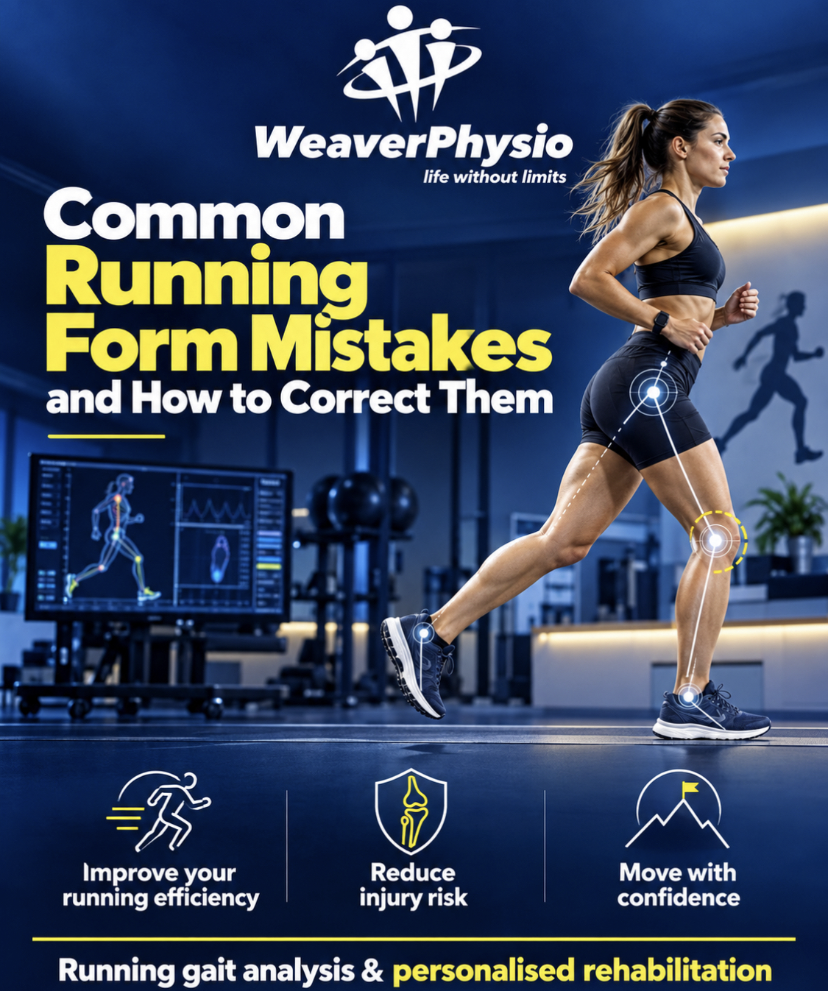
At Weaver Physiotherapy & Sports Injury Clinic, our Runner’s MOT includes detailed video gait analysis to identify:
Overstriding
Excessive vertical movement
Cadence issues
Stability deficits
Running technique inefficiencies
Improving biomechanics can help reduce unnecessary loading on the body.
Common Running Injuries We Treat
Our team regularly helps runners overcome:
Achilles Tendinopathy
Pain and stiffness affecting the Achilles tendon.
Plantar Fasciitis
Persistent heel pain affecting runners of all abilities.
Shin Splints
One of the most common overuse injuries.
Runner’s Knee
Patellofemoral pain affecting the front of the knee.
IT Band Syndrome
Pain on the outside of the knee during running.
Hamstring Injuries
Often linked to strength deficits and training errors.
How a Runner’s MOT Can Help
Our Runner’s MOT (£65) includes:
✔ Video gait analysis
✔ Running biomechanics assessment
✔ Strength testing
✔ Mobility assessment
✔ Injury risk screening
✔ Personalised exercise programme
✔ Running performance recommendations
Whether your goal is completing your first 5K or achieving a marathon personal best, understanding how your body moves can make a significant difference.
Why Choose Weaver Physio?
At Weaver Physiotherapy & Sports Injury Clinic, we are proud to be recognised as Cheshire’s Running Injury Specialists.
With over 70 years of combined clinical experience, we help runners from Northwich, Winsford, Knutsford, Middlewich, Tarporley, Frodsham, Chester and across Cheshire recover from injury, improve performance and enjoy running with confidence.
Our clinic combines:
Physiotherapy
Running gait analysis
Sports rehabilitation
Strength and conditioning
Shockwave Therapy
Sports massage
Injury prevention strategies
to help runners achieve long-term success.
Book Your Runner’s MOT Today
If recurring injuries, niggles or performance plateaus are holding you back, a Runner’s MOT could help identify exactly what is limiting your progress.
📍 Weaver Physiotherapy & Sports Injury Clinic, Northwich
📞 01606 227484
🌐 http://www.weaverphysio.com
Weaver Physio – Cheshire’s Running Injury, Gait Analysis & Performance Specialists. Recover Stronger. Perform Better. Live Pain-Free.