Occupational Health Physiotherapy Northwich
Supporting a Healthier, Stronger Cheshire Workforce
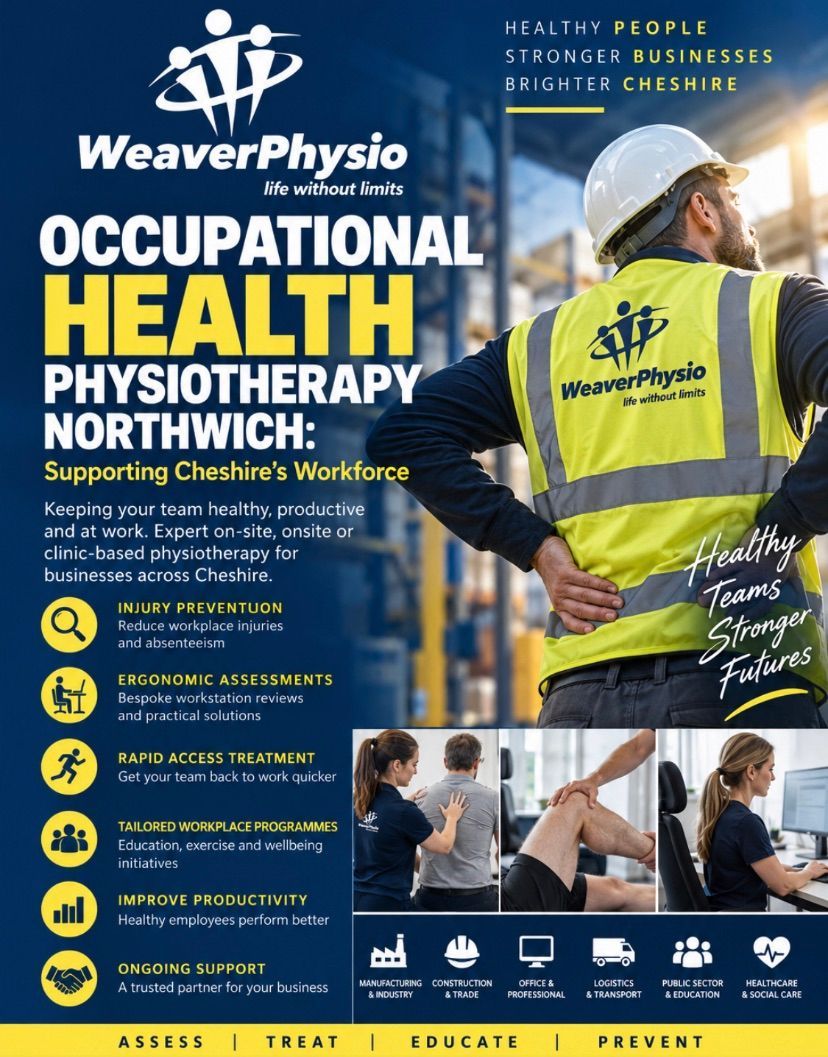
Work-related pain can have a significant impact on both employees and businesses. A persistent back problem, repetitive strain injury or painful shoulder may begin as a minor irritation, but without appropriate management it can affect concentration, productivity, physical capacity and ultimately an employee’s ability to remain at work.
Across Great Britain, musculoskeletal problems remain a major workplace health issue. The Health and Safety Executive (HSE) estimates that 511,000 workers were affected by work-related musculoskeletal disorders during 2024/25, resulting in approximately 7.1 million working days lost.
At Weaver Physiotherapy & Sports Injury Clinic in Northwich, we provide professional occupational health physiotherapy in Northwich and across Cheshire, helping employees recover from musculoskeletal problems while supporting employers who want to reduce sickness absence, improve workplace wellbeing and maintain a healthier workforce.
With 70+ years of combined clinical experience, our team provides evidence-informed assessment, treatment and rehabilitation tailored to the individual, their occupation and the physical demands of their role.
What Is Occupational Health Physiotherapy?
Occupational health physiotherapy focuses on the relationship between a person’s physical health and their work.
Unlike a generic approach to pain management, occupational physiotherapy considers not only where it hurts, but also the factors that may be contributing to the problem.
These might include:
Repetitive movements
Manual handling and lifting
Prolonged sitting
Poor workstation ergonomics
Sustained or awkward postures
Repetitive computer or keyboard work
Driving for extended periods
Physically demanding employment
Reduced strength, mobility or physical capacity
Previous injuries aggravated by work
The objective is not simply to provide temporary symptom relief. Our aim is to understand the problem, restore function and develop a practical rehabilitation strategy that helps the employee perform their role more comfortably and confidently.
Why Workplace Musculoskeletal Health Matters
Musculoskeletal disorders affect hundreds of thousands of UK workers.
According to the Health and Safety Executive’s latest musculoskeletal disorder statistics , work-related MSK disorders accounted for approximately 27% of work-related ill health cases in 2024/25.
Back problems accounted for around 43% of work-related MSK cases, while upper-limb and neck conditions represented approximately 41%.
For employers, this makes early access to appropriate assessment and rehabilitation an important component of workforce health.
For employees, early intervention may prevent a relatively manageable problem from developing into persistent pain, reduced physical capacity or prolonged absence.
Common Work-Related Conditions We Assess
Our Northwich occupational health physiotherapy service supports employees from a broad range of working environments, including offices, healthcare, manufacturing, engineering, logistics, construction, retail and other physically demanding occupations.
Common presentations include:
Back Pain
Lower back pain is one of the most frequent problems encountered in occupational physiotherapy.
Symptoms may be associated with manual handling, repeated bending, prolonged sitting, driving, lifting or physically demanding work.
Assessment can help identify contributing factors such as reduced spinal mobility, strength deficits, movement patterns and work-related loading.
Neck and Shoulder Pain
Long periods at a desk, sustained postures and repetitive upper-limb movements can contribute to neck, shoulder and upper-back discomfort.
We assess mobility, strength, posture, workstation demands and movement to develop an individual treatment and rehabilitation programme.
Repetitive Strain and Upper-Limb Problems
Repetitive tasks can contribute to symptoms affecting the hands, wrists, elbows and shoulders.
Conditions may include:
Tennis elbow
Golfer’s elbow
Carpal tunnel symptoms
Rotator cuff-related shoulder pain
Tendon problems
Forearm and wrist pain
Repetitive strain injuries
Manual Handling Injuries
Workers involved in lifting, carrying, pushing, pulling or repetitive physical tasks may experience back, shoulder, hip or knee injuries.
Our rehabilitation programmes can be adapted to reflect the actual physical demands of the person’s occupation.
Lower-Limb Pain
Employees who spend long periods standing or walking may develop problems involving the feet, ankles, knees or hips.
These can include plantar heel pain, Achilles tendon problems, knee pain and other load-related conditions.
A Thorough Occupational Physiotherapy Assessment
Effective rehabilitation starts with understanding why the problem has developed.
At Weaver Physio, we take time to understand both the injury and the working environment.
Your assessment may include:
Clinical history
We discuss the symptoms, how they started, previous injuries, general health and the activities that aggravate or relieve the problem.
Workplace demands
A warehouse operative has very different physical requirements from an office worker, driver, engineer or healthcare professional.
Understanding these demands helps us create rehabilitation that is relevant to the employee’s actual working life.
Movement assessment
We may assess joint movement, muscle flexibility, strength, balance, functional movement and other relevant physical factors.
Functional testing
Where appropriate, rehabilitation can include movements similar to those required at work, helping determine whether the employee is physically prepared for their normal duties.
The result is a personalised occupational rehabilitation plan, rather than a generic sheet of exercises.
Occupational Health Physiotherapy Treatment in Northwich
Treatment depends entirely on the assessment findings and individual clinical needs.
A programme may incorporate:
Physiotherapy and Manual Therapy
Hands-on techniques may be used alongside rehabilitation to improve movement, reduce stiffness and help manage musculoskeletal symptoms.
These may include joint mobilisation, soft-tissue techniques and other appropriate manual therapy interventions.
Exercise Rehabilitation
Exercise is central to many occupational rehabilitation programmes.
Depending on the condition and occupation, rehabilitation may focus on:
Mobility
Strength
Muscular endurance
Core control
Balance
Stability
Functional movement
Lifting capacity
Progressive loading
Work-specific conditioning
The ultimate objective is to build a body that can tolerate the demands being placed upon it.
Strength & Conditioning
For physically demanding occupations, returning to work may require more than becoming pain-free.
An employee may need sufficient strength, endurance and confidence to repeatedly lift, carry, bend, climb or perform other demanding tasks.
Progressive strength and conditioning helps bridge the gap between clinical rehabilitation and the realities of the workplace.
Acupuncture and Dry Needling
Where clinically appropriate, acupuncture or dry needling may form part of a broader physiotherapy programme to help manage pain and muscular symptoms.
These treatments are normally combined with movement and rehabilitation rather than being used as standalone solutions.
Shockwave Therapy
For selected persistent tendon and soft-tissue conditions, Extracorporeal Shockwave Therapy (ESWT) may be considered as part of a wider rehabilitation programme.
Shockwave therapy is non-invasive and delivers acoustic waves through the skin to the treatment area. NICE has published guidance covering ESWT for several musculoskeletal conditions, although evidence and recommendations vary depending on the condition.
Further independent information is available from NICE guidance on extracorporeal shockwave therapy
Running and Biomechanical Assessment
For employees whose work requires prolonged standing or walking, lower-limb biomechanics can sometimes contribute to recurring symptoms.
Where clinically appropriate, movement and gait assessment can help identify factors contributing to foot, ankle, knee or hip problems.
Ergonomic Advice and Workplace Injury Prevention
Occupational health physiotherapy should not only address existing injuries.
Preventing recurrence is equally important.
We can provide practical advice around:
Desk and workstation positioning
Sitting and standing habits
Manual handling
Movement breaks
Lifting technique
Postural variation
Workplace exercise
Managing physical workload
Gradually increasing activity following injury
Small changes can sometimes make a considerable difference when repeated throughout an eight-hour working day.
Supporting a Safe Return to Work
Returning to work after injury is not simply a question of whether pain has disappeared.
An employee may feel considerably better but still lack the strength, mobility or endurance required for their job.
Our return-to-work rehabilitation in Northwich can progressively rebuild these physical qualities.
Depending on the employee’s occupation, rehabilitation might involve:
Lifting and carrying
Squatting
Repeated bending
Pushing and pulling
Reaching overhead
Walking
Standing tolerance
Grip and upper-limb strength
Repeated functional movements
This provides a more meaningful measure of recovery than pain levels alone.
Occupational Physiotherapy for Northwich & Cheshire Businesses
Weaver Physio can work with employers who want faster access to musculoskeletal assessment and rehabilitation for their employees.
Occupational physiotherapy can form part of a broader strategy designed to:
Identify musculoskeletal problems earlier
Support employees experiencing workplace pain
Reduce the risk of persistent problems
Facilitate rehabilitation
Support return-to-work planning
Improve employee physical wellbeing
Provide ergonomic and injury-prevention advice
Help employees remain active and productive
Early intervention can be particularly valuable. Instead of waiting until symptoms become severe enough to require prolonged absence, employees can receive professional assessment when problems first begin affecting their work.
Supporting Different Industries Across Cheshire
Our approach can be adapted to suit a wide variety of occupations.
Office & Desk-Based Workers
Support for neck pain, back pain, shoulder discomfort, repetitive strain problems and postural issues associated with prolonged computer work.
Manufacturing & Engineering
Assessment and rehabilitation for lifting injuries, repetitive movement problems, shoulder conditions, back pain and other physically demanding workplace injuries.
Logistics & Warehousing
Rehabilitation for employees involved in repeated lifting, carrying, walking, bending and manual handling.
Healthcare Workers
Physiotherapy and rehabilitation for musculoskeletal problems associated with patient handling, prolonged standing and physically demanding clinical work.
Drivers
Support for back, neck, hip and shoulder symptoms associated with prolonged sitting, driving and repetitive vehicle-based tasks.
Why Choose Weaver Physio for Occupational Health Physiotherapy in Northwich?
We believe effective occupational rehabilitation should be individual, evidence-informed and focused on function.
At Weaver Physiotherapy & Sports Injury Clinic, you benefit from:
70+ years of combined clinical experience
A highly experienced team providing musculoskeletal assessment, physiotherapy and rehabilitation.
Chartered Physiotherapists
Professional assessment and treatment from appropriately qualified clinicians.
Individualised rehabilitation
No two occupations — or employees — are identical. Rehabilitation is designed around the individual and the physical requirements of their job.
Comprehensive treatment options
Our Northwich clinic offers physiotherapy, manual therapy, exercise rehabilitation, strength and conditioning, sports massage, acupuncture, dry needling, shockwave therapy and biomechanical assessment where appropriate.
Convenient Northwich location
Our clinic provides easy access for individuals and businesses across Northwich and surrounding Cheshire areas, including Hartford, Weaverham, Winsford, Middlewich, Knutsford and surrounding communities.
Investing in a Healthier Workforce
Work-related musculoskeletal disorders are not simply an employee health issue. They can affect attendance, productivity, morale and the overall performance of a business.
The HSE estimates that work-related illness and workplace injury resulted in approximately 40.1 million working days being lost across Great Britain during 2024/25.
Providing employees with timely access to professional musculoskeletal care can therefore be an important part of a proactive occupational health strategy.
At Weaver Physio in Northwich, our objective is straightforward:
Identify the problem. Restore movement. Rebuild physical capacity. Support a confident return to work.
Occupational Health Physiotherapy Northwich – Contact Weaver Physio
Whether you’re an employer looking to support your workforce or an employee struggling with a work-related musculoskeletal problem, we’re here to help.
Weaver Physiotherapy & Sports Injury Clinic
📍 Northwich, Cheshire
📞 01606 227484
🌐 http://www.weaverphysio.com
Supporting Northwich and Cheshire businesses with professional physiotherapy, workplace rehabilitation and musculoskeletal injury management.
Frequently Asked Questions
Do I need a GP referral for occupational health physiotherapy in Northwich?
Private physiotherapy can normally be accessed without a GP referral, allowing employees to arrange an assessment directly. If treatment is being funded through an employer or insurance policy, it is worth checking whether the organisation or insurer has its own referral or authorisation requirements.
What workplace injuries can physiotherapy help with?
Occupational physiotherapy can assess and manage many musculoskeletal problems, including back and neck pain, shoulder injuries, repetitive strain problems, tendon conditions and lower-limb injuries. Treatment depends on the individual’s diagnosis, occupation and functional requirements.
Can physiotherapy help an employee return to work?
Yes. Rehabilitation can be progressively adapted to reflect the physical demands of an employee’s role. This might include rebuilding strength, mobility, endurance and confidence before progressing towards normal duties.
Can Weaver Physio work with local employers?
Yes. Weaver Physio can provide occupational health physiotherapy and musculoskeletal support for businesses in Northwich and across Cheshire, with programmes tailored to the needs of individual employees and organisations.
What is the difference between occupational therapy and occupational health physiotherapy?
Although there can be some overlap, the professions have different areas of expertise. Occupational health physiotherapy primarily focuses on physical movement, musculoskeletal injury, rehabilitation and an individual’s physical capacity for work. Occupational therapists have a broader focus on enabling participation in everyday activities and may recommend environmental adaptations, equipment and strategies to help people function independently.
How can employers reduce work-related musculoskeletal problems?
There is rarely one solution. A comprehensive approach may involve ergonomic assessment, appropriate manual handling practices, variation in physical tasks, regular movement, employee education and early access to assessment when symptoms develop. The Health and Safety Executive provides further guidance for employers on managing musculoskeletal risks in the workplace.