
How Physiotherapy Can Help You:

August 6, 2025

Expert Support from Weaver Physio in Northwich
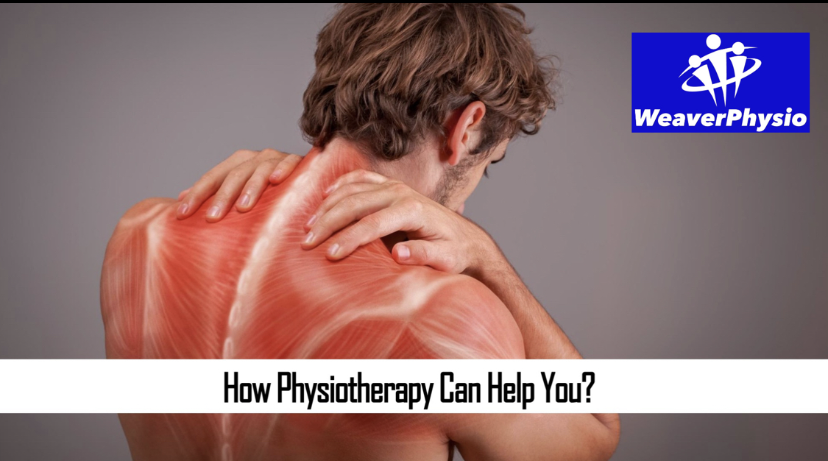
If you’re living with pain, recovering from an injury, or simply want to move better, physiotherapy could be the solution you need. At Weaver Physiotherapy & Sports Injury Clinic, we help people across Northwich, Knutsford, Winsford, and Cheshire overcome physical limitations, relieve pain, and return to doing what they love.


In this comprehensive guide, we’ll explore exactly how physiotherapy can help you — from injury recovery and chronic pain relief to improved mobility, posture, and performance.


What Is Physiotherapy?


Physiotherapy is a science-based healthcare profession focused on restoring movement and function when someone is affected by injury, illness, or disability. It combines hands-on treatment, targeted exercise, and educational advice to address the root cause of your problem — not just the symptoms.


At Weaver Physio, our Chartered Physiotherapists are trained to assess your condition, develop a personalised treatment plan, and guide you through recovery and rehabilitation. Whether you’re an athlete, an office worker, or managing age-related aches and pains, physiotherapy offers a safe, effective, and evidence-based solution.


Conditions Physiotherapy Can Help With


We treat a wide range of musculoskeletal conditions, including:


๐Ÿฆต Sports Injuries

    •    Sprains, strains, and overuse injuries

    •    Runner’s knee, shin splints, Achilles tendinopathy

    •    Ligament injuries (ACL, MCL)

    •    Post-surgical rehab (e.g., meniscus or rotator cuff repair)


๐Ÿฆด Joint & Muscle Pain

    •    Back pain, sciatica, and spinal stiffness

    •    Neck and shoulder pain

    •    Hip, knee, and ankle pain

    •    Repetitive strain injuries and tendinitis


๐Ÿง  Neurological & Postural Issues

    •    Postural dysfunction and muscle imbalances

    •    Nerve pain and impingements

    •    Vestibular (balance) issues


๐Ÿ’ผ Work-Related Injuries

    •    Ergonomic stress from desk jobs

    •    Manual handling injuries

    •    Return-to-work rehabilitation


1. Physiotherapy for Pain Relief


Pain is one of the most common reasons people seek physiotherapy — and for good reason. We use a variety of techniques to alleviate both acute and chronic pain, including:

    •    Manual therapy (joint mobilisation, soft tissue release)

    •    Dry needling and acupuncture

    •    Shockwave therapy (for stubborn tendon and soft tissue injuries)

    •    Postural retraining and ergonomic advice


Rather than masking the pain, physiotherapy identifies and treats the underlying cause, providing long-term relief and prevention of flare-ups.


โœ… Commonly Treated Conditions: Back pain, neck pain, arthritis, frozen shoulder, bursitis, plantar fasciitis.


2. Injury Rehabilitation


Injuries from sport, exercise, or everyday life can be frustrating — especially if they stop you from doing what you enjoy. Physiotherapy helps you recover faster, move better, and reduce your risk of reinjury.


Our injury rehab plans are individualised and may include:

    •    Strength and stability exercises

    •    Range of motion and mobility work

    •    Gait re-education

    •    Return-to-sport testing


Whether it’s a sprained ankle, hamstring strain, or post-surgical recovery, we’re with you every step of the way.


3. Improved Mobility & Flexibility


Feeling stiff or restricted? Physiotherapy improves joint mobility and soft tissue flexibility, allowing you to move more freely and comfortably.


Through:

    •    Stretching programs

    •    Joint mobilisations

    •    Fascial and trigger point release


…we can help restore optimal movement patterns. This is especially helpful for older adults, desk-based workers, or anyone feeling tight and restricted due to inactivity or poor posture.


4. Posture Correction & Ergonomic Support


Poor posture is a leading cause of chronic neck, shoulder, and lower back pain — especially for office workers or drivers. At Weaver Physio, we provide comprehensive postural assessments, identify muscular imbalances, and create personalised plans to:

    •    Retrain your core and postural muscles

    •    Improve your spinal alignment

    •    Reduce strain on joints and soft tissue


We also offer ergonomic advice to help you set up your workstation or home office to support better posture throughout the day.


5. Support for Long-Term Conditions


Physiotherapy is highly effective in managing chronic and degenerative conditions, such as:

    •    Osteoarthritis

    •    Fibromyalgia

    •    Rheumatoid arthritis

    •    Long COVID

    •    Chronic fatigue


While these conditions may not be “cured”, physiotherapy can significantly reduce symptoms, maintain mobility, and improve your daily quality of life. Our approach focuses on education, self-management strategies, and gentle progressive movement tailored to your needs and energy levels.


6. Physiotherapy for Runners, Gym-Goers & Active People


At Weaver Physio, we’re trusted by runners, athletes, and gym enthusiasts across Cheshire. Our Running Injury Specialists offer a comprehensive approach to both performance and injury prevention, including:

    •    Running gait analysis

    •    Strength and conditioning programs

    •    Load management advice

    •    Recovery support (massage, needling, rehab)


If you’re training for a 5K, marathon, or just want to exercise pain-free, we can help you move efficiently and stay injury-free.


7. Post-Surgery Physiotherapy


After surgery, the right physiotherapy plan can make the difference between a slow recovery and a full return to function. We regularly help patients following:

    •    Knee surgery (ACL repair, meniscus, replacement)

    •    Hip replacements

    •    Shoulder surgery (rotator cuff repair, decompression)

    •    Spinal surgery


Our goal-based rehab focuses on rebuilding strength, improving range of motion, and restoring functional independence at your pace.


What to Expect at Your First Physiotherapy Appointment


When you come to Weaver Physiotherapy & Sports Injury Clinic, you can expect:


๐Ÿ“ A Detailed Assessment


We’ll take time to understand your symptoms, medical history, and goals. A physical examination will assess your posture, movement, strength, and flexibility.


๐Ÿ“‹ A Personalised Treatment Plan


We’ll explain what’s going on, how physiotherapy can help, and map out your treatment journey — always keeping your personal goals in focus.


๐Ÿค Hands-On Care from Experts


Every treatment session is delivered by experienced, HCPC-registered Chartered Physiotherapists, with a focus on evidence-based care and real-world results.


Why Choose Weaver Physio?


We’re proud to be a trusted name for physiotherapy in Northwich and the surrounding areas. Here’s why hundreds of people choose us each year:


โœ… Professional & Friendly Team


We’re passionate about helping people move better. Our friendly team offers a welcoming, supportive environment where you feel heard and cared for.


โœ… Same-Week Appointments


We understand how frustrating it is to wait weeks for help. That’s why we offer flexible, same-week appointments, often within 24-48 hours.


โœ… Individualised Care, Not Generic Advice


Every body is different. We don’t do cookie-cutter programs — your rehab is tailored to your goals, lifestyle, and condition.


โœ… Wide Range of Treatments Under One Roof


From shockwave therapy and sports massage to acupuncture and rehab programming, we combine advanced therapies with hands-on expertise for complete care.


Real Results, Real People


Here’s what some of our clients have said:


“I went from barely being able to walk to running pain-free within 6 weeks. The care I received at Weaver Physio was outstanding.”

— Tom H, runner from Knutsford


“Professional, effective, and friendly. My back pain is gone and I’ve got my mobility back. Highly recommended.”

— Sarah J, office worker in Northwich


“After my knee replacement, I was worried about recovery. The physios here were brilliant – encouraging, knowledgeable, and genuinely invested in my progress.”

— Mark P, retired builder from Winsford


Ready to Start Your Recovery?


If pain, stiffness, or injury is holding you back, don’t wait. At Weaver Physiotherapy & Sports Injury Clinic, we’re ready to help you feel better, move better, and live better.


๐Ÿ“ Based in Northwich, we welcome clients from:

    •    Knutsford

    •    Winsford

    •    Middlewich

    •    Frodsham

    •    Tarporley

    •    Surrounding Cheshire villages


Book Your Appointment Today


๐Ÿ“ž Call us on 01606 227484

๐Ÿ’ป Book online www.weaverphysio.com


Final Thoughts


Whether you’re recovering from a sports injury, struggling with daily aches and pains, or looking to improve your mobility and strength, physiotherapy offers a safe, effective, and long-term solution. At Weaver Physio, we combine clinical expertise with a warm, personalised approach to help you get back to doing what you love.


โœ… Move Better. โœ… Feel Stronger. โœ… Live Pain-Free.


๏ปฟ

November 2, 2026
How Measurement and Stride Affect Efficiency
November 2, 2026
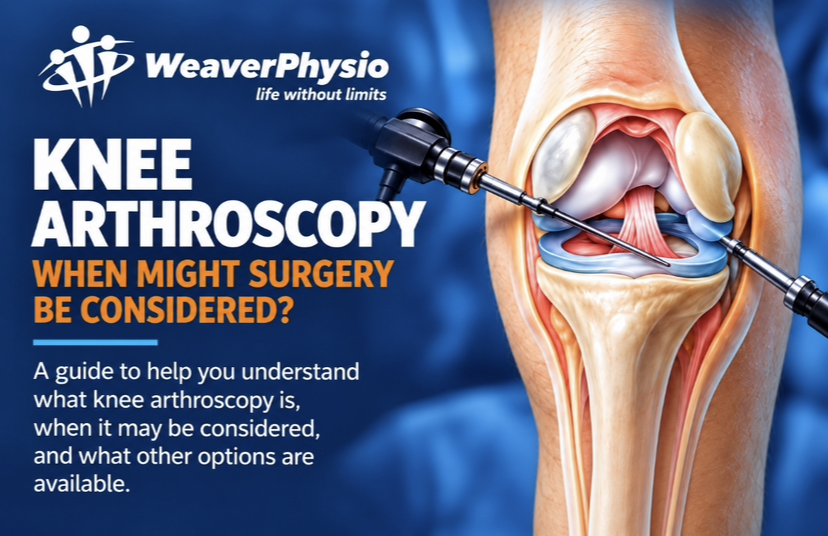
When Might Surgery Be Considered?
November 2, 2026
A Guide for Hip and Knee Patients
October 29, 2026
When an injury affects your child’s sport, play or everyday activities, it can be difficult to know what to do next. At Weaver Physiotherapy & Sports Injury Clinic, we offer assessment and rehabilitation for children and young people with sports-related and musculoskeletal problems. Based in Northwich, our clinic welcomes families from across Cheshire, including Tarporley, Knutsford, Winsford, Middlewich, Hartford, Weaverham, Sandbach and Frodsham. You can contact us directly to discuss your child’s symptoms and arrange an appointment; a GP referral is not required to book privately. A physiotherapy assessment considers the injury, your child’s movement and the activities they want to return to. Treatment and rehabilitation are then discussed in light of their needs and assessment findings. What happens at a child’s sports injury assessment? The appointment begins with a discussion about when the problem started, what activities affect it and how it is changing your child’s movement. We may ask about their usual sport, training routine, recent changes in activity and relevant medical history. The practitioner will then assess the affected area and relevant movement and function. This helps explore possible causes and identify appropriate next steps. Depending on your child’s presentation, the plan may include advice, a tailored exercise programme and hands-on treatment where appropriate. Treatment is individual . The approach will depend on the assessment findings, your child’s symptoms and how they respond to activity. If rehabilitation is recommended, exercises can be progressed to support comfortable movement and a gradual return to sport. Sports injuries and pain we can assess Children and teenagers may develop pain or injury after a sudden movement, a knock or a change in training. Assessment may be appropriate for concerns involving the: Back, hip or knee Ankle or foot Shoulder, elbow, hand or wrist Sports-related problems can include sprains, strains, tendon pain and injuries associated with repeated loading. Your child’s symptoms and activity will guide the assessment, rather than focusing only on the painful area. If you have noticed a change in your child’s posture or are concerned about a possible spinal curve, speak to your GP. The NHS advises contacting a GP if you think your child may have scoliosis. Read NHS guidance on scoliosis โ . Booking an appointment Please contact Weaver Physio to discuss your child’s symptoms and arrange a suitable appointment. Same-day appointments depend on availability, so please book ahead rather than relying on a walk-in consultation. When you get in touch, it can help to explain: When the symptoms began Which movements or activities make them better or worse Whether the problem affects walking, sleep, school, training or sport Any relevant medical history or recent changes in activity It can also help to let your child describe how the problem feels in their own words. Please bring comfortable clothing that allows movement to be assessed. Weaver Physiotherapy & Sports Injury Clinic 110 Middlewich Road, Northwich, Cheshire, CW9 7DP Call 01606 227484โ  or visit weaverphysio.com โ . Free onsite parking is available. When to seek urgent medical help A physiotherapy appointment is for non-emergency musculoskeletal concerns. If your child has a serious injury, or you are unsure whether they need urgent care, use NHS guidance or contact NHS 111. The NHS advises taking a child to A&E or an urgent treatment centre if they have an arm or leg injury and cannot use the limb. Read the NHS guidance on children’s accidents . For information about checking an individual physiotherapist’s registration, visit the HCPC Register โ . Frequently asked questions Do we need a GP referral? No. You can contact the clinic directly to ask about booking a private appointment for your child. Do you accept walk-ins? Please book an appointment in advance. Same-day consultations may be available, depending on the clinic schedule. What should my child wear? Comfortable clothing that allows them to move freely is helpful for the assessment. Do you provide scans? Scans are not included in every clinic appointment. If further investigation appears appropriate, this can be discussed with you and your child. How much does an appointment cost? Please contact the clinic for current fees and to discuss the appointment that may be suitable for your child. Discuss an appointment for your child If pain or an injury is affecting your child’s movement, sport or usual routine, contact Weaver Physiotherapy & Sports Injury Clinic to discuss an assessment in Northwich. We’ll talk through your concerns and the possible next steps for your child.
October 22, 2026
A Practical Guide for Runners
October 22, 2026
Recovery and Injury Prevention
October 14, 2026
A Practical Guide
By M NORMAN • October 8, 2026
A Practical Guide for Endurance Runners
October 7, 2026
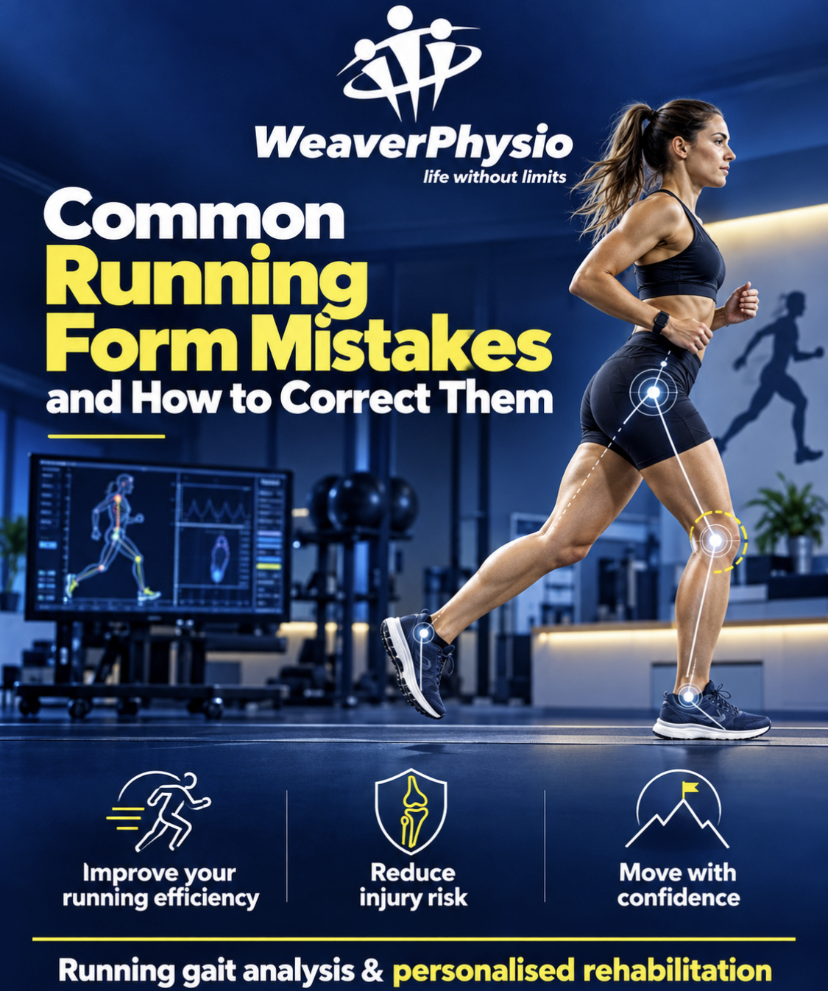
Have you ever been told that your running style is “wrong” and immediately wondered whether you need to change it? Advice online can make normal differences in movement look like faults. While certain running habits may be worth exploring—particularly when pain keeps returning—there is no single perfect stride, cadence or foot strike for every runner. At Weaver Physiotherapy & Sports Injury Clinic, we take an individual approach to running technique. Your training history, symptoms, strength, mobility, goals and the way you respond to load all matter. For runners in Northwich, Middlewich, Winsford, Knutsford, Sandbach, Frodsham and Tarporley, our Runner’s MOT and running gait analysisโ  provides clear, personalised feedback rather than generic rules. What are common running form mistakes? A “running form mistake” is often better described as a movement habit to investigate. A pattern may look unusual without being harmful, and a video alone cannot confirm that it is the cause of pain. Common concerns include: Overstriding – the foot appearing to land well ahead of the body. Upper-body tension – raised shoulders, clenched hands, a tight jaw or stiff arm swing. Forcing foot strike – deliberately trying to run on the forefoot or heel when it feels awkward. Slumped posture – losing trunk control as fatigue develops. Abrupt changes in technique – trying to alter cadence, posture and foot strike at the same time. These patterns can change with pace, hills, footwear, fatigue, confidence and training load. Research has found limited evidence that individual biomechanics alone predict running injury, which is why form should be considered alongside the wider picture rather than treated as a diagnosis. Is there one correct way to run? No. Effective running does not look identical from person to person. Your anatomy, strength, experience, speed, terrain and fatigue level all influence your stride. A single photograph or short clip captures only one moment. It cannot explain how you feel during a run, what your training has involved that week, or whether a movement pattern is actually contributing to symptoms. If you are comfortable, progressing well and free from persistent pain, you may not need to change your technique simply because it differs from someone else’s. The aim is not to chase a “perfect” running style. It is to understand your own movement and make sensible adjustments only when they are relevant to your goals or symptoms. How to assess your running form safely Start with one question. Perhaps your foot feels as though it reaches too far forwards, your shoulders tighten on longer runs, or you notice discomfort appearing as you fatigue. During an easy run at your usual pace, consider: Does your breathing feel relaxed? Are your shoulders, hands and jaw unnecessarily tense? Does your stride feel comfortable and natural? Does your movement alter later in the run? Is there recurring pain during, after or the following day? If you use video, record a brief clip from a safe, consistent position beside the route or on a treadmill. Never hold or watch a phone while running. Footage can be useful for observation, but it should prompt questions—not provide a self-diagnosis. How to change running technique without overdoing it Avoid making dramatic changes based on a social-media tip or a one-size-fits-all rule. A sudden change in cadence, posture or foot strike may feel unnatural and can make it difficult to work out what is helping. Instead: Choose one area to explore. Use one simple cue during an easy run. Keep the adjustment gentle and brief. Notice how it feels during the run and over the next 24–48 hours. Do not introduce several technique changes at once. For example, if you feel tense through the upper body, a helpful cue may be “soft shoulders and easy arms” rather than forcing a rigid posture. If you are concerned about stride length, focus on a light, comfortable rhythm rather than trying to land in a prescribed position. Training progression matters too. Increasing distance, pace, hills and frequency too quickly can overload tissues, regardless of how your running looks. NHS advice recommends building running gradually and listening to pain rather than pushing through it. Read the NHS guide to common running injuries โ . When should you seek individual running advice? Consider a running assessment if pain: Keeps returning or becomes more severe Changes the way you run Persists after reducing or adapting training Is associated with swelling, weakness, limping or a loss of confidence Leaves you unsure which changes, if any, are appropriate Sudden severe pain, inability to bear weight, major swelling, numbness, deformity or a suspected serious injury should be assessed urgently. NHS guidance on sprains and strains explains when to seek urgent help. What can running gait analysis help with? A running gait analysis does not promise to predict injury or reveal one universal correction. It can, however, provide a clearer view of movement patterns in the context of your symptoms, training and goals. At Weaver Physio, our Runner’s MOT (/runners-mot)โ  combines slow-motion video gait analysis with strength, mobility and movement assessment. We look at factors such as: Running rhythm and lower-limb control Trunk, hip, knee and foot movement Strength, balance and mobility Previous injuries and current symptoms Training volume, recovery and running goals Your findings are then used to create practical, personalised recommendations. This may include a gradual gait cue, running-specific strength work, mobility exercises, load-management advice or a structured return-to-running plan. Our Chartered Physiotherapists and Sports Rehabilitators bring more than 70 years of combined clinical experience to help runners move with greater understanding and confidence. Build a stronger, more confident running stride Running form is not a test you have to pass. A movement pattern may be worth exploring, but it does not automatically mean that something is wrong. Pay attention to comfort, recurring symptoms and changes that develop with fatigue. Make adjustments gradually, progress training sensibly and seek individual support if pain continues. For runners across Northwich and Cheshire, Weaver Physio’s running gait analysis service (/runners-mot)โ  offers professional, tailored guidance to help you run stronger and with more confidence. Frequently Asked Questions Is there one correct running form for everyone? No. There is no single ideal foot strike, cadence or posture that applies to every runner. Comfortable, efficient running can look different depending on the individual, their pace, experience and physical characteristics. Can changing my running form cause pain? It can. Sudden or uncomfortable changes may increase stress in unfamiliar areas. Make one gradual change at a time and reduce or stop if pain worsens. How can I tell if I overstride? Overstriding may appear as the foot landing well ahead of your body, but this does not automatically mean it is causing a problem. A short video can provide useful context, while a gait assessment can help interpret the pattern alongside your symptoms and training. When should I book a running gait analysis? Book an assessment if pain is recurring, your running style has changed, you are returning from injury, or you would like clearer guidance about your stride and training. Weaver Physio supports runners from Northwich, Middlewich, Winsford, Knutsford, Sandbach, Frodsham, Tarporley and across Cheshire.
Show More